
Legion Cove Destin Homes Buyer Guide and Due Diligence
Explore Legion Cove homes along Nautica Way in Destin, with a guide to single-family property, lot records, ownership questions and the buying process.

Legion Cove is a Destin subdivision with homes along Nautica Way. Okaloosa County’s address records place a Legion Cove home on that street in Destin, while the county parcel record identifies Lot 19 in Legion Cove S/D as single-family property.
For buyers looking at Legion Cove Destin homes, that detached-home context makes the house, lot and improvements the starting point for comparison. The City of Destin’s recorded-plat resource provides a further reference for matching a particular home to its subdivision record.
Table of Contents
- What Legion Cove S D Is and Where It Sits in Destin
- How to Confirm Your Exact Lot and Legal Description
- What Planned Unit Development Status Means for Buyers
- Association Deed Controls and Common Area Obligations
- Housing Stock and Lot Variation With a Verified Example
- Short-Term Rental Rules and City Registration
- Flood Insurance Permits Survey Title and Financing Checks
- Source Linked Due Diligence Matrix for Legion Cove
- Current Inventory and Neighborhood Comparisons
- Quick Reference Checklist From Offer to Closing
What Legion Cove S D Is and Where It Sits in Destin
Recorded subdivision identity controls the deal before price, finishes, or rental projections do. In Destin, buyers get in trouble when they rely on informal area labels instead of the name used in the plat, parcel, and legal description.
Legion Cove appears in county parcel records and the city’s plat resources linked above. Match the exact recorded name rather than assuming that another development containing “Legion” refers to the same property or ownership format.
Use the recorded name first.
I treat Legion Cove as a document-defined subdivision, not a marketing label. That approach is the basis for the due diligence matrix later in this article, where the lot, plat reference, restrictions, and short term rental checks are tied back to the exact recorded parcel path buyers should verify before making assumptions.
Why the exact subdivision name matters
Loose naming causes real errors. Buyers, agents, and even lenders can pull the wrong map layer, the wrong restrictions, or the wrong comparable set if they start with “Legion” instead of the full subdivision name.
The practical fix is simple. Match the street address to the subdivision name used in the public record, then confirm that the parcel, legal description, and plat all point to the same place. If one record breaks from the others, stop there and resolve it before you rely on any statement about access, use, or ownership obligations.
Start with the recorded subdivision name. Then verify the lot, plat, and parcel trail.
The practical location frame
For orientation, Legion Cove sits in Destin and includes Nautica Way as a useful on-the-ground reference. For underwriting and due diligence, that physical location is only the starting point. The essential work is building a clean document map tied to the exact lot under contract.
For broader market context, start with current Destin properties. Return to the exact address, parcel and recorded subdivision details when narrowing the comparison to a Legion Cove home.
How to Confirm Your Exact Lot and Legal Description
Buyers get Legion Cove wrong at the lot level more often than they should. The fix is disciplined and simple. Build the document trail from the parcel record to the legal description, then to the recorded plat, and do not rely on MLS shorthand or neighborhood labels.
For example, the county parcel record identifies parcel 00-2S-22-1480-0000-0190 as Lot 19, Legion Cove S/D, with a single-family land-use description. Use that as an example of the record-matching process, not as evidence that the property is currently available or that every lot has the same characteristics.

The verification sequence I use
Start with the county parcel record for the street address under contract. Confirm the site address, owner name, and parcel identifier match the property being marketed.
Next, read the vesting deed and legal description line by line. You are looking for the exact lot number, the subdivision name as recorded, and the plat book and page reference. If the deed says Lot 19 and the listing remarks or seller disclosure describe something different, stop and resolve it before you discuss use, value, or closing timing.
Then pull the recorded plat tied to that legal description. The plat is where you confirm lot configuration, frontage, access relationships, easements, and any notes that affect how the parcel should be understood on the ground.
Last, check for later recorded instruments that attach to the same lot or subdivision. Amendments, restrictions, easements, corrective deeds, and title exceptions can change how a buyer should read the original plat path.
What I want to see before advising a buyer
I want one clean chain. Parcel record. Legal description. Plat reference. Survey. Title commitment.
If one item breaks from the others, the file is not ready for assumptions.
That standard matters in Legion Cove because buyers often jump from a street address to conclusions about lot lines, setback room, parking, fence placement, or rental use. Those calls come later. First confirm the exact lot and legal description tied to the recorded subdivision documents. That is how you build a source-linked Legion Cove document map that holds up under title, lending, and city review.
What Planned Unit Development Status Means for Buyers
Read the recorded plat and any development approvals for the exact lot. If the title or planning file identifies planned-unit-development provisions, ask which approved conditions and later amendments apply. A development label alone does not establish setbacks, shared facilities or permitted rental use.
What PUD status usually controls
A recorded PUD often answers physical-use questions before you ever get to aesthetics. The plat may show lot arrangement, access relationships, utility or drainage easements, and notes that shape what can be improved or rebuilt.
That's why I treat the plat as a control document, not background noise.
What PUD status does not prove
It does not prove there's an HOA. It does not prove there are common amenities. It does not prove short term rental rights. And it does not tell you, by itself, how a lender or insurer will underwrite the exact house.
Applicable public regulations and enforceable private restrictions must both be considered. Neither a plat label nor a private document automatically displaces city requirements. Have the title professional or appropriate attorney resolve any inconsistency before relying on a proposed use.
Association Deed Controls and Common Area Obligations
Recorded subdivision restrictions decide more buyer disputes in Destin than marketing remarks ever will. For Legion Cove, the right approach is simple. Match the exact lot and legal description to the recorded plat, then check the chain of title for any covenants, amendments, maintenance duties, or common-area burdens tied to that parcel.

Portal summaries are not enough. A blank HOA field does not clear a lot of private restrictions, and a casual seller statement does not override recorded documents. I verify this at the county level first, then confirm whether the city imposes any separate maintenance or use limits that matter to the same address.
Buyers should separate three questions:
- What is recorded against the lot? Check the deed, subdivision records, and any later-filed covenants or amendments.
- Who maintains shared areas or access elements? Confirm whether any private road segment, drainage feature, entry area, or utility area creates shared cost exposure.
- Who can enforce the restrictions? Determine whether enforcement sits with an active association, adjacent owners, a declarant, or no practical enforcer at all.
That last point matters more than people think. A restriction can still affect value and closing risk even if formal collection or day-to-day enforcement appears loose.
My recommendation is direct. Do not rely on a general HOA answer from a listing sheet. Build a lot-specific document set. That means the recorded plat, the vesting deed, title commitment exceptions, seller disclosure, and any estoppel or written dues statement if an association or maintenance entity exists. This is the only reliable way to build a Legion Cove document map that ties the house you are buying to the obligations that run with that parcel.
Ask practical questions, not abstract ones:
- Is there any required contribution for entry features, drainage, signage, or shared landscaping?
- Does exterior work need prior approval under recorded controls?
- Do the private restrictions limit parking, occupancy, boats, trailers, or leasing in a way city code does not?
- Are there lot-specific exceptions or amendments in the chain of title?
If you are comparing private-control structures across Destin neighborhoods, that difference is one reason some buyers also review the Villages of Crystal Beach buyer guide before choosing which set of recorded restrictions they want to live with.
Housing Stock and Lot Variation With a Verified Example
Legion Cove does not trade as a one-size-fits-all housing block. Buyers who assume every house carries the same lot utility, build profile, and resale risk usually miss the items that change value at inspection, underwriting, and closing.
The Lot 19 county record supplies a single-family example within Legion Cove S/D. Its recorded characteristics are specific to that parcel, not a template for the subdivision’s other homes.
That distinction matters.
In a small Destin subdivision, minor lot differences can carry outsized consequences. A corner lot may handle parking differently. A narrow interior lot may leave less room for additions, pool placement, or revised drainage. An older house with later enclosure work can also present a very different permit and insurance file than a house built to the same original plan.
My recommendation is simple. Tie every comparison back to the exact lot, the recorded plat, and the parcel record before you rely on square footage or a listing description.
What to verify on the subject property, not the neighborhood generally
Check these items address by address:
- Lot shape and recorded dimensions
- Whether the survey matches current fences, drive areas, and improvements
- Original build year versus later remodel or enclosure work
- Permit history for roofs, windows, mechanicals, additions, and storm repairs
- Public record consistency with the actual structure and use
- Any site limits that affect parking, drainage, or accessory improvements
A buyer who builds a Legion Cove document map the right way can test each of those points against the exact parcel instead of relying on neighborhood assumptions.
The house you are buying sets the inspection scope, permit review, and lender questions.
That is the practical point of a verified example. Use one recorded parcel to establish how to check the next one. Do not use it as a template for every lot in Legion Cove.
Short-Term Rental Rules and City Registration
Short-term rental eligibility in Legion Cove turns on two records, not one. You need the subdivision controls tied to the exact lot, and you need the City of Destin to allow registration for that address. If either file fails, the property does not work for this use.
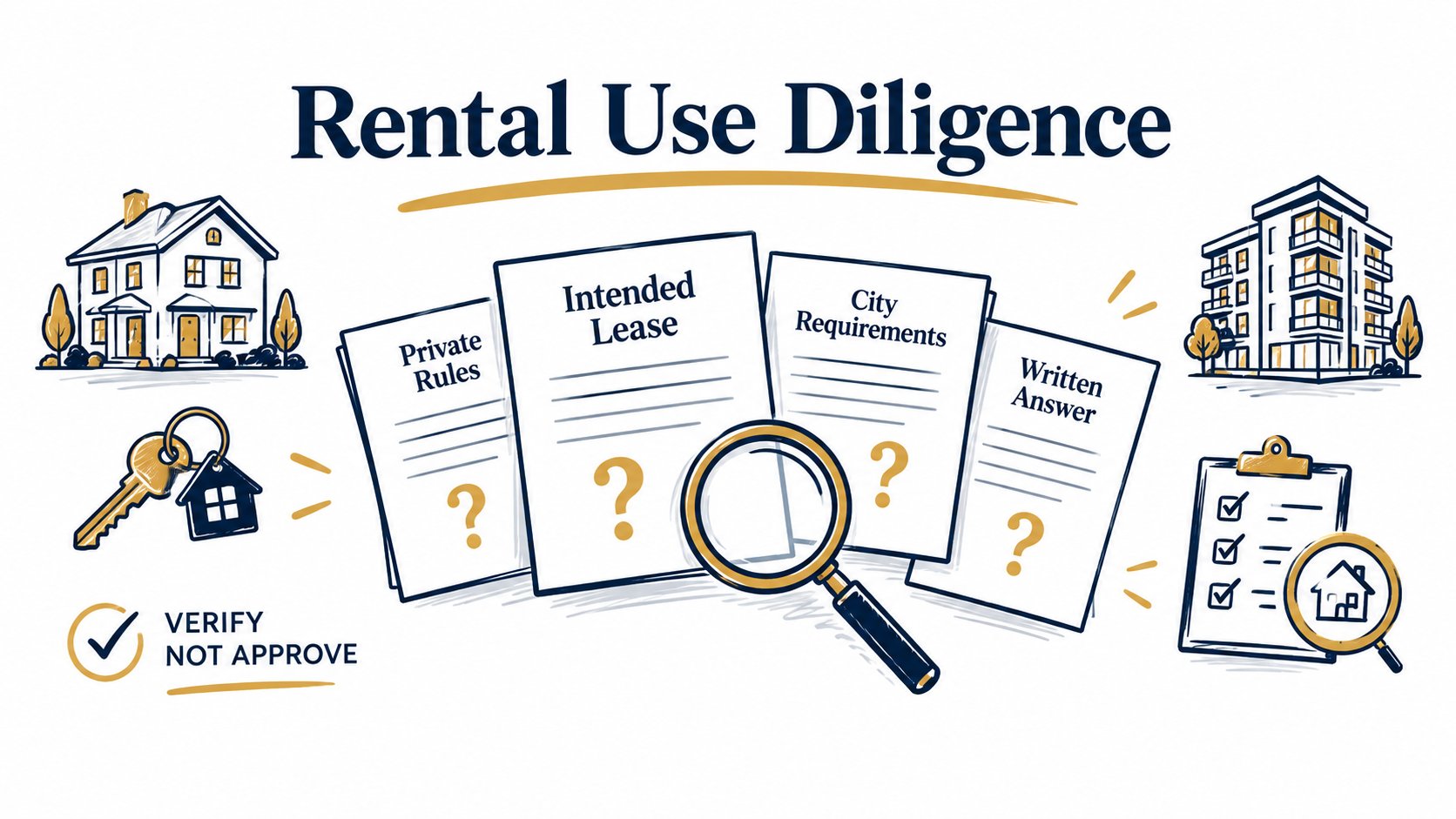
I advise buyers to build a document map before they rely on any listing claim about rental income. Start with the recorded plat and deed chain for the parcel. Then pull the city zoning designation for that same address and confirm whether the property can be registered as a short-term rental. That is the only clean way to test Legion Cove assumptions against the lot you are buying.
Use a two-file review, not a neighborhood assumption
The first file is private. Read the deed restrictions, amendments, and any association rules that apply to the lot. Restrictions can be narrower than city law, and a seller's past rental activity does not rewrite them.
The second file is public. Confirm zoning and the applicable process using the city’s current registration materials. The city’s STR FAQ states that registration does not transfer automatically when ownership or management changes. Ask how those provisions apply to the proposed purchase.
What buyers miss in practice
Buyers often stop after hearing that other homes nearby rent short term. That is weak diligence.
A Legion Cove due diligence matrix should tie each conclusion to the exact parcel, its legal description, the subdivision documents in the title file, and the current city registration path for that address. If your file does not show those links clearly, you are still working from rumor.
Budgeting matters too. Registration, renewal timing, local contact requirements, and inspection or life-safety items can affect the carrying cost of the deal even after eligibility is confirmed. Treat those as operating items, not proof of permission.
Do not budget for rental operations until the intended use is supported by current, property-specific records. This guide establishes no short-term-rental eligibility or rental-performance expectation for Legion Cove.
Flood Insurance Permits Survey Title and Financing Checks
A clean closing sequence in Legion Cove starts with the address, then moves outward through insurance, records, and lender conditions. Don't wait for the title commitment to discover a survey issue or for final underwriting to discover an insurance gap.
The order that prevents last-minute surprises
I'd run the file in this order:
- Flood map context first. Review the address against official flood mapping and ask the insurer what they need for a quote.
- Permit history next. Match visible improvements to public permits when the house has additions, enclosure work, or major repairs.
- Survey and title together. The survey should be read against the legal description and plat, not in isolation.
- Financing review after that. Lenders care about legal access, flood exposure, insurability, and any ownership structure that changes underwriting.
What buyers usually miss
The biggest misses aren't dramatic. They're clerical and timing related.
- Insurance timing: A quote can change once elevation or flood-zone detail sharpens.
- Survey timing: Encroachments and easement conflicts are easier to negotiate before closing documents are drafted.
- Permit timing: Unpermitted work can affect insurability and lender comfort.
For address-specific flood information, start with the City of Destin’s flood-map information service. Keep the resulting determination with your survey, title and insurer correspondence. Buyers comparing detached-home ownership may also review Shores of Crystal Beach, while checking that community’s own records separately.
Source Linked Due Diligence Matrix for Legion Cove
A Legion Cove file usually breaks in one of three places: the lot is misidentified, the recorded restrictions are assumed instead of verified, or the buyer treats short term rental use as a marketing claim instead of a legal question. The fix is simple. Tie every conclusion to the exact parcel, the recorded plat reference, and the current city and county record before you rely on it.
Legion Cove Due Diligence Source Map
| Checkpoint | Primary Source | What to Verify |
|---|---|---|
| Subdivision identity | City plat resource and county parcel example | Confirm the address actually sits within Legion Cove S/D and matches the subdivision shown in public records |
| Lot number and legal description | Current deed, prior deed chain, and recorded plat reference | Match the street address to the legal description, lot number, subdivision name, and plat book and page |
| Parcel identity | County property appraiser record and tax parcel record | Confirm the parcel ID, situs address, owner of record, land use description, and any mismatch between tax and deed records |
| PUD and plat implications | Recorded plat, plat notes, and county clerk instruments tied to the subdivision | Check access, easements, setback lines, drainage areas, common elements, and any note that changes how the lot can be used |
| Declarations, covenants, amendments | County clerk recorded instruments | Confirm whether deed restrictions exist, whether they were amended, and whether the lot is subject to all later recordings |
| Association status | Recorded documents, state entity records, seller disclosures, estoppel material if applicable | Verify whether an association is active, dormant, or only document-based, and identify dues, assessments, and maintenance duties |
| Parking, pets, occupancy, leasing | Governing documents first, then municipal rules where relevant | Read the private restrictions before assuming parking count, guest use, pet limits, or lease terms |
| Short term rental legality | City code, zoning confirmation, and written city response when needed | Confirm the property's zoning, dwelling type, and registration path before treating STR use as allowed |
| Registration and renewal obligations | Current city registration materials | Verify whether registration is required, how renewal works, and what operating conditions apply after approval |
| Market negotiation context | Current listing history, recent closed sales, and parcel-level comparison work | Use nearby sales to frame pricing, but keep them separate from legal and use approval questions |
| Flood and insurance | City flood information, insurer questions and elevation documents if requested | Confirm flood zone treatment, quote conditions, and any document the carrier will require before binding coverage |
| Survey, title, and financing | Boundary survey, title commitment, lender conditions, and closing requirements | Confirm legal access, easements, encroachments, title exceptions, insurability, and underwriting conditions tied to the parcel |
One bad row is enough to stop the deal. Treat any unsupported item as open, not assumed.
How to use the matrix
Run the file in this order. Legal identity first. Recorded restrictions second. STR legality third. Insurance, survey, title, and financing after that.
Public requirements and enforceable private restrictions both apply. If the deed, plat, city records or listing description conflict, leave the question unresolved and obtain clarification from the relevant authority and title or legal adviser. A marketing claim is not evidence that a broader use is permitted.
My recommendation is to build a property-specific document set for the exact house under contract. Start with the deed and parcel record. Add the recorded plat page for that lot. Add every restriction and amendment that runs with title. Then add the city correspondence or registration material only after the parcel and use question are clear. That gives you a clean Legion Cove document map instead of a pile of mixed neighborhood references that may not apply to your lot.
Current Inventory and Neighborhood Comparisons
Current listings are useful as a live entry point, not as evergreen market truth. For Legion Cove, the most useful action step is to review the current Legion Cove S/D listings page, then compare what you find against other Destin neighborhoods using a broader neighborhood framework rather than relying on one moment-in-time listing page.
Why live inventory should be treated carefully
Inventory changes fast. A page that shows one active property today can show none tomorrow, or several later, and none of that creates a durable neighborhood conclusion.
What does help is comparing the kind of ownership question each community raises. In Legion Cove, the legal-description and restriction work is central. In other areas, flood exposure, common-area governance, or different lot patterns may dominate the analysis.
The best comparison path
Use the live listing page to inspect the current house. Then widen out and explore Destin real estate only after you know what characteristics matter to you, such as lot size, detached-house format, access patterns, or governance structure.
For neighborhood-level comparison, use a broader buyer resource alongside your property notes: the Destin FL homes for sale neighborhoods and investment guide. That's the right way to compare Legion Cove to nearby options without confusing a live listing snapshot for a long-term trend.
Quick Reference Checklist From Offer to Closing
Use this sequence on any Legion Cove address.
- Before the offer: Confirm the subdivision name, lot number, legal description, and plat reference.
- Early contract period: Pull deeds, covenants, amendments, and any association or management confirmation tied to the exact lot.
- Use analysis: Check city zoning and registration requirements before assuming any seasonal rental use.
- Property condition review: Match public record details to permit history, visible improvements, and inspection scope.
- Closing file prep: Order survey, review title exceptions against the plat, and line up insurance quotes early.
- Lender coordination: Confirm any underwriting questions tied to flood context, PUD status, or private restrictions.
- Final verification: Recheck unresolved document gaps before contingency deadlines expire.
A Legion Cove deal usually goes wrong in the spaces between these steps, not inside them.
For help comparing a Legion Cove address with other Destin options and organizing property-specific questions, learn about Dream Destin Realty. Bring the exact address, intended use and contract timing so the review can focus on the records that matter to your purchase.


