
Marlers Landing Destin Homes
Explore Marler's Landing in Destin, its recorded Kelly Street and Sibert Avenue lots, and practical steps for comparing a home and preparing an offer.

On this page
On this page
Marler's Landing is a recorded Destin subdivision with four numbered lots shown on the City's Marler's Landing plat. Kelly Street and Sibert Avenue appear on that sheet, which identifies the filing as Plat Book 26, page 19. Those two street references and the recorded lot layout give a buyer a concrete starting point for comparing homes.
The recorded subdivision creates a lot-specific way to explore Destin housing. A home offered on Kelly Street can be compared through its layout, condition, documented improvements and ownership costs, while the plat helps connect the address to the exact land being purchased. Four platted lots describes the recorded design, not a current home count or available inventory.
Table of Contents
- How Marler's Landing Fits Inside the City of Destin
- The Marler Family and the Historic Roots of the Name
- What the Public Record Shows About Sales and Pricing
- Flood, Elevation, and Insurance Due Diligence for the Exact Lot
- Permits, Wind Load, and the 2023 Florida Building Code
- The No HOA Illusion Who Actually Maintains What
- Checking Intended Rental Use Before Buying
- 1031 Exchange Mechanics for Investment-Minded Buyers
- Ownership Objectives and Document Priorities
- The Offer-to-Closing Decision Matrix for Marler's Landing
- Final Advisory and the Exact Next Step
How Marler's Landing Fits Inside the City of Destin
Current Okaloosa County parcel records carry the Marlers Landing legal description on a Kelly Street lot in Destin, which confirms the name and street context. Use the exact deed, title commitment and current parcel records for the home under consideration, rather than treating one lot's record as evidence of every building or private right.
The City of Destin's subdivision directory links Marler's Landing to the recorded plat identified as Plat Book 26, Page 19, described as the replat of Lot 177, Block D, Second Revision of Calhoun's Subdivision, City of Destin, Okaloosa County. The plat shows four numbered platted lots, with Kelly Street and Sibert Avenue shown as 100-foot rights-of-way. Review the official Marler's Landing plat record, then compare it with the deed and current title commitment for the lot under consideration.
That recorded identity gives you geography. It doesn't give you current construction facts, road maintenance obligations, access rights, association identity, rental permission, private views, or amenities. A historic plat also doesn't prove the current road width, the condition of a home, or who pays for repairs.
Practical rule: Use the plat to confirm where the parcel sits. Use the deed, title commitment, county records, municipal records, and current governing documents to determine what you're actually buying.
For broader context, review this Destin market overview, which is citywide context rather than Marler's Landing inventory. Connect the selected home's parcel, legal description, current deed, survey and title exceptions before comparing its price and obligations with another Destin property.
The Marler Family and the Historic Roots of the Name
The subdivision name alone does not establish a connection to a particular historical person or prove who developed the current homes. The City's history of Destin places the area's development in its fishing-village context and records municipal incorporation in 1984. That regional history is distinct from the subdivision's recorded plat.
The linked account of Destin's founding history offers a secondary historical narrative. It is not the recorded subdivision document or proof of a selected home's construction date, historic designation, ownership chain or present legal rights.
Regional history can explain Destin's broader setting without establishing preservation status, original construction quality or continuous ownership for a Marler's Landing residence. Obtain the selected home's records before relying on a historical description.
For a buyer, history belongs in the context file, not the inspection conclusion. Verify the parcel's construction date, ownership chain, zoning, alterations, and any preservation treatment separately. A neighborhood name can preserve a meaningful local connection while the homes within it vary substantially in age, design, condition, and legal history.
That distinction is especially useful for buyers drawn to old Destin streets. Historical character may influence how a property feels, but title rights, flood exposure, permits, insurance, and physical condition determine how the property performs as an ownership decision.
What the Public Record Shows About Sales and Pricing
Request current comparable evidence for the selected home, including the observation date, property selection criteria and relevant adjustments. A thin or dated sample does not establish a current neighborhood trend.
A single dated sale can provide historical context. It cannot tell you what a particular home should sell for today. The property may have differed in floor plan, renovation level, lot characteristics, location within the plat, condition, or functional utility. Those differences can matter more than the neighborhood name.
A defensible valuation should separate three items:
- Tax-assessed value: A public assessment figure used for taxation, not a substitute for a current market opinion.
- Last sale price: A historical transaction tied to a specific property and date.
- Current market range: A property-specific opinion supported by relevant comparable sales, current competition, condition, and verified improvements.
For a low-volume pocket, comparable selection deserves more attention than a broad zip-code average. Start with homes that share meaningful physical characteristics, then adjust for renovation quality, roof and system age, lot attributes, flood-related features, legal use, and documented additions. Do not use nearby coastal properties as stand-ins without examining those differences.
When the search extends beyond Marler's Landing, compare the exact residences rather than relying on a neighborhood average. A listing price is an asking position, not proof of value. The useful question is which current evidence supports this particular home's price and ownership costs.
Flood, Elevation, and Insurance Due Diligence for the Exact Lot
Flood review should begin with the exact parcel and applicable current map information. Ask a qualified professional to establish the flood zone, map panel, base flood elevation where applicable, and any coastal-barrier implications for the selected address. The City's flood protection and management guidance explains broader protection and permitting considerations, not this lot's flood determination.
The generic graduated post below introduces vertical measurement; it is not a survey instrument or an elevation reading for Marler's Landing. A qualified surveyor must establish the selected home's measurements, reference datum and elevation certificate.

Request these documents before inspection and financing deadlines expire:
- Flood-zone determination: Confirm the current zone and applicable map panel.
- Elevation certificate: Obtain one if available, then compare finished-floor and equipment elevations with the applicable BFE.
- Survey: Confirm boundaries, structures, lower areas, drainage features, and site improvements.
- Claims and mitigation history: Ask for prior flood claims, remediation records, elevation work, and related documentation where obtainable.
- Insurance quote: Obtain a property-specific quote that addresses flood, wind, deductibles, exclusions, replacement assumptions, and loss-of-use coverage.
A lower-risk map designation can reduce the chance of a lender requiring flood coverage, but it doesn't prove that flood loss exposure is absent or that wind coverage will be inexpensive. Standard homeowners insurance also isn't a substitute for flood insurance.
Renovation planning requires particular care. The City of Destin's substantial-improvement guidance states that a renovation, addition, or reconstruction costing 50% or more of the building's market value can trigger current FEMA requirements. That threshold can change the scope of a project, especially where finished floors, utilities, enclosed lower areas, fill, floodproofing, or substantial improvements are involved.
For Marler's Landing, the insurance binder and flood documentation should influence the offer strategy as much as the inspection report.
Permits, Wind Load, and the 2023 Florida Building Code
A good inspection tells you what is visible. Permit research tells you whether the visible work was authorized, inspected, and completed in the way the city records show. Destin's Building Division reviews plans, interprets code, conducts inspections during construction or alteration, and issues Certificates of Occupancy under the City of Destin building and permitting framework.
The current City Building Division page lists the 2026 Florida Building Code, 9th Edition with an effective date of December 31, 2026; until then, the 2023 Florida Building Code, 8th Edition remains in effect. Ask the Building Division and the responsible design professional which code provisions, wind-design criteria and inspections apply to the exact proposed work. An older component may have been built under a different edition; no universal wind-speed requirement is established here. The generic metal connector below illustrates a connection component, not Marler's Landing construction or an approved design.

Ask for:
- The original permit history and any available Certificates of Occupancy.
- Permits and final inspection records for roof replacements.
- Documentation for additions, enclosures, pools, seawalls, and marine work.
- Plans showing changes to impervious surface, drainage, access, or site grading.
- Wind-mitigation documentation and evidence of approved storm-related improvements.
Compare the records with the physical property. A converted enclosure, added room, pool, seawall, roof replacement, or altered drainage feature deserves specific attention. The city identifies construction without a permit, increased impervious surface, and marine construction without a permit as compliance issues.
Unresolved work can affect closing, insurance, financing, and future resale. It can also intersect with flood rules and substantial-improvement requirements. Have the inspector, surveyor, insurance adviser, and licensed contractor reconcile the building's visible condition with municipal records before releasing contingencies.
Window-edge damage is another condition question to document during inspection. The illustration compares generic intact and cracked frame edges; it does not show the selected home or establish a repair scope. Obtain the inspector's findings and any qualified repair estimate before relying on a replacement cost.

The No HOA Illusion Who Actually Maintains What
Current association status and private maintenance obligations must be established through the selected property's recorded documents and written governing records. The linked reported HOA and maintenance uncertainty is general Florida insurance coverage, not Marler's Landing association evidence. Do not use it to conclude that an HOA exists, is absent, or covers any particular repair.
Ask the title company or closing agent for the recorded declaration, amendments, title exceptions, easements, covenants, and any current estoppel or owner statement that applies. Request recent tax and assessment records, then obtain written confirmation of separate club, gate, amenity, or maintenance memberships if anyone suggests they exist.
A useful “who pays for what” review should cover:
| Ownership item | What to confirm |
|---|---|
| Roads and access | Public dedication, private maintenance, easements, and repair responsibility |
| Drainage and stormwater | Maintenance obligations, shared systems, and assessment authority |
| Landscaping | Individual responsibility, shared service, or private agreement |
| Utilities | Metering, lines, service access, and repair responsibility |
| Insurance | Building, common-area, liability, and owner-specific coverage |
| Amenities | Mandatory charges, optional memberships, or no documented facility |
| Capital repairs | Assessment rights, project triggers, and payment allocation |
If the current documents establish shared exterior maintenance, identify who contracts and pays for it.
The point is simple. A low or zero HOA charge may eliminate one line item, or it may shift maintenance into private agreements, episodic repairs, or direct owner responsibility. Don't treat “no HOA” as a cost conclusion until the documents show who pays.
Checking Intended Rental Use Before Buying
No public research establishes a Marler's Landing specific rental allowance, rental cap, minimum stay, or registration status. Don't infer permission from the community name, nearby Destin properties, a listing, a rental advertisement, past rental activity, or a manager's marketing.
The sequence should be strict:
- Recorded restrictions first: Review the deed, declaration, amendments, covenants, and title exceptions for leasing limits, minimum stays, occupancy terms, parking rules, and use restrictions.
- Current property confirmation next: If an association, manager, or other governing party exists, obtain written confirmation that the intended rental use is permitted for the exact property.
- Jurisdictional requirements after that: Verify current City of Destin and Okaloosa County registration, zoning, licensing, occupancy, and minimum-stay requirements.
- State licensing separately: Confirm the applicable Florida licensing category, while recognizing that a state license doesn't override stricter private covenants or local restrictions.
- Operating analysis last: Only after permission and regulatory eligibility are documented should a buyer evaluate any operating information.
If any layer is missing, stale, conflicting, or restrictive, remove rental benchmarks and performance language from the investment case. Reframe the property around permitted personal use, long-term ownership, resale considerations, or another documented use.
For broader local discussion, buyers can review the Emerald Coast short-term rental rules for 2026, but the exact property still controls. A state license isn't a community approval, and a history of past bookings isn't proof that future bookings are allowed.
1031 Exchange Mechanics for Investment-Minded Buyers
A 1031 exchange is a tax-deferral mechanism, not an investment return guarantee. The IRS states that the rule generally applies to real property held for investment or productive use in a trade or business, while property held primarily for sale doesn't qualify. Personal-use property, including a primary residence or a second home used mainly as a vacation home, generally falls outside the rule. Review the IRS guidance on like-kind real estate exchanges before treating a Marler's Landing purchase as exchange property.
The IRS Form 8824 instructions describe the general deferred-exchange deadlines: identify qualifying replacement property within 45 days and receive it within 180 days or the applicable tax-return due date, including extensions, if earlier. Identification rules, exceptions and safe-harbor arrangements require tax advice. Form 8824 reports the exchange; these general rules do not establish this home's eligibility.
The practical sequence looks like this:
- Establish that the relinquished and replacement properties are held for qualifying investment or business use.
- Engage a qualified intermediary before closing logistics make the exchange impossible.
- Document written identification within the applicable period.
- Complete the replacement acquisition within the applicable deadline.
- Report the exchange correctly and preserve records supporting the intended tax treatment.
Deferred gain isn't permanently eliminated. The ownership structure, holding history, personal-use pattern, intended use, and intermediary arrangement all need review with a tax adviser before an offer is made.
A buyer who wants to defer taxes on rental property shouldn't assume that occasional personal enjoyment preserves eligibility. The facts must support investment or productive use, and the exact property must first clear its own rental and ownership restrictions.
Ownership Objectives and Document Priorities
Different ownership objectives change the documents a buyer prioritizes. A home purchase for personal use and a transaction intended for qualifying business or investment use require separate legal and tax analysis. Neither objective establishes leasing permission, current costs or a performance result for Marler's Landing.
| Document | Primary Residence | Second Home | Business-use tax review |
|---|---|---|---|
| Parcel ID and current deed | Establishes legal identity and ownership | Confirms the property and access rights during periods away | Supports title, entity, and exchange review |
| Permit history and Certificate of Occupancy | Confirms additions and alterations | Protects insurance and remote ownership decisions | Supports financing, resale, and compliance analysis |
| Flood determination and elevation information | Sets physical risk and insurance questions | Adds hurricane preparedness and absentee-owner planning | Identifies insurance and financing questions |
| Wind-mitigation inspection | Helps evaluate structure and coverage | Helps plan storm readiness and insurance documentation | Supports lender and insurer review |
| Current insurance quote | Tests affordability of ownership | Measures carrying cost between visits | Confirms current coverage terms for the intended ownership use |
| Deed restrictions and association records | Clarifies use and maintenance | Determines access, obligations, and private rules | Controls whether intended leasing is permitted |
| Rental registration and licensing records | Usually secondary unless use changes | Relevant only if leasing is intended and permitted | Required before any rental operating analysis |
| Comparable property records | Supports a residence-focused offer | Supports lifestyle value and resale analysis | Supports documented underwriting after eligibility is verified |
A primary-residence buyer should lead with the parcel, permits, flood determination, inspection, and insurance binder. The negotiation posture is condition-focused.
A second-home buyer needs the same foundation, then adds practical questions about storm preparation, access while away, security arrangements, taxes, insurance, and maintenance. The key issue is the total ownership burden between visits, not a generic amenity list.
A buyer considering qualifying business or investment use should obtain tax advice about the exact holding purpose, personal-use pattern and exchange arrangement. Separately establish any intended leasing through current property-specific governing documents and applicable approvals. Do not use booking comparisons, market benchmarks or an expected return to fill a permission gap.
The Offer-to-Closing Decision Matrix for Marler's Landing
Run the transaction as a file with owners, evidence, and deadlines. The exact dates depend on the executed contract, so write them into the contract calendar instead of relying on informal promises.
| Record or review | Decision it informs | Who supplies or coordinates it | Controlling deadline |
|---|---|---|---|
| Parcel ID, legal description, current deed | Confirms the exact property and ownership chain | Title company, seller, county records | Before offer acceptance if available, and during title review |
| Recorded plat, easements, and title exceptions | Clarifies boundaries, access, and private rights | Title company and surveyor | Title and survey review period |
| Flood-zone determination and BFE information | Determines flood exposure and required follow-up | Insurance adviser, surveyor, municipal or federal records | Before inspection and insurance deadlines expire |
| Elevation certificate and survey | Tests finished-floor, equipment, boundary, and drainage facts | Seller if available, surveyor, inspector | Inspection and insurance review |
| Prior claims and mitigation records | Identifies loss history and prior work | Seller, insurer, closing agent where obtainable | Before insurance commitment |
| Permit history and Certificate of Occupancy | Reconciles improvements with approved work | City records, seller, closing agent | Inspection and financing contingency |
| Wind-mitigation and four-point inspection | Supports structural and insurance review | Licensed inspector | Before insurance binder and contingency release |
| Association or covenant confirmation | Identifies dues, restrictions, assessments, and maintenance | Seller, title company, association or governing party | Document review period |
| Rental-eligibility proof, if relevant | Determines whether intended leasing is permitted | Seller, association or governing party, local authorities | Before relying on rental use in the offer |
| Financing approval and appraisal | Tests loan terms and collateral value | Lender and appraiser | Financing contingency |
| Insurance binder | Confirms coverage availability, deductibles, and exclusions | Insurance adviser and carrier | Before financing and closing |
| Final inspection and closing package | Confirms condition, title, funds, and agreed repairs | Buyer, inspector, title company, lender | Final inspection and closing date |
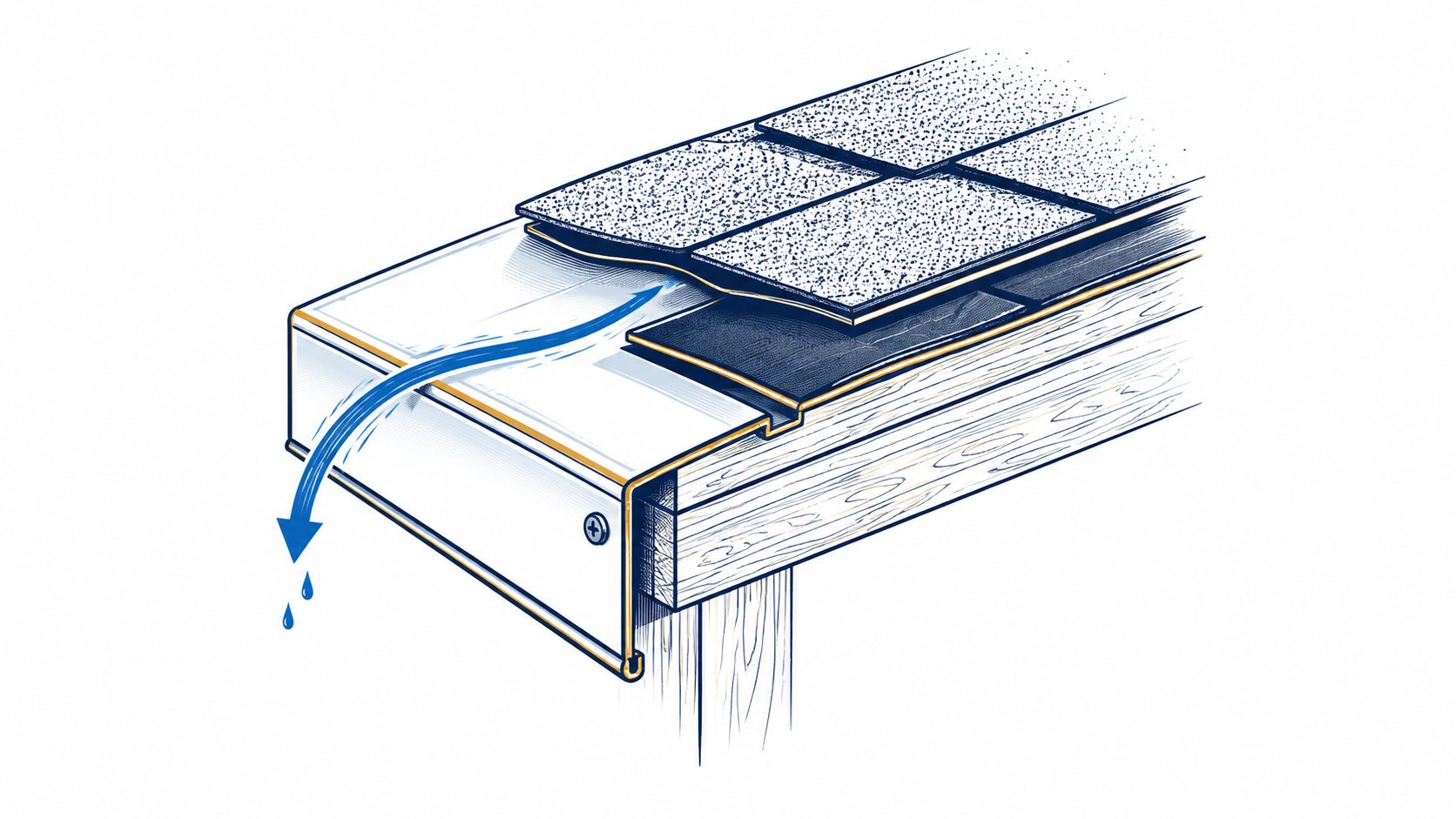
The generic roof-edge cutaway below explains water shedding at a flashing detail. It does not show a Marler's Landing roof or establish its condition. Have a qualified inspector document the selected home's roof and moisture concerns before deciding whether to release the relevant contingency.
Don't release a contingency because a document was promised. Release it after the responsible professional has reviewed the actual record and the contract gives you enough time to act. If the title commitment reveals an easement, the insurer changes terms, or an unpermitted improvement appears, the decision belongs in the written transaction file.
Final Advisory and the Exact Next Step
Marler's Landing's recorded lots and Kelly Street and Sibert Avenue references provide a useful local starting point. For the selected home, bring the current condition, asking price, insurance terms, flood information, title exceptions and maintenance obligations together before deciding how to proceed. Resolve intended-use questions through the exact property's current records.
Ask one question before you let the neighborhood label influence your offer: For the exact lot I'm considering, what do the current deed and governing documents, latest permit history, FEMA determination, insurance binder, and rental-eligibility records say?
Start by pulling the parcel ID and legal description. Then have a local adviser coordinate title, survey, flood, insurance, permits, inspection, financing, and, if relevant, rental-eligibility reviews in parallel before the applicable contract deadlines expire. That process gives you a defensible decision instead of a conclusion built on a thin neighborhood profile.
Dream Destin Realty can coordinate buyer representation, document collection, inspection follow-up and closing preparation. Contact Dream Destin Realty about the exact Marler's Landing home and the contract deadlines for its review. Visit Dream Destin Realty for broader company information. Title, legal, tax, insurance and inspection conclusions belong with the appropriately qualified professionals.


