
Destiny Subdivision Destin Homes: A Local Buyer Guide
Destiny subdivision Destin homes explained with plat facts, association scope, insurance notes, and a buyer due-diligence checklist for the Emerald Coast.

On this page
On this page
The Destiny subdivision is a recorded planned unit development in Destin, Okaloosa County. The City-hosted plat labels Destiny Way and Royal Palms Boulevard, giving this namesake subdivision a distinct place in Destin's recorded neighborhood history. See the City-hosted Destiny plat.
The City's historical ledger lists Destiny as recorded on January 31, 1994, in Book 14, page 60, separately from Destiny East, Destiny Shores and Destiny By The Sea. This guide focuses on that namesake Destiny subdivision and the ownership, condition and purchase questions buyers can compare within it. The City historical plat ledger supplies the recording reference.
Table of Contents
- What the Recorded Destiny Plat and Ledger Actually Show
- The Destiny Subdivision Versus Destiny East, Destiny Shores, and Destiny By The Sea
- The Buyer Decision Matrix for Plats, Covenants, and Disclosures
- Ownership Form, Density, and Lot Pattern in the Destin Market
- HOA, Covenant, and Association Scope for the Destiny Subdivision
- Insurance, Inspections, and Financing Sequencing for Destin Homes
- Short-Term Rental Eligibility and Occupancy Rules in Destin
- Investment Strategy Without Inflated Promises
- Pre-Offer Checklist Translated From the Matrix
- Quick Reference and Next Steps for Buyers and Sellers
- Destiny Buyer Questions
What the Recorded Destiny Plat and Ledger Actually Show
The City of Destin's recorded DESTINY planned unit development plat identifies the subdivision in Destin, Okaloosa County. Its sheets label Destiny Way and Royal Palms Boulevard. Those are useful identifiers when comparing a listing with public records, but a street label alone doesn't prove that a property is within the plat or establish its current legal rights.
A separate City historical ledger entry lists Destiny as recorded on January 31, 1994, in Book 14, page 60. The ledger lists Destiny separately from Destiny East, Destiny Shores, and Destiny By The Sea. That separate treatment is a strong reason not to treat every property carrying a Destiny name as part of one subdivision or association.
Read a recording as a record, not a current-condition report
A recorded plat documents a historical land record. It doesn't prove that a labeled road, lake, pool, park, or easement is currently constructed, accessible, maintained, or owned by a particular party. Nor does a plat, by itself, establish current rental permission or the terms of an association.
Start by matching the property's legal description and parcel identification to the recorded plat, then compare that information with the title and current seller disclosures. For a separate example of how subdivision identity matters in Destin, consult the Indian Woods buying guide. The same discipline applies here: confirm the property first, then evaluate the documents attached to it.
The Destiny Subdivision Versus Destiny East, Destiny Shores, and Destiny By The Sea
The names are similar. The records identify separate entries, and buyers shouldn't assume that their boundaries, covenants, or association responsibilities overlap. Use the name on a listing as a lead for research, not as proof of the subdivision.
| Recorded name | Primary source | Scope covered | Status caveat |
|---|---|---|---|
| Destiny | City plat and historical ledger | The namesake recorded plat and its documented labels | Confirm the parcel's legal description, current governing documents, and association scope |
| Destiny East | Separate name in the City ledger | The separately listed Destiny East identity | The ledger entry doesn't establish its boundaries, amenities, or current association terms |
| Destiny Shores | Separate name in the City ledger | The separately listed Destiny Shores identity | Confirm the parcel and its applicable recorded documents independently |
| Destiny By The Sea | Separate name in the City ledger | The separately listed Destiny By The Sea identity | The namesake entry doesn't prove any specific property's current rights or restrictions |
This table separates recorded names; it isn't a substitute for subdivision maps, title work, or a current governing-document review. For the plain namesake plat, the Destiny community search and context is the relevant starting point. It covers Destiny as a subdivision, not every community with a Destiny name.
A property described as Destiny East or Destiny By The Sea needs its own parcel-level confirmation. Buyers can use the Destiny by the Sea community guide as a distinct community reference, then match the property's legal description and association materials rather than transferring assumptions between similarly named areas. The public ledger confirms separate names, not a shared set of rules.
The Buyer Decision Matrix for Plats, Covenants, and Disclosures
A useful offer file connects each document to a decision. Don't collect PDFs to accumulate them; ask what each one will establish, who can provide it, and when you need it to make a sound choice.
| Document | Buyer decision it informs | Who supplies it | Typical deadline |
|---|---|---|---|
| Recorded plat and covenants | Whether the parcel belongs to the subdivision and what recorded restrictions apply | Public records, seller, title representative | Before offer terms are finalized, then within the applicable review period |
| Parcel and title records | Whether the legal description, ownership, easements, and title exceptions match the deal | Property records, title representative, seller | During title review and before closing |
| Association materials | Which association applies and what rules, financial obligations, and pending decisions affect ownership | Seller, association, or its manager | Early in the contract review period |
| Permits | Whether documented work and open permits need attention | Seller and relevant public records | During property and title review |
| Flood information | What mapped flood conditions may affect insurance, lending, or improvements | FEMA mapping and insurer or lender review | Before insurance and financing decisions are locked |
| Survey | Whether the improvements and visible boundaries align with the property records | Seller or survey professional | Before the survey review deadline |
| Inspection reports | What the inspector observes about the specific home and systems | Buyer's inspector | Within the inspection period |
| Insurance terms | Whether available coverage, exclusions, and deductibles fit the purchase | Insurance representative | Before the insurance and financing deadlines |
| Financing review | Whether the lender will approve the property and loan structure | Lender, with information from the buyer and association | Within the financing contingency |
| Exact-property disclosures | What the seller has disclosed about known conditions, claims, or work | Seller | Before the relevant disclosure review deadline |
The “typical deadline” column isn't a contract promise. The executed agreement controls, and a buyer should put actual dates on a calendar as soon as the contract is signed. If a required document arrives late or is incomplete, raise that with the appropriate professional before the contingency expires.
Practical rule: Match every document to a decision and a deadline. If a document can change your willingness to buy, price, or proceed, don't let it sit unread in the file.
Ownership Form, Density, and Lot Pattern in the Destin Market
A detached home, townhome, and condominium can look comparable in a listing while transferring very different responsibilities to the buyer. The recorded Destiny plat helps identify the land-record context, but it doesn't certify the current mix of ownership types or the number and condition of properties in the subdivision.

Generic building forms illustrate why appearance alone does not establish legal ownership or maintenance responsibilities; these are not depictions of Destiny homes.
What the ownership form changes
With a single-family property, the buyer generally needs to understand the lot, structure, exterior obligations, and insurance covering the home. A townhome may involve both owner responsibilities and shared components, depending on its legal structure and governing documents. A condominium usually adds an association's responsibility for common elements and master insurance, while the owner's policy may need to cover interiors, contents, and other exposures.
Don't infer the ownership structure from exterior appearance. Read the legal description, declaration, survey, and insurance documents together. The deed may convey a lot, a condominium unit, or another interest; those distinctions affect what the buyer owns and what the association maintains.
Compare carrying costs, not just asking prices
Two properties at similar asking prices can carry different insurance, association, maintenance, and repair obligations. For a condominium, the association's budget and insurance terms matter alongside the unit's condition. For a detached house, the buyer must understand the property's individual coverage and maintenance responsibilities. Townhome arrangements can fall between those patterns.
The Destin market overview provides a broader place to compare property types and areas. For a specific Destiny property, use the legal and financial documents to establish its actual ownership form and responsibilities. Don't assume that a small association bill means low risk, or that a detached property has no shared obligations.
HOA, Covenant, and Association Scope for the Destiny Subdivision
The association question is property-specific. A listing may use “HOA” as shorthand, but a buyer needs to know which recorded declaration applies, whether a master association or sub-association is involved, and what obligations attach to the exact parcel.
Declarations and amendments can set restrictions involving property use, exterior changes, parking, pets, and rentals. Bylaws and articles describe association governance, while budgets, reserve information, and meeting minutes help show how the association is handling its responsibilities. Board action or a member vote may affect policies and finances, subject to the governing documents and applicable law.
Ask for the full current packet, not just a summary page. Compare the legal description against the association's records, then look for amendments, current rules, budgets, insurance information, meeting minutes, notices, and pending assessments. If more than one association is involved, request materials from each and establish which services and costs belong to which entity.
A familiar subdivision name doesn't tell you which association governs the lot. The recorded documents and current association materials do.
Insurance, Inspections, and Financing Sequencing for Destin Homes
Start with the exact property location, then work through insurability and building condition before assuming financing will proceed smoothly. Use the Flood Map Service Center and Florida flood-risk resources to begin a current flood-map inquiry, then ask the insurer and lender which maps, elevation information and coverage terms they require for the purchase.
For a planned repair or improvement, ask the permitting authority and appropriately qualified design professional which current code requirements apply to the proposed work and its location. A general coastal description, a subdivision name or a home's appearance is not a property-specific wind-design or engineering determination.
Roof details: Ask the inspector which accessible roof edges and flashing details were evaluated, what limitations apply, and whether a qualified roofer should investigate a finding. Compare the inspection with available roof permits and the insurer's requirements; an illustration cannot establish a home's roof assembly or condition.
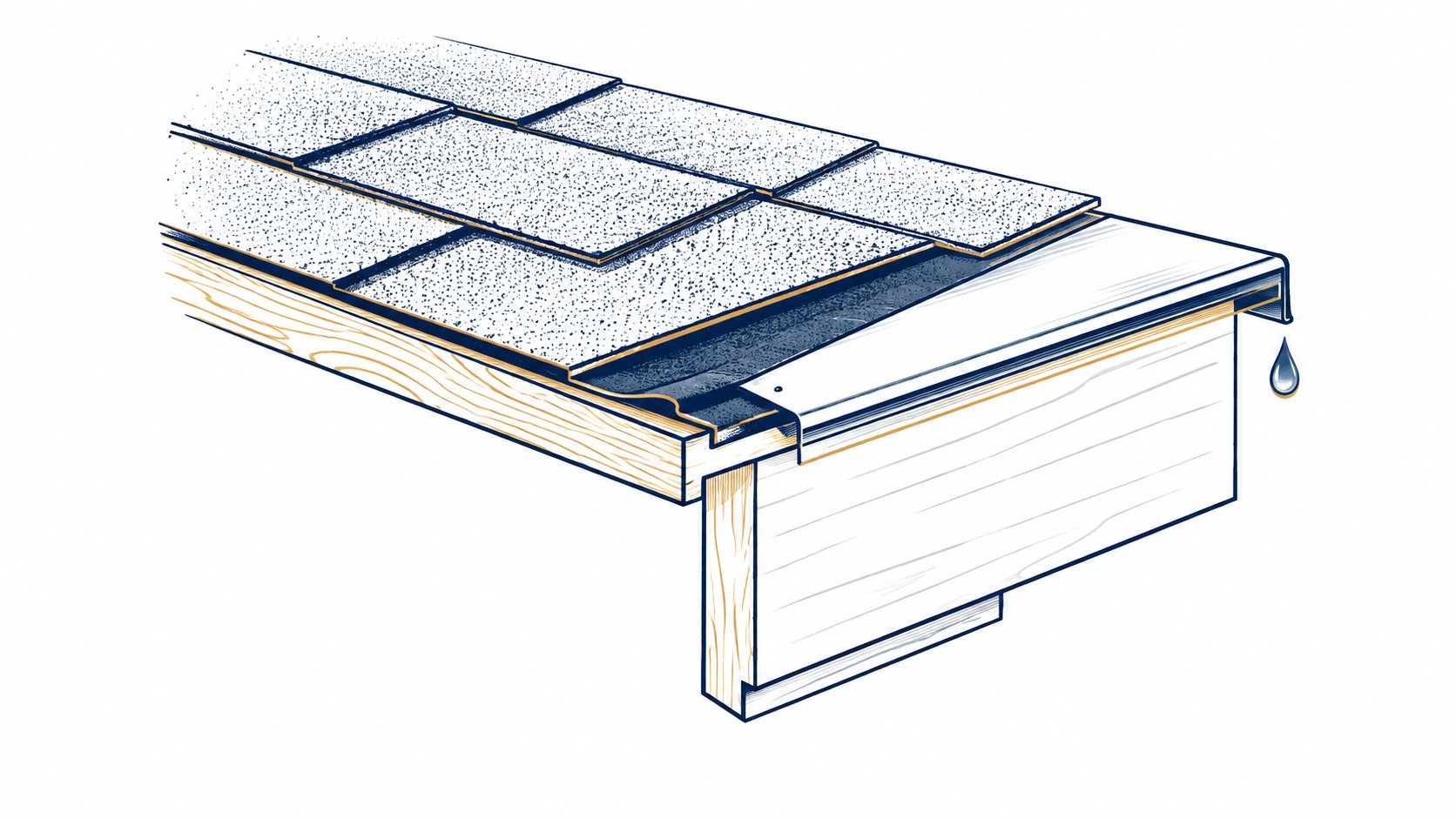
Generic roof-edge cutaway showing layered covering and metal flashing, not a Destiny roof specification or condition report.
Windows and weather seals: Ask the inspector to describe accessible glazing, frames and seals, any observed moisture concerns, and the limits of the inspection. Have a qualified professional investigate findings when recommended; this drawing does not demonstrate a window's rating, installation quality or performance.

Generic window-frame corner and glazing cutaway, not an installation detail or performance certification for a particular home.
Put the file in underwriting order
- Map and elevation: Identify the property's flood-map location and obtain an elevation certificate if one is available. Ask the insurer and lender what else they require.
- Coverage and building condition: Request current policy declarations, deductibles, prior flood-claim information when available, roof details, permits, and any wind-mitigation inspection.
- Ownership-specific records: Match the requested insurance and structural records to the actual ownership form. The linked 2023 condominium inspection and reserve-study law is a dated legislative reference, not a complete statement of today's duties or proof that a Destiny home is a condominium. Ask the responsible association, lender and qualified adviser for the current requirements and records applicable to the purchase.
- Lender review: Send the lender the association's insurance, financial, inspection, and reserve materials early. A condo loan can depend on the building and association file as well as the buyer's finances.
For a second home, ask an insurance professional about coverage for a vacation property, then confirm the terms, exclusions, and price available for the specific address.
Short-Term Rental Eligibility and Occupancy Rules in Destin
A rental claim needs to pass three separate tests: City requirements, association permission for the specific property, and applicable state licensing and operating rules. A listing label or past rental activity doesn't establish that a buyer can use the property as intended.
The City of Destin requires short-term rentals inside city limits to register every year. Registration opens January 1, and the City charges a late fee after March 31. The City's registration page and current guide list which properties must register and the full requirements. Confirm the current requirements for the actual ownership form and intended use with the City; public registration rules do not establish private association permission.
Check the City's current registration guidance for the applicable renewal period, fees and signage requirements before planning an operation. A public registration or an existing sign does not resolve private leasing restrictions.
Apply the occupancy rule to the property
For the house rentals covered by its current short-term rental FAQ, the City describes an overnight limit of two adults per bedroom plus four additional people, capped at 24 overnight occupants, from 10:00 p.m. to 7:00 a.m. Its three-bedroom-house example is 10 people. This is an attributed City operating-rule example, not a statement that any Destiny home may be rented or that an association allows that occupancy.
Before relying on rental use, read the current recorded covenants and amendments, obtain the association's current rental rules or written confirmation, and confirm the City and state requirements for the exact property. The broader short-term rental regulations Destin resource can help frame the questions, but it doesn't prove permission for a particular parcel. Without current property-specific confirmation, don't build a purchase decision around rental income or operating assumptions.
Investment Strategy Without Inflated Promises
A Destiny purchase should stand on verified property facts, not an assumed return. The records discussed above establish subdivision identity, but they don't establish current rental permissions, operating costs, appreciation, or income for an individual home.
For an investment-oriented purchase, Section 1031 applies only to exchanges of real property after the Tax Cuts and Jobs Act. The IRS guidance on like-kind real estate exchanges explains why a qualifying exchange requires more than buying another property after a sale. Identification and closing deadlines, qualified-intermediary procedures, proceeds, debt replacement, and tax reporting call for advance coordination.
A buyer considering a second home should separate personal-use plans from investment intent before choosing a financing and ownership structure. An intended investment use doesn't automatically make a property eligible for exchange treatment, and a Destin-area purchase isn't automatically qualifying because the buyer plans to rent it.
Use actual property records and professional advice to assess the deal. An agent can provide comparable-sale context, while a tax adviser, qualified intermediary, lender, and insurer can address the parts of the transaction that fall within their expertise. For wider Emerald Coast property buying insights, compare locations and ownership types without treating broad market context as a forecast for one Destiny parcel.
Pre-Offer Checklist Translated From the Matrix
Turn the matrix into a dated request list as soon as an offer is under consideration. The exact contract sets the deadlines, so don't assume that a general review period gives you enough time to obtain association records, insurance terms, or a survey.
- Confirm identity: Match the legal description and parcel record to the City plat and applicable recorded covenants.
- Request association materials: Ask the seller or association for current declarations, amendments, rules, budgets, minutes, insurance information, and any pending assessment details.
- Review public and property records: Check available permits, title exceptions, surveys, seller disclosures, and property-specific inspection reports.
- Start flood and insurance review: Have the lender and insurer assess the address and request relevant elevation, wind, roof, and policy information.
- Confirm financing and intended use: Give the lender the association file early. If rental use matters, obtain current written association confirmation and verify the applicable City and state rules before relying on it.
Water-supply controls: Ask the inspector to identify accessible shutoff controls and explain any limitations or plumbing findings. Request a qualified plumber's follow-up when recommended. Do not operate an unfamiliar or deteriorated valve merely because a generic diagram shows a handle.

Generic water-supply pipe and shutoff handle, not a depiction of a Destiny home's plumbing.
Keep the contract dates visible to the buyer, agent, lender, insurer, and inspector. Don't treat a marketing description as a replacement for a document or professional determination.
Quick Reference and Next Steps for Buyers and Sellers
Keep the Destiny subdivision separate from neighboring subdivisions: use the City Destiny plat and City historical ledger for recorded scope, the Destiny community page for namesake context, and the Destin hub for broader comparisons.
Sellers, assemble the association packet, permit history, title information, insurance details, and disclosures before setting the asking price. Flag gaps for your agent before marketing begins. Buyers, request that file before discussing offer terms.
The recording is a starting point, not a complete account of a home today.
For property-specific research and local representation, visit Dream Destin Realty.
Destiny Buyer Questions
How do the recorded Destiny plat, selected lot legal description and current title documents distinguish the plain Destiny subdivision from Destiny East, Destiny Shores and Destiny By The Sea?
Start with the City-hosted namesake plat and its historical ledger entry, then have the title representative match the purchase's legal description to the relevant recorded instruments. The City lists Destiny, Destiny East, Destiny Shores and Destiny By The Sea separately; a similar marketing name is not evidence of shared boundaries or governing documents.
Which current governing documents and written records establish the selected Destiny property’s actual maintenance, insurance, reserve and assessment responsibilities without inferring them from the plat or corporate name?
Request the applicable current recorded declaration and amendments, current association rules and financial materials, insurance records, seller disclosures and any relevant written association clarification. Compare the documents with the deed and title file. A plat or corporate name alone does not allocate today's maintenance duties, reserve obligations or assessments.
How should a buyer verify a claimed beach, lake, common-area, parking or leasing right for the exact Destiny lot rather than assuming that a similarly named neighborhood’s amenities or rental practice apply?
Ask the title representative and relevant association or rights holder to identify the recorded instruments and current written rules supporting each claimed right for the purchase. Check public-use and licensing requirements separately where relevant. Do not transfer an amenity or leasing practice from a similarly named neighborhood, a listing advertisement or another owner's experience. On our site, the Destiny subdivision is marked Short-Term Rental Eligible, based on Dream Destin Realty's own review. Confirm the recorded documents, current association rules and City registration for the exact home before relying on rental income.
Which property-specific title, survey, permit, inspection, insurance, financing and contract-deadline questions should a Destiny buyer resolve before agreeing to price and closing terms?
Coordinate title exceptions, a current survey when needed, available permit history, property-specific inspections, insurance terms and lender review against the actual contract deadlines. Ask each professional what remains outstanding and what findings could affect proceeding. Use comparable-sale context supplied for the transaction, not a permanent price, return or rental-income promise in a community guide.
To organize a Destiny community search and the purchase questions above, contact Dream Destin Realty.


