
Eagles Landing Destin Homes: A Buyer Decision Guide
Eagles Landing Destin homes explained, with subdivision facts, insurance costs, STR eligibility, and buyer due diligence for 2026.

If you're evaluating Eagles Landing Destin homes, start with the ownership math, not the listing photos. Local property-market coverage describes the subdivision as a compact pocket of approximately 44 homes, averaging about 2,347 square feet, with most built around 1995 (local Eagles Landing property coverage). That age and scale make roof condition, wind mitigation, flood exposure, association controls, and parcel records more important than generic neighborhood marketing.
Destin remains an active but price-sensitive coastal market. A Redfin-based snapshot reported a median sale price of $556,197 for the three months ending June 2026, up 1.7 percent year over year, with a median of 98 days to sell (Destin housing-market snapshot). Another tracker reported a median sale price of $704,450, down 3.2 percent year over year, which is a useful reminder that source, property mix, and update window can materially change the headline number. Eagles Landing should be valued from comparable homes and parcel-specific evidence, not from a citywide median alone.
Table of Contents
- What Eagles Landing in Destin Actually Is
- Housing Stock, Lot Variation, and Mid-1990s Build Considerations
- Parcel Records, Deed and Association Verification
- Realistic Ownership Costs in 2026 Destin Insurance Markets
- Short-Term Rental Eligibility and City of Destin Rules
- Eagles Landing Against Current Destin Market Data
- Buyer Due-Diligence Checklist and Listings CTA
What Eagles Landing in Destin Actually Is
Eagles Landing at Destin is best treated as an established, relatively compact residential subdivision, not as a large resort community. The available local market description identifies approximately 44 homes, an average home size of about 2,347 square feet, and a majority build period around 1995 (Eagles Landing subdivision details). Those facts give buyers a useful first frame: established construction, limited neighborhood scale, and enough age for condition differences between individual homes to matter.
The name itself requires care. Florida has multiple communities called Eagle's Landing or Eagles Landing, including a separate community at Suntree with a documented plat filing on August 28, 1979, incorporation paperwork filed on November 23, 1979, and first residents moving in by January 1981 (recorded Eagle's Landing Suntree history). That record doesn't establish the legal history of the Destin subdivision. It does show why buyers should confirm the exact recorded entity, parcel, declaration, and association documents instead of relying on a similarly named Florida community.
Eagles Landing at a glance
| Attribute | Recorded detail |
|---|---|
| Community | Eagles Landing at Destin |
| Approximate home count | About 44 homes |
| Average home size | About 2,347 square feet |
| Predominant build period | Around 1995 |
| Community character | Compact, established residential subdivision |
| Buyer focus | Parcel records, home condition, insurance, association controls, and resale evidence |
The most useful questions are practical. What documents govern the parcel? What does the association require? What will wind and flood coverage cost for this specific structure? Does the intended rental use comply with both public rules and private restrictions? The answers can vary by property, even among homes that look similar from the street.
For broader neighborhood comparisons, use the Destin homes for sale neighborhood and investment guide as a starting point, then move quickly to the exact parcel and governing documents. Buyers comparing Eagles Landing with nearby Crystal Beach, Holiday Isle, Regatta Bay, Indian Bayou, Miramar Beach, Santa Rosa Beach, Inlet Beach, or Fort Walton Beach should compare physical and legal characteristics, not just names or marketing language.
Housing Stock, Lot Variation, and Mid-1990s Build Considerations
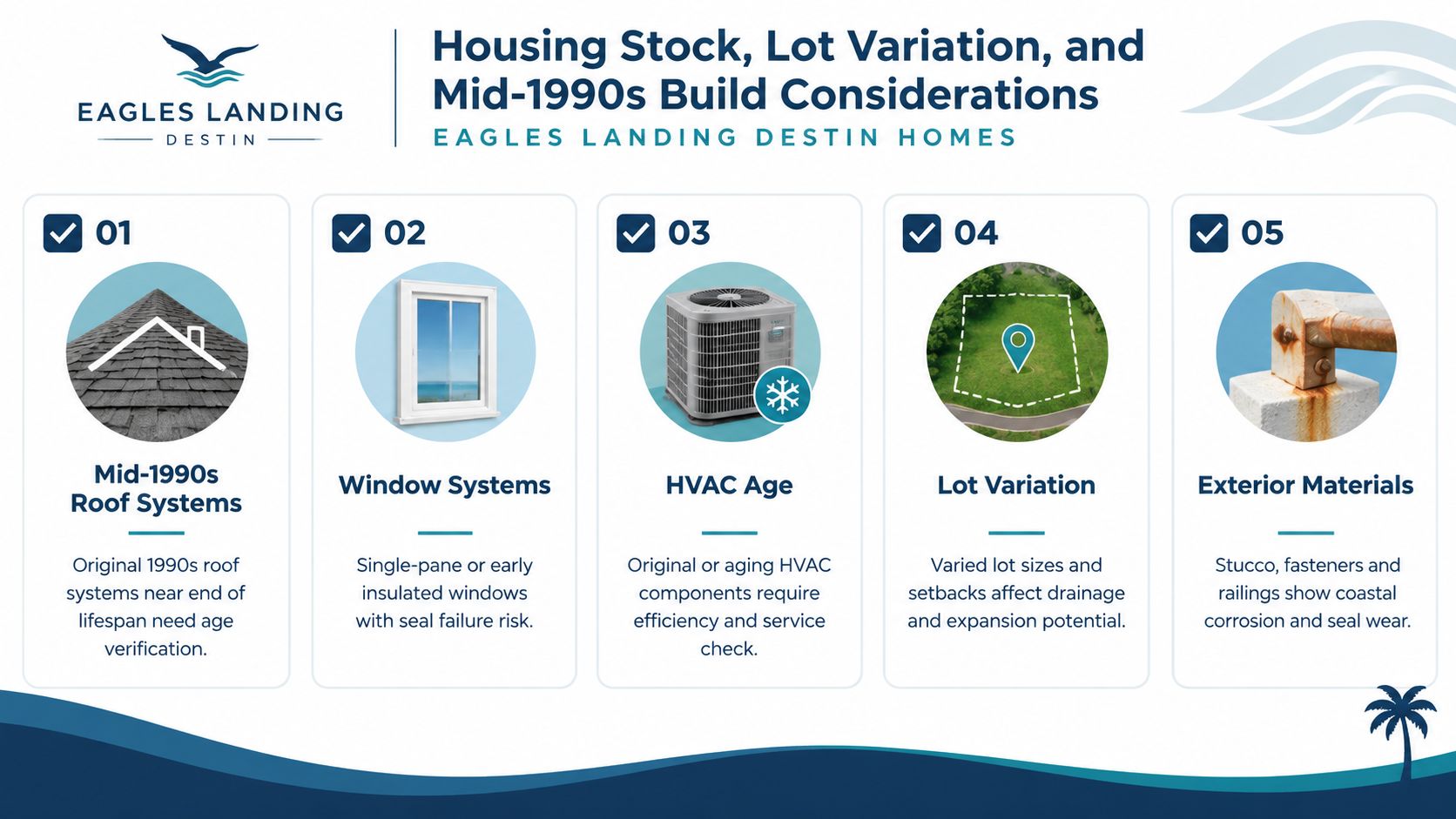
A home built around 1995 deserves a property-level inspection strategy. The subdivision's age doesn't prove that a roof, HVAC system, windows, plumbing, foundation, or exterior assembly is original. It does tell you that replacement timing and renovation quality may vary widely across a small collection of established homes.
Start with the roof. Ask for installation records, permits when applicable, maintenance invoices, and the insurer's required documentation. A roof that looks acceptable during a showing can still produce underwriting problems if its age, fastening, opening protection, or wind-mitigation documentation is unclear.
What deserves inspection attention
- Roof documentation: Confirm the roof's age, material, permit history, installation standard, and remaining insurability.
- HVAC records: Identify replacement dates, service history, equipment condition, and whether the system can support the home's current configuration.
- Window performance: Inspect seals, frames, operation, water intrusion evidence, and any storm-protection features.
- Exterior exposure: Examine fasteners, railings, stucco or other exterior finishes, caulking, drainage paths, and signs of coastal corrosion.
- Lot and site conditions: Review setbacks, fences, additions, grading, drainage, and any improvements that may require association or municipal approval.
Lot variation matters because an interior parcel and a perimeter parcel may face different drainage, fencing, privacy, setback, and expansion questions. Don't assume that a renovation visible at one Eagles Landing address can be repeated at another. The governing documents, survey, site plan, permits, and parcel dimensions control the answer.
Older construction can also hide shortcuts that a cosmetic walkthrough misses. Buyers should find out what shortcuts old homes hide before treating an updated kitchen or fresh paint as evidence of whole-house modernization.
For a nearby comparison, buyers can find Crystal Beach subdivision details, then compare actual construction records and current disclosures rather than assuming two Destin communities share the same maintenance profile. The right offer reflects the specific home's condition, not the subdivision's approximate build year alone.
Parcel Records, Deed and Association Verification
Before pricing an Eagles Landing offer, verify the parcel, title, and association obligations. The county property appraiser database supplies public tax-roll information, but recent sales generally appear three to four weeks after closing, so the record may lag current activity (Okaloosa County property appraiser search). In a small community, that delay can distort a buyer's view of value.
Pull the file in the right order
- Identify the parcel. Match the street address, parcel identification number, legal description, ownership, and assessed information.
- Review recorded instruments. Obtain the current deed and examine vesting, transfer history, easements, restrictions, releases, and other recorded matters.
- Order title work early. A title commitment can reveal easements, lien issues, or gaps in the chain of title that a public property page does not fully explain.
- Request association documents. Obtain the declaration, amendments, bylaws, rules, current budget, insurance information, assessment notices, and architectural requirements.
- Get an estoppel before closing. Confirm dues, balances, violations, pending assessments, approval issues, and transfer obligations in writing.
The appraiser's assessed value is a records check, not a market analysis. Compare the property with similar Eagles Landing sales, adjusting for renovation quality, lot position, square footage, roof condition, garage configuration, and insurance constraints.
A listing describes the seller's presentation. The deed, title commitment, association records, inspection reports, and insurance quote establish what you are buying.
Association silence about leasing does not grant rental approval. If the declaration or rules are unclear, obtain written clarification from the association or its authorized representative before relying on a rental plan. Use this guide to Destin STR rules to organize public-rule questions, then confirm the answer against the property documents. Those documents control the home's private restrictions, while current city requirements control municipal compliance.
Realistic Ownership Costs in 2026 Destin Insurance Markets
Insurance is the cost most generic Eagles Landing summaries leave out. Independent 2026 Destin insurance guidance places typical annual homeowners premiums around $4,500 to $7,500 or more for a standard single-family home, with many homes priced from $350,000 to $450,000 near $6,500 annually (Destin homeowners insurance guidance). Older, higher-value, or more exposed coastal properties can price above that range.
Those figures are context, not a quote for any Eagles Landing address. Underwriters will look at roof age, construction details, opening protection, wind-mitigation documentation, replacement-cost valuation, prior claims, deductibles, occupancy, and the condition of major systems. A home built around 1995 may need current inspection documentation before an insurer can evaluate it properly.
Flood coverage is a separate question. The City of Destin directs owners and buyers to its planning division for help interpreting current FEMA flood maps and policy-writing information (Destin flood mapping resources). Check the exact parcel on the current map. Proximity to water doesn't establish the parcel's flood designation, and a flood quote must be reviewed alongside the lender's requirements and the home's elevation or mitigation information.
Eagles Landing 2026 insurance cost variables
| Cost variable | Typical 2026 range | Impact direction |
|---|---|---|
| Homeowners premium | $4,500 to $7,500 or more annually | Higher exposure, age, value, or weaker mitigation can increase cost |
| Common premium context | Around $6,500 annually for many $350,000 to $450,000 homes | Property-specific underwriting controls the final quote |
| Flood coverage | Property-specific | A mapped flood hazard area can affect lender and insurance requirements |
| Wind and hazard deductibles | Property-specific | Higher deductibles reduce premium but increase out-of-pocket exposure |
| Association obligations | Document-specific | Dues, assessments, and shared insurance responsibilities must be confirmed |
A worked annual carrying-cost example must use the actual home's quote, not a generic assumption. Obtain homeowners, wind, flood if applicable, deductible, association, tax, and maintenance figures before calculating debt-service affordability. For context on coverage beyond standard flood limits, buyers can review Miami flood insurance beyond NFIP limits, while remembering that policy structure must be designed to the Destin parcel.
For a different ownership model, these Gulf-front condo ownership tips can help clarify why single-family insurance analysis shouldn't be borrowed from a condominium purchase. The building, parcel, association, and policy responsibilities are different.
Short-Term Rental Eligibility and City of Destin Rules
Eagles Landing homes need public approval before any short-term rental income belongs in an offer analysis. Prior listing history, rental advertising, or a seller's statement does not prove that the current owner can continue that use. Confirm the property's legal status with the City of Destin before relying on projected revenue.
Public requirements in Destin
City rules define a short-term rental as occupancy of a single-family dwelling for one day to no more than six months. Residential homes must complete the city's Change of Use process before operating as short-term rentals, as set out in the City of Destin short-term rental ordinance.
Qualifying properties must also complete city registration. Registrations remain valid for no more than 12 months and expire on the last day of February each calendar year. The city's City of Destin short-term rental registration information covers the registration process and current administrative requirements.
Single-family homes and townhomes need the applicable city registration, Business Tax Receipt, and Florida DBPR license. Zoning and private property restrictions remain separate checks, as summarized in these Destin short-term rental requirements. Do not treat a city registration as approval of a deed restriction or any other private limitation.
The annual registration fee depends on home size. Homes up to 2,499 square feet are charged $500, homes from 2,500 to 4,999 square feet are charged $600, and homes at 5,000 square feet or more are charged $700. Overnight occupancy from 10:00 p.m. to 7:00 a.m. is capped at two adults per legal bedroom plus four additional people, with an absolute maximum of 24 persons per property. Both requirements appear on the city's registration page.
Before advertising, assemble the parcel record, written zoning confirmation, registration materials, Business Tax Receipt, DBPR license, and required safety documentation. Use the verification steps in Section 3 for the recorded declaration, amendments, leasing provisions, and current association records. If any public document is missing or conflicts with another, pause the rental plan and resolve the discrepancy.
For buyers comparing ownership structures, this investor guide to Destin condos offers useful context. Do not transfer condominium assumptions to an Eagles Landing single-family property. Its eligibility depends on the exact parcel, its public approvals, and its governing documents.
Eagles Landing Against Current Destin Market Data
Eagles Landing requires a narrow comparable set, not a citywide headline. Its compact size, established construction, lot differences, and possible use restrictions can move value more than a broad Destin median. Compare homes with similar square footage, lot characteristics, renovation level, insurance profile, and documented leasing rights.
A June 2026 Destin snapshot reports a median sale price of $556,197 for the three months ending in June, a median 98 days to sell, and a year-over-year increase of 1.7 percent (June 2026 Destin market snapshot). Another market tracker lists a median sale price of $704,450, down 3.2 percent year over year. The gap reflects different property mixes and measurement windows, so neither figure should set an Eagles Landing offer by itself.
How to Compare Eagles Landing With Nearby Destin Areas
A neighborhood table filled with unverified medians would create false precision. Crystal Beach, Holiday Isle, Regatta Bay, and Indian Bayou contain different housing types, lot conditions, build eras, renovation levels, insurance exposure, and rental rules. A sale in one area is not automatically a useful comparable for an Eagles Landing home.
Use a short, property-specific set of closed sales. Start with homes that match the subject property's living area, lot position, garage and pool features, construction condition, storm upgrades, and documented legal use. Then adjust for roof age, HVAC systems, flood exposure, wind mitigation, unfinished repairs, and association obligations. Build era matters too. A mid-1990s home may need a different inspection and insurance review than a newer property, even when the floor plans look similar.
List price is only the opening reference. Compare it with the closed price, concessions, repair credits, appraisal conditions, and closing timing. Insurance availability can change the buyer's effective cost before financing is finalized. A lower-priced home with an aging roof, unclear rental rights, or incomplete records may cost more to own than a higher-priced home with insurable systems and clean documentation.
For Eagles Landing, ask the agent or appraiser to show the selected sales and each adjustment. Reject a valuation that relies on subdivision names alone. The strongest comparable is the home with the closest physical, financial, and legal profile, whether or not it sits in the same neighborhood.
Buyer Due-Diligence Checklist and Listings CTA
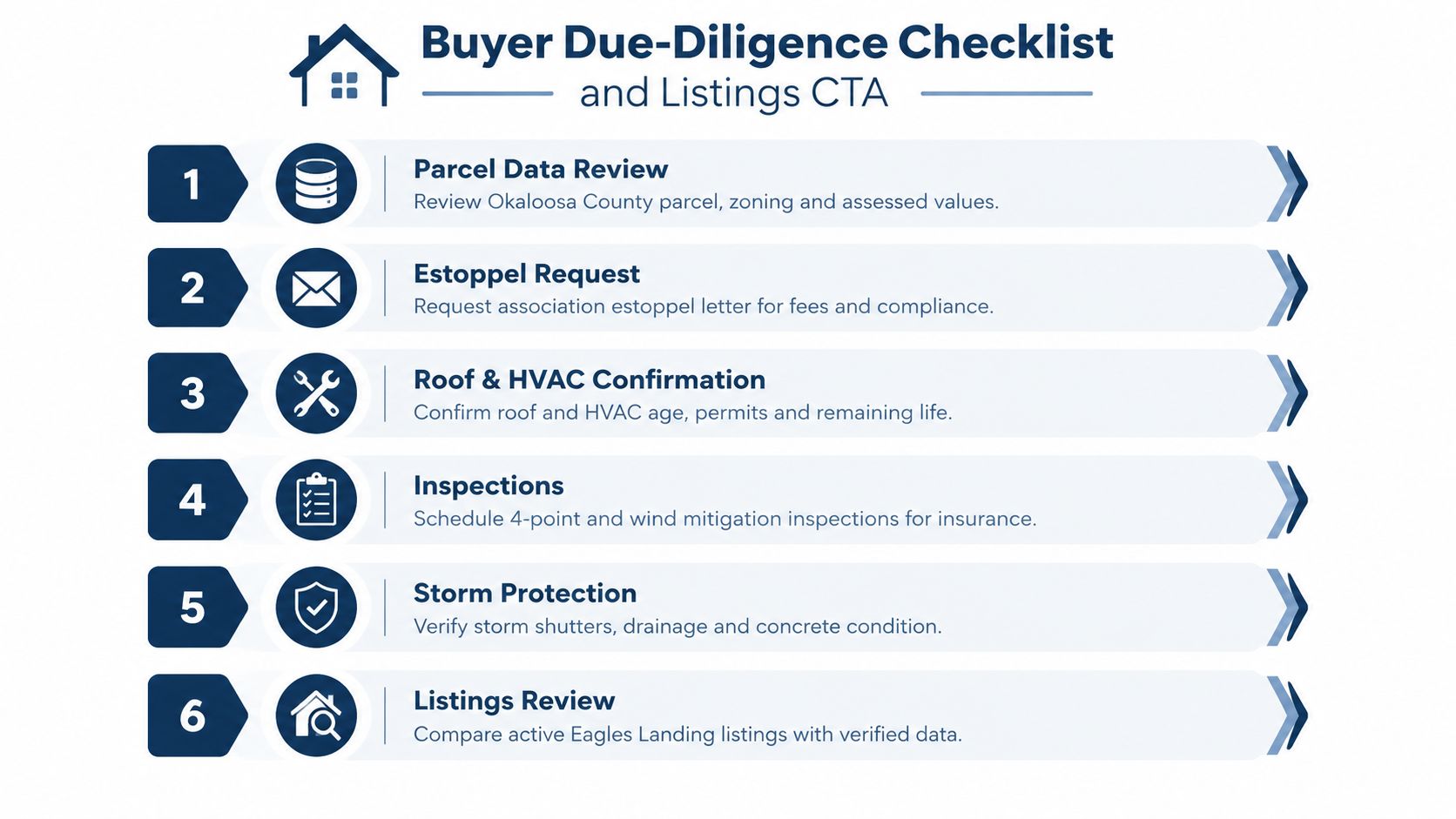
A strong showing is not evidence that an Eagles Landing property is ready for an offer. Build the file in sequence, verify the parcel and association documents, and price insurance before you commit. In a small subdivision, one property's condition, restrictions, or recent sale can mislead casual neighborhood assumptions.
The offer-to-closing sequence
- Review the parcel. Confirm the address, parcel identification number, legal description, assessed information, ownership, and recorded sale timing through the county property appraiser database, as noted earlier.
- Request the association file. Obtain the declaration, amendments, rules, budget, insurance information, assessment notices, architectural requirements, and written leasing position.
- Order title work. Review the title commitment, deed, easements, liens, releases, and every exception that could affect use, financing, or resale.
- Inspect the structure. Confirm roof and HVAC age, applicable permits, water intrusion evidence, drainage, windows, storm protection, exterior fasteners, and concrete condition. Use this water damage inspection advice to focus the moisture review.
- Get insurance quotes early. Give the insurance professional the actual dwelling details. Request homeowners, wind, flood if applicable, deductible, and mitigation pricing. Insurance availability and deductibles can change the effective cost before financing is finalized.
- Confirm intended use. If rental use matters, obtain written property-specific permission and complete the public zoning, registration, Business Tax Receipt, DBPR, Change of Use, occupancy, and safety review before relying on that income.
The financial worksheet should include purchase price, taxes, association obligations, insurance, deductibles, utilities, maintenance, financing costs, and known assessments. Update it through closing. A document dated before an amendment or assessment may not describe the obligation transferring with the property.
To compare inventory, view Dream Destin Realty properties, then open the exact Eagles Landing Destin homes for sale search page. Match each listing against verified parcel, condition, insurance, association, and intended-use information.
Before writing an offer, bring the parcel file, insurance quotes, association documents, inspection findings, and intended-use records to a buyer consultation with Dream Destin Realty. Verify the numbers against the actual property first.


