
Seller Closing Costs Florida: What You Pay and Why
Learn which seller closing costs Florida sellers pay, which are set by law and which the contract decides, with notes for Destin and Walton County.

On this page
On this page
Seller closing costs in Florida usually include the documentary stamp tax on the deed, paying off any mortgage, prorated property taxes, association estoppel charges for a condo or HOA, and whatever the contract assigns to the seller, such as title or closing fees. State law sets the deed tax rate; the contract decides who pays most of the rest.
That split explains the surprise. Two sellers can accept the same contract price and still walk away with different checks, because a statute fixes how a line is calculated while the contract decides whether that line lands on the seller's side. The deed tax is the fixed piece. Most other lines are allocations you can read, question, and sometimes negotiate before closing.
Table of Contents
- Which Seller Closing Costs Florida Come Out of Your Proceeds?
- How Does Florida Law Set the Deed Tax?
- Which Debts and Taxes Come Out of Your Proceeds?
- What Does an Estoppel Certificate Show and When Should You Request It?
- Are Title and Brokerage Costs Set by Rule or by Contract?
- Which Federal Tax Items Should You Review?
- What Should You Request Before Closing?
- Common Questions About Seller Closing Costs
Which Seller Closing Costs Florida Come Out of Your Proceeds?
Every dollar that leaves your proceeds answers to one of three sources: a statute, a rule, or your contract. This table shows which source controls each seller cost, so you can see which lines are fixed and which can move in your deal.
| Seller cost | What sets it | Where to verify |
|---|---|---|
| Documentary stamp tax on the deed | Florida statute sets the rate; the contract allocates who pays | Florida Department of Revenue; closing agent |
| Mortgage payoff and recorded liens | The closing agent orders payoff figures; each debt is paid from proceeds | Lender payoff letter; title search |
| Property tax proration | Your contract | County tax collector bill |
| Condo or HOA estoppel certificate | Florida statute sets the association's duties | The association or closing agent |
| Title insurance premium | A state rule sets the premium; the contract assigns who pays for the owner's policy | Closing agent; draft settlement statement |
| Other title and closing fees | Your contract assigns each fee | Draft settlement statement |
| Brokerage compensation | Your listing agreement; negotiable | Your listing agreement |
| Recording the deed and any satisfaction | Clerk of Court recording | Okaloosa or Walton County Clerk of Court |
| Federal tax items | Federal tax law | IRS Publication 523 and FIRPTA guidance |
How to read it: the middle column tells you whether to check a statute, a rule, or your contract. That difference decides which lines are fixed and which lines you can negotiate.
A line the contract assigns, such as who buys the owner's title policy, can differ from one deal to the next.
Where the middle column names your contract or listing agreement, the line can move between parties while the deal is still open. The closing agent's settlement statement carries the actual figures for your sale, so use this table to learn where each number comes from. For the sequence from listing to closing, see Dream Destin Realty's selling steps.
How Does Florida Law Set the Deed Tax?
The deed tax is the clearest fixed line on the seller side. In every Florida county except Miami-Dade, the rate is 70 cents on each $100 or portion thereof of the total consideration, under s. 201.02(1)(a), Florida Statutes, as the Florida Department of Revenue's documentary stamp tax page describes.
What Counts as Total Consideration
Total consideration can include amounts paid or to be paid. The phrase "or portion thereof" does quiet work here. The tax works like a parking meter that charges by the hour: a partial $100 is billed as a full increment, so a price that lands just over a $100 boundary pays for the whole next step rather than a fraction of it.
All parties to the document remain liable for the tax even when the contract assigns it to one side. Your contract decides who pays on the settlement statement, but the state's claim does not disappear because two parties agreed on a different split.
Before you sign, read the consideration stated in the draft contract and ask the closing agent how the tax line is allocated on the settlement statement. Miami-Dade follows a different structure, so this rate does not describe a sale there.
Which Debts and Taxes Come Out of Your Proceeds?
Debt comes out before you see a check. The closing agent orders a payoff from each lender of record, and your existing loans are paid from proceeds at closing. A payoff applies to a specific closing date, so an older loan statement is not a substitute for a current payoff letter.
Recorded liens follow the same path. The closing agent reviews the liens of record that appear in the title search and resolves them through the closing process. Some liens are paid from proceeds. Your settlement statement shows the lines that apply to your property.
Property taxes are prorated between buyer and seller as the contract provides. The result depends on the closing date and the terms your contract uses, not on a generic calendar rule. For your own bill, use the Okaloosa County Tax Collector or the Walton County Tax Collector.
A short check before closing:
- Confirm each lender of record. Ask the closing agent which payoff letters will be ordered.
- Confirm the proration method in the contract. Read the tax section rather than assuming a calendar method.
- Confirm the liens in the title search. Ask which ones will be paid at closing and which need a separate release.
If a trust holds title, the trustee's authority and the vesting deed belong in the same review. selling a trust-held home in Florida covers that paperwork. Payoff letter timing is covered in the final steps below.
What Does an Estoppel Certificate Show and When Should You Request It?
An estoppel certificate is a statement from the association that shows what is owed to it at closing. For a condominium, s. 718.116(8), Florida Statutes requires the association to issue the certificate within 10 business days after a written or electronic request from the unit owner, the owner's designee, a unit mortgagee, or the mortgagee's designee. A homeowners' association has the same 10 business days under s. 720.30851, Florida Statutes.
The statute sets the response window. Ask the association or the closing agent what the certificate will state for your property, then compare that figure with the allocation your contract assigns.
Timing rule: request the estoppel as soon as the contract is signed. The 10 business days run from the request, not from the closing date.
A late request can compress the closing schedule, since the association may use the full window the statute allows.
Are Title and Brokerage Costs Set by Rule or by Contract?
Title insurance and brokerage compensation follow different rules, which is why one line can be quoted with confidence and another has to be read from your agreement.
Florida sets the title insurance premium by rule. s. 627.782(1), Florida Statutes requires the commission to adopt a rule specifying the premium title insurers charge. The rule fixes the premium, not the payer. The contract decides which party pays for the owner's policy and the closing services. A separate guide on owner's title insurance explains what the policy covers.
Other title and closing fees are also allocated by the contract. Read the draft settlement statement line by line and ask which party the contract assigns to each fee. For the buyer's side of the same statement, Florida closing costs explains that list.
Brokerage compensation is set by the listing agreement and is negotiable. No single rate applies to every listing. Read the listing agreement for its terms and raise commission questions with your broker.
Which Federal Tax Items Should You Review?
Federal tax items sit beside the settlement statement, not inside the state's deed tax calculation. The closing agent may issue Form 1099-S to report the sale to the IRS. IRS Publication 523 explains the home sale exclusion and the reporting rules, including who may qualify.
If you are a foreign person under FIRPTA, the transaction has a separate withholding step. The IRS FIRPTA withholding guidance explains the buyer's role as the usual withholding agent. Both items depend on facts a tax professional should review.
Questions to Bring to a Tax Professional
- Home sale exclusion: whether your facts meet the ownership and use conditions described in Publication 523.
- FIRPTA: whether the buyer must withhold from your sale.
- Reporting: what the closing agent will report and what records you should keep.
Route the decision: the closing statement reports the sale; it does not decide your federal tax result.
A like-kind exchange raises its own timing questions. how reverse 1031 funding works explains the funding sequence. These are questions for a tax professional, not conclusions from a closing statement.
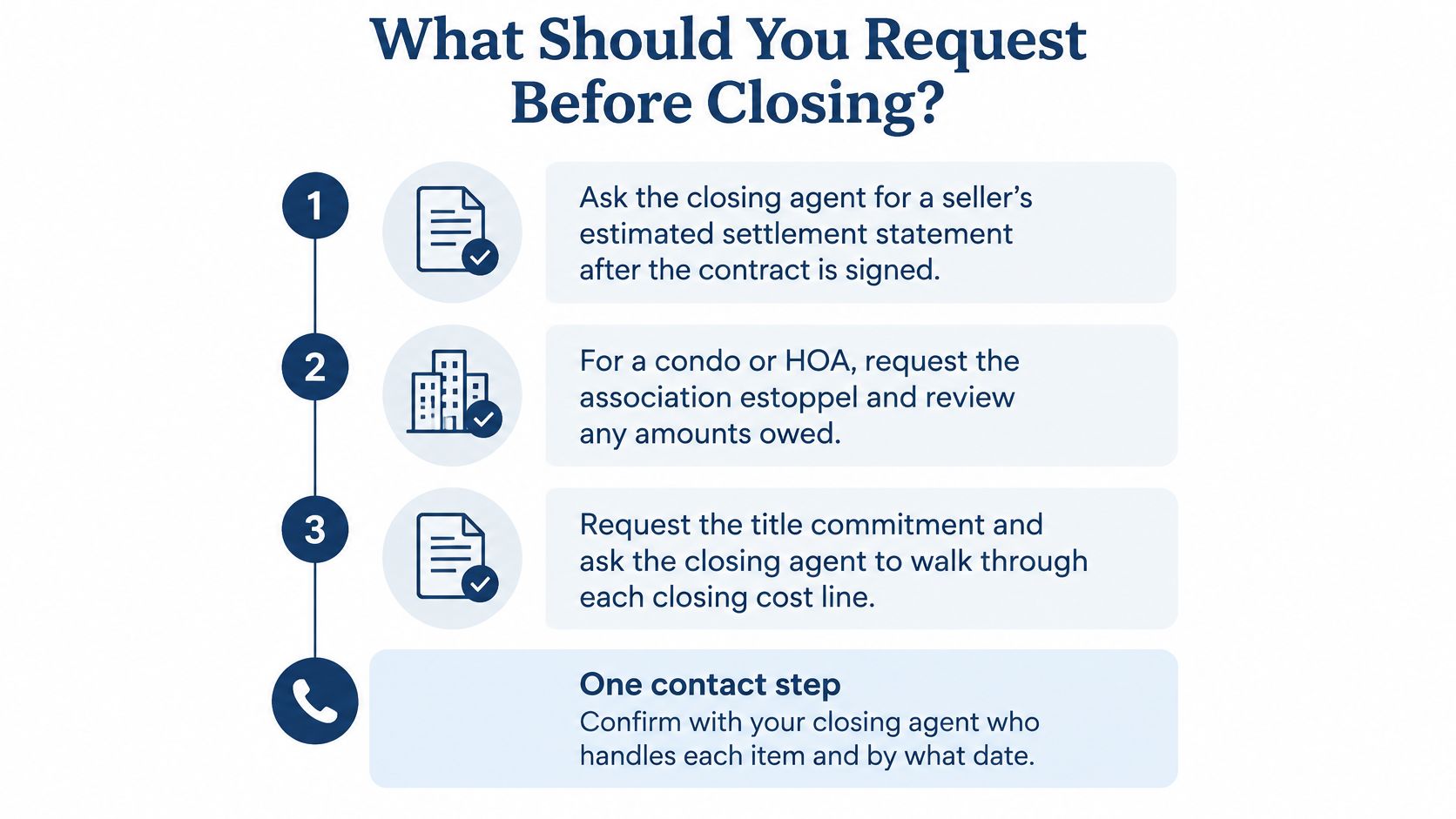
What Should You Request Before Closing?
Each request below goes to the party that controls the number: the closing agent, the association, the lender, or the contract itself.
- Ask for the settlement statement twice. Request the seller's estimated version once the closing agent is engaged, then the draft final version before the closing date in your contract. Comparing the two shows which figures moved.
- Sort each line by what sets it. Statute fixes some charges; the contract allocates others, such as title costs, between buyer and seller. Flag any line that does not match the allocation you signed.
- Match the draft to its source documents. The association balance should equal the estoppel figure, and each loan payoff should equal the letter that lender issued for your closing date.
- Check the date behind credits and prorations. The statement should split charges using the closing date in the contract, not a projected one.
Recording happens after closing. The deed and any mortgage satisfaction are recorded in the official records of the Okaloosa County Clerk of Court or the Walton County Clerk of Court. The clerk's current schedule controls the recording charge, so confirm that fee appears on the draft statement before you approve it.
Dream Destin Realty's home valuation can inform pricing, but it is not an estimate of your net proceeds. For seller resources, start with sell my Emerald Coast home; for local context, read the Destin area guide. If the property has unpermitted work, selling a house with unpermitted work covers the records to gather before a buyer raises it.
To ask about your situation, contact Dream Destin Realty through its contact page.
Common Questions About Seller Closing Costs
If the contract makes the buyer pay the deed tax, is the seller still liable?
Yes. Under s. 201.02(1)(a), Florida Statutes, all parties to the document are liable for the tax regardless of which party agrees to pay, according to the Florida Department of Revenue. The contract decides who funds the line at closing. It cannot erase the statutory liability itself.
Do I have to report the sale if I cannot exclude all the gain?
Generally yes. IRS Publication 523 says a seller who meets certain conditions may exclude up to $250,000 of gain, or up to $500,000 for a married couple filing jointly. Gain above those limits, or gain on a sale where the conditions are not met, is generally taxable and must be reported. A tax professional can confirm how much of your gain falls outside the exclusion.
Who sets the estoppel deadline?
The delivery deadline is fixed by statute: s. 718.116(8), Florida Statutes, for condominium associations and s. 720.30851 for homeowners' associations.
What happens at closing if the seller is a foreign person?
Under FIRPTA, the buyer, as the usual withholding agent, must generally withhold 15% of the amount realized on the sale by a foreign person, per the IRS FIRPTA withholding guidance. Sellers in this position should talk to a tax professional before closing.
Dream Destin Realty provides a free home valuation, seller guides, and the ability to connect with a local expert across Destin, Miramar Beach, and the rest of the Emerald Coast. If you are weighing whether to sell, those tools can help you gauge your property's position before a contract allocates each cost. Visit Dream Destin Realty to ask about your sale.


