
Walton County Vacation Rental Laws: A 2026 Guide
Walton County vacation rental laws explained: county certificates, state licenses, tax registrations, HOA rules and the buyer evidence file to gather.

On this page
On this page
A condo on 30A, a townhome in Santa Rosa Beach, and a home near Miramar Beach can sit under different combinations of county and association rules. In unincorporated Walton County, a covered short-term rental needs an annual County certificate under Land Development Code section 1.13.16, and the certificate must be recertified when the property changes hands; a Florida DBPR lodging license and tax registrations are separate approvals, and none of them overrides an association's recorded rental rules. The right first move is to identify the property's jurisdiction and ownership structure, then build a purchase file that shows which approvals apply to that specific unit.
For buyers comparing South Walton locations, Dream Destin Realty's Santa Rosa Beach area guide provides regional context. The 30A corridor page is useful for orientation, but 30A is a corridor name, not a municipality or legal boundary. That distinction matters: an address associated with a familiar community or coastal corridor doesn't establish which government's rules apply.
Table of Contents
- Municipal or Unincorporated Walton and Which Registration Applies
- Buyer Evidence Matrix for Licenses, Taxes and Permissions
- County Application and Annual Renewal Steps
- Life-Safety Review and Smoke Alarm Inspection Scope
- Egress Doors and Latch Checks Before Operations
- Equipment Condition Records for Fire Extinguishers
- Conditional Pool Gate and Barrier Review
- Confirm the Transfer Sequence Before Any Rental Operations
- Walton County Buyer Questions
Municipal or Unincorporated Walton and Which Registration Applies
Begin with the parcel, not the listing description. Pull the parcel record and municipal boundary map first, then check whether the property sits inside an incorporated city or in unincorporated Walton County. If it's inside a city, confirm that city's rules directly. If it's unincorporated, review the county code and any private restrictions recorded against the property. That jurisdiction note becomes the first page of the buyer's file, since it decides which registration path applies. For property on the Okaloosa County side of the line, including Destin, see Okaloosa County vacation rental laws; for the statewide layer, see Florida vacation rental laws.
Walton County's posted Land Development Code, Chapter 1, section 1.13.16(A) through (C), sets out the covered uses requiring annual certification, the specified exemption categories, and recertification at transfer. The code text determines whether a particular use falls within the county program, so the file should cite the section number rather than rely on summary pages. The County FAQ's broader descriptions shouldn't be treated as a blanket rule for every property.
Does Walton County require a certificate for every rental?
No. The code defines the uses covered by the certification program and identifies specified exemption categories. Compare the exact unit and its circumstances with the current code rather than assume that every rental is covered or that a familiar property type is exempt.
A county certificate, when required, is one part of a larger eligibility question. It doesn't establish that the city, zoning rules, recorded documents, or an association permits the intended rental use. As an outside-Walton comparison only, buyers also considering Destin communities such as the Villages of Crystal Beach homes for sale should treat the community name as a starting point for property research, not as evidence of rental permission.
Does a registration exemption mean I can rent?
No. An exemption from the county's certification program doesn't create unrestricted rental rights, and it doesn't resolve private restrictions, zoning, licensing, or other applicable requirements. Exemption review is property-specific, and no particular property is certified as exempt here.
The useful question is whether this unit, under its ownership and intended use, clears each applicable public and private requirement. Jurisdiction, certification status, and private documents are three separate records. Each belongs in the file before the first booking.
Buyer Evidence Matrix for Licenses, Taxes and Permissions
A purchase file earns its keep at handover. Before the first booking, someone has to show which jurisdiction applies to this unit, which record proves each requirement, and which step cleared at transfer. The matrix below ties each decision to the source or professional who can answer it, the evidence that supports the answer, and the material that cannot substitute for that evidence.
| Decision | Current source or professional | Evidence needed | What does not prove it |
|---|---|---|---|
| Whether the County certificate covers this unit | Walton County Office of Short-Term Vacation Rental Registration and LDC Chapter 1 | Current certificate status, expiration, and the certificate record for this unit | A listing ad, MLS remark, or past rental history |
| Whether a state lodging license applies | Florida DBPR transient public lodging license guide | License classification and licensed location for the dwelling or condo unit | County registration alone |
| Tax registrations for the rental | Florida Department of Revenue and Walton County Clerk of Courts | Registration records for the owner or operator tied to the rental activity | Tax collected on a prior stay or a platform payout history |
| Owner entity and title structure | Florida Department of State business registration and the deed | Deed vesting and entity status when a company holds title | A verbal statement from the seller or a manager |
| Declarations and association rules | Recorded declaration, amendments, and current written association rules, reviewed by counsel | Recorded documents and current written rules for this exact property | MLS remarks, rental ads, manager marketing, or a seller statement |
| Zoning and local code for the parcel | Applicable zoning and city or county code, confirmed by a professional | Written confirmation of permitted use for this parcel | A permit or rental history for a different parcel or building |
| Certificate treatment after closing | Walton County program treatment at transfer under LDC recertification rules | Current County confirmation of how the certificate applies to the new owner | The prior owner's certificate or expired paperwork |
The matrix is a checklist, not an approval.
The County FAQ collects the prerequisite registrations in one place, but its summaries span several agencies. Use the posted code for scope, and record in the file which prerequisites apply to this ownership and use.
The DBPR guide distinguishes license classifications from licensed locations, which matters when a unit sits inside a larger condominium property. The state license and the County certificate are separate approvals, and neither establishes permission under recorded declarations or association rules. Rental-use due diligence considers recorded declarations and amendments, applicable association rules, and local requirements for the exact property. The buyer's professional still reviews the actual records for the property under contract.
Keep the building records together in the purchase file: association information, inspection reports, reserve details, rental rules, and insurance material, each dated so the file shows what was reviewed and when. The brokerage helps buyers review available building records during due diligence, but the buyer's professionals work from the documents the seller and the association produce.
Does a state license replace the County certificate?
No. When both apply, each comes from a different authority, so the file needs evidence of both.
Does a certificate carry over after a sale?
Not automatically. Confirm how the current program treats the certificate for the new owner or operator before relying on it.
County Application and Annual Renewal Steps
For a purchase covered by the County program, align the closing date with the current certificate cycle, ownership records and responsible-party arrangements. The County short-term rental certificate does not apply to condominiums governed by Chapter 718, Florida Statutes (Land Development Code section 1.13.16(B)(1)); state licensing, tourist tax and the rules of the condominium association still apply. Keep a dated record of each applicable step rather than assuming that the seller's earlier registration determines the new owner's obligations.
- Confirm whether the use is covered. Compare the property and intended use with section 1.13.16(A) to (C) of the posted Land Development Code. This keeps a listing description or property type from substituting for the code's scope.
- Assemble the state, tax, and entity records. The County FAQ lists state licensing and tax registrations, county tourism-tax registration, and, when a company owns the property, state business registration among the prerequisites. Keep each record tied to the correct owner, operator, and parcel.
- Work through the current application checklist. The County's Form WCSTR 2301-C application checklist organizes the requested evidence, including agent affidavits, licensing and tax identifiers, and owner and responsible-party information. The checklist shows what the application requests; a filed form is not an approval.
- Identify the responsible party and managing agent. Use the details requested by the form, then review the responsible-party duties in section 1.13.16(E) of the posted code. The application information should match the people responsible for the property.
- Calendar the current renewal cycle. The Office of Short-Term Vacation Rental Registration page shows an April 1 renewal opening and a June 1 cycle. Check that page for the cycle in effect and set the annual renewal date in the file.
The same office page posts current fees, reminder timing, and penalty amounts. Before the first booking, the owner should understand Emerald Coast short-term rental eligibility for the exact property and clear each handover step in the transfer sequence below, since a seller's prior use does not establish the new owner's standing.
Life-Safety Review and Smoke Alarm Inspection Scope
For the purchase file, the life-safety entry should name the reviewer, the date, and the exact areas or devices checked. Section 1.13.16(D) of the posted code says routine interior inspections are not performed under that provision and describes circumstances in which inspections may occur. Keep the County process distinct from a buyer's independently arranged inspection, and identify who performed any review and its actual scope.
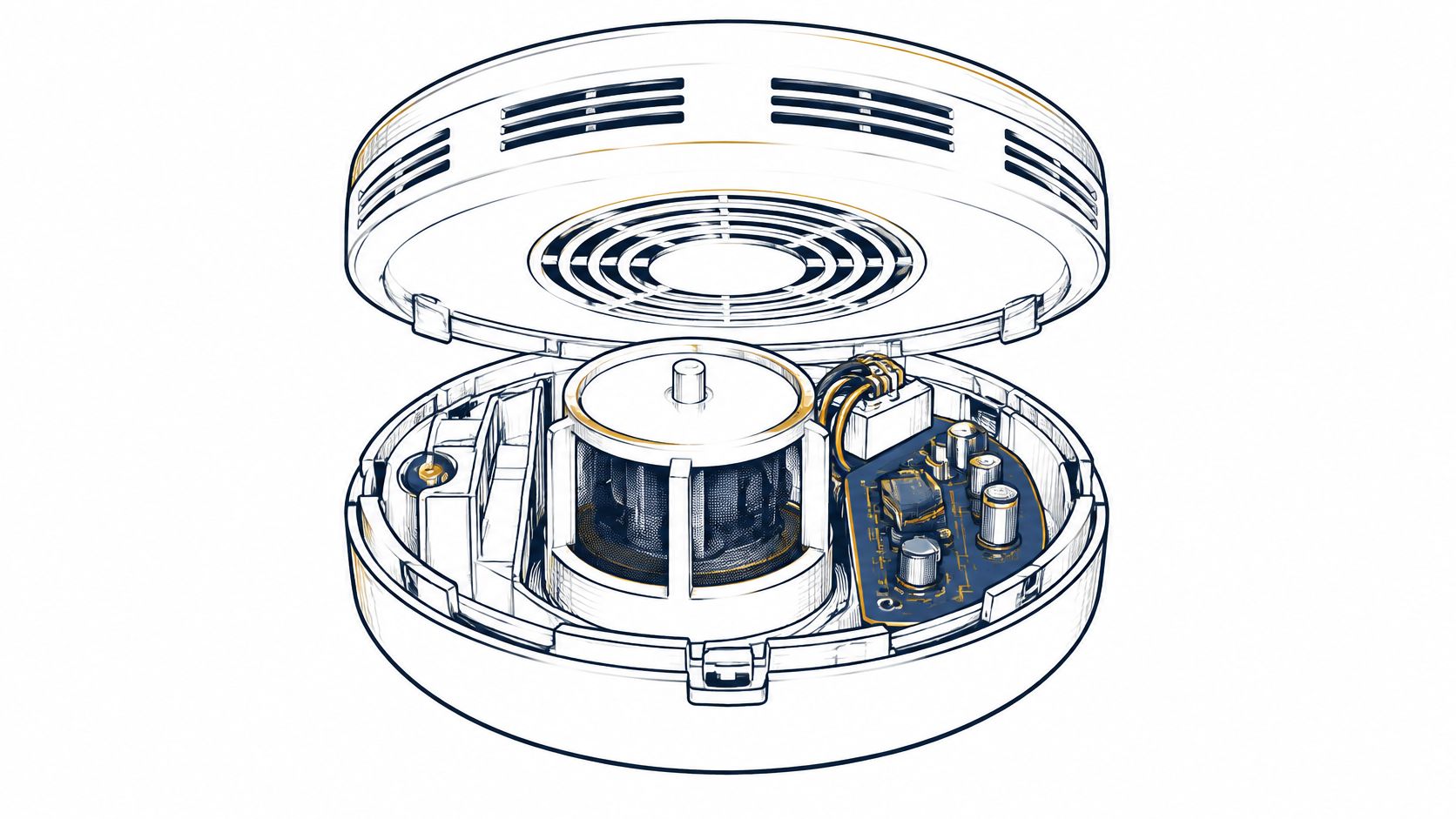
Ask the inspector to write down whether the alarm's placement and power source meet current rules, what standard was applied, and what remains untested. Keep the test date, observed condition, and any limitations with that note. A vague “checked” leaves the file weaker than a signed scope that names the unit and the basis for the conclusion.
Egress Doors and Latch Checks Before Operations
Responsible-party duties are set out in section 1.13.16(E) of the posted County code. Keep responsible-party arrangements separate from the qualified physical review of door hardware and the requirements applicable to the property.
The drawing below shows the hardware a reviewer will likely handle: a latch, a lever, and a strike plate. Use it to learn the part names before a walkthrough.

For the purchase file, a reviewer should test each egress door against specific behaviors:
- Whether the latch retracts fully when the handle is operated
- Whether any required closing and latching functions work as specified for that door
- Whether any lock needs a key or tool to open from the inside
Record what was tested, the result, and the date. That produces a door-by-door record the buyer can hand to the next owner or operator, rather than a broad owner statement that the unit looked fine.
The fire authority and a licensed inspector set the actual review scope. Their written assessment should identify which doors and hardware were examined and which requirements were applied. An owner's visual check or a general description of the unit will not substitute for that written assessment, so file it with the inspection records before the first booking.
Equipment Condition Records for Fire Extinguishers
Treat each extinguisher as a file item: unit location, gauge reading, valve and handle condition, pin and tamper seal, hose or nozzle, corrosion, and the date on the service tag. Use the drawing to name the parts a reviewer can inspect; required class, count, and placement still depend on the exact property.

Have the qualified service professional evaluate the actual equipment, including any gauge indication, pin and seal, valve, handle and cylinder condition under the applicable service instructions. Keep the dated findings and service identification rather than treating a buyer's visual check or the conceptual drawing as a service certification.
The applicable fire authority and a licensed fire-equipment service professional set the service scope for the exact unit. Keep their dated findings with the purchase documents and handover materials; an owner note can flag a concern, while the service record should come from the qualified issuer before the first booking.
Conditional Pool Gate and Barrier Review
Start with the property itself. If the purchase involves a private pool or rights to use a shared pool, identify the relevant facilities and responsibilities before defining the review. Where no pool facility or pool-use interest is involved, omit pool-specific checks rather than assuming that every Walton purchase includes them.

Where a pool is present, the record that matters is behavior rather than appearance. Note whether the gate swings closed and latches on its own from different open positions, and record the barrier type and hardware condition in the purchase file. State and local pool-barrier rules, plus any association rules, set the actual standard; a pool professional or the appropriate authority should confirm what applies to that specific property.
Keep the inspector's written scope alongside the gate observations so the file shows what was checked and what falls outside it. For ongoing upkeep after closing, Dream Destin Realty's property management guide covers operational context, while the handover file stays limited to the barrier, gate, and hardware present.
Confirm the Transfer Sequence Before Any Rental Operations
A closing date is where many Walton County rental purchases stall. The seller hands over keys and a stack of paperwork, but the applicable County certificate-transfer provisions call for recertification at transfer, and the prior owner's records do not settle what the new owner must file. Changes in operator or agent details also need review under the current program rather than an assumed identical treatment. The posted County code, linked in the first section of this article, provides for recertification at transfer, so treat the handover as its own workstream in the purchase file.
Work through this sequence before the first booking:
- Confirm County certificate treatment. Get the current program's determination for the new owner under section 1.13.16. A prior certificate is not proof that it carries over after closing.
- Check the state license. Confirm the DBPR classification and licensed location for the unit. The state licensing guide cited earlier in this article explains which license category applies.
- Verify tax registrations. Confirm that applicable Department of Revenue and Clerk of Courts registrations match the new owner or operator name, not the seller's.
- Update responsible-party details. Review the owner, responsible-party, and managing-agent fields against the County application checklist referenced above.
- Review the property records. Pull the recorded declarations, amendments, and current written rules for the exact property, along with available association information, inspection reports, reserve information, and rental rules.
- Wait for written confirmation. Begin rental operations only after each applicable item is confirmed in writing. Keep the building records in the purchase file before any operations start.
The order matters. An unresolved County certificate question does not establish that separate state or tax registrations are invalid; each authority administers its own requirements. Resolve the applicable certificate and responsible-party steps before relying on a planned operating date.
Walton County Buyer Questions
Which jurisdiction and current registration program apply to the exact Walton County parcel?
Match the exact parcel and municipal boundary first, then read the applicable local program for the property and intended use. The posted Walton County code and current office resources describe the County certificate process; the familiar Santa Rosa Beach or 30A search label alone does not establish jurisdiction. No particular parcel or exemption is certified by this general guide.
Which declaration, amendments and current association rules establish whether the intended rental duration is permitted?
The applicable recorded declaration and amendments, together with current written governing and leasing rules, must address the exact property and intended rental duration. Have the relevant legal or closing professional interpret those materials in the transaction. Registration, a state license, advertising and earlier rental activity do not independently establish private permission; no named community or unit is certified as rental-eligible here.
What current registration, inspection, responsible-party and renewal requirements must the buyer verify before operating?
For a covered use, review the current County certificate application and annual cycle, the applicable responsible-party duties, and any inspection or compliance evidence relevant to the actual property. The County process, an independently arranged buyer inspection and specialist equipment service are different reviews. Use the linked code, office page and checklist for their respective scopes, and keep property-specific written findings rather than assuming that a submitted form establishes approval.
What records should transfer at closing, and which licenses or approvals require a fresh application rather than an assumed transfer?
Retain the applicable governing documents, dated inspection and service findings, certificate records, licensed-location information, tax-registration records and responsible-party details available in the purchase. Under the cited County provision, a certificate transfer calls for recertification at transfer. Separately establish how each relevant authority treats the new owner, operator or licensed location; this guide does not promise automatic transfer or declare that every approval requires the same new application. Resolve any required new filing before relying on the intended operation.
For additional context, review rental buying advice from Dream Destin Realty. Buyers who want help organizing a property-specific evidence file can request a consultation; that consultation does not replace the professional reviews described above.


