
Destin Harbor Homes for Sale: 2026 Market Guide
Explore Destin Harbor homes for sale with verified market data, STR regulations, insurance considerations, and buying tips for this premium Emerald Coast

Destin Harbor listings range from 62 to 73 homes, spanning condos, townhomes, single-family homes, land, and multifamily options. That range shows why property type and documented harbor access matter more than any single neighborhood summary.
The market also moves at a measured pace rather than a frantic one. In the three months ending in June 2026, Destin homes sold for a median $556,000, were on the market for a median 98 days, and June sales reached 211 homes, compared with 187 a year earlier, according to Redfin's Destin housing market data. For a buyer searching for Destin Harbor homes for sale, the right question isn't which listings are available. It's what ownership structure, access rights, insurance obligations, and permitted use come with the exact property.
Table of Contents
- The Destin Harbor Market Landscape
- Property Types and Harbor Access Categories
- Location, Pricing, and Micro-Market Nuances
- Insurance, Flood Zones, and Regulatory Compliance
- Short-Term Rental Rules and Occupancy Limits
- Financing for Out-of-State and International Buyers
- Buyer Consultation and Closing Checklist
The Destin Harbor Market Landscape
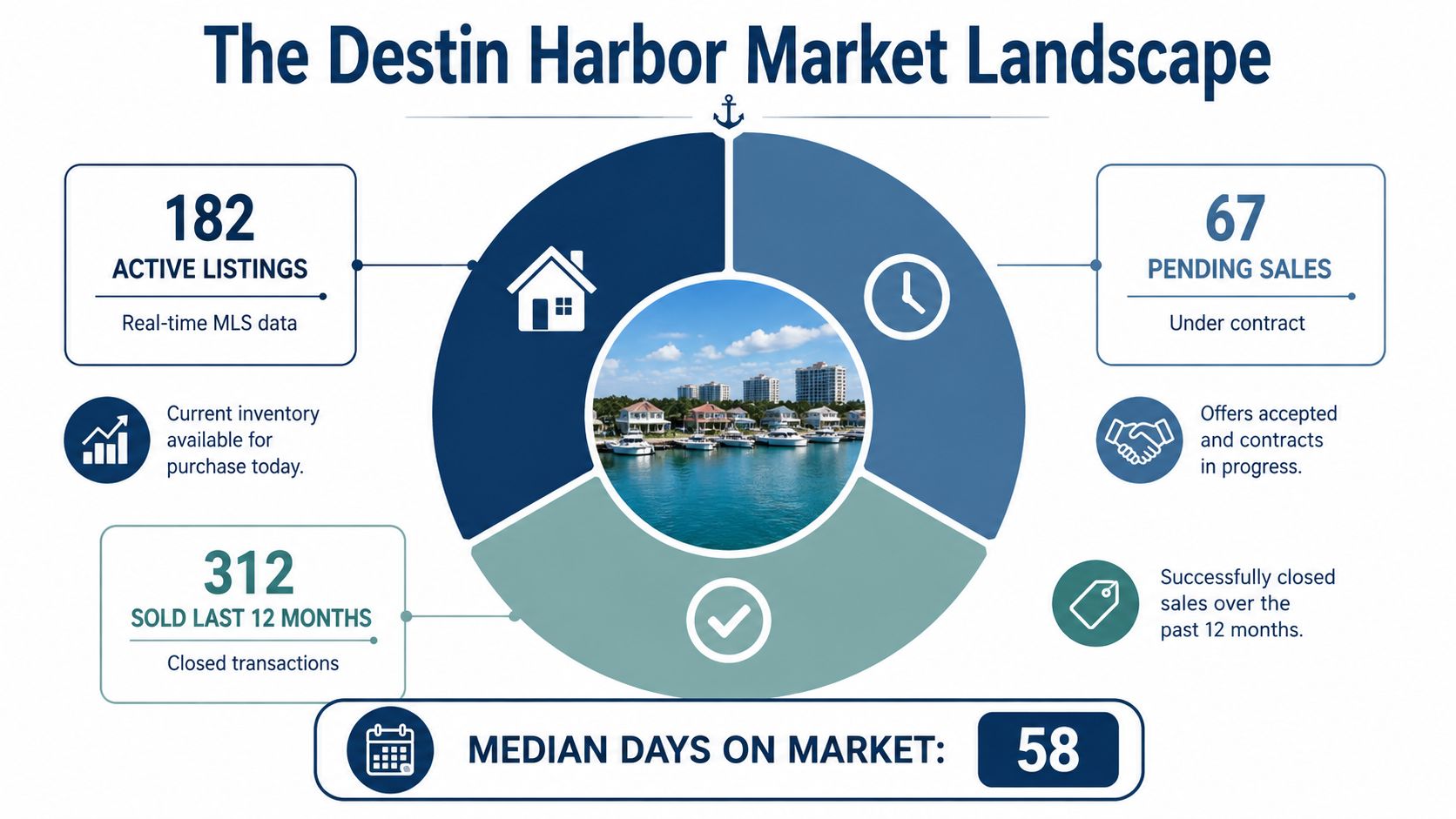
Public listing counts for Destin Harbor vary from 62 to 73 homes, and the available inventory is divided among condos, townhomes, single-family homes, land, and multifamily properties, as shown by current Destin Harbor listing categories. Those aren't interchangeable products. A condominium with a harbor view, a single-family parcel with documented dock rights, and an undeveloped lot may appear in the same search feed while carrying completely different financing, maintenance, access, and leasing considerations.
That's why a broad neighborhood feed can mislead even when every individual listing is accurate. The search label may describe a general area, while the ownership documents define the actual property. Harbor frontage, canal frontage, a shared dock, a nearby marina, and a water view each represent different rights. A photograph can suggest proximity, but it doesn't establish ownership of a slip, permission to use a dock, or access to navigable water.
Why listing snapshots differ
Inventory changes as properties enter, go pending, close, expire, or return to the market. Different search pages may also group nearby streets and property types differently. The inconsistency is useful information, because it tells buyers to treat public counts as a starting point, not as a complete description of the market.
The most productive comparison separates:
- Housing type: Determine whether the property is a condo, townhome, detached home, land parcel, or multifamily building.
- Water relationship: Identify direct frontage, canal position, harbor view, shared access, or no documented water right.
- Ownership documents: Review declarations, amendments, plats, easements, association records, and any separate dock or slip agreement.
- Intended use: Decide whether the purchase is for a primary residence, second home, or legally verified rental use.
Buyers researching coastal ownership can also review broader canal-front real estate highlights to see why frontage and access documentation deserve separate attention. For condominium buyers, the practical next step is to find Destin condos for sale and compare building-level documents rather than relying on a shared search label.
Property Types and Harbor Access Categories
Destin Harbor homes for sale can be organized into access categories, but the category must be confirmed property by property. The listing description may mention a dock, boat slip, water view, or harbor proximity. The deed, plat, declaration, association records, and separate agreements determine what the buyer receives.
| Property Type | Ownership Structure | Harbor Access | Key Documents to Review |
|---|---|---|---|
| Harbor-front or canal-front home | Usually fee-simple ownership of the residence and parcel | May include private or shared waterfront improvements, subject to recorded rights | Deed, survey, plat, easements, dock records, flood information, insurance requirements |
| Harbor-view condominium | Unit ownership with shared common elements | View or nearby access may not include a private slip or dock right | Declaration, amendments, bylaws, rules, budget, reserves, insurance, parking and leasing provisions |
| Townhome with shared access | Ownership may include the unit and defined exterior interests | Access can be shared and controlled by association documents | Declaration, maintenance schedule, easements, dock or amenity agreements, association records |
| Vacant residential land | Ownership of an undeveloped parcel | Water access depends on recorded frontage and rights | Survey, zoning confirmation, title, utility information, wetlands or flood documentation |
| Dry storage or separate slip interest | Separate ownership or contractual interest may apply | Boat storage or slip use may be distinct from the home | Purchase agreement, recorded interest, marina or association rules, transfer conditions |
Access is a legal and physical question
A private dock isn't the same as a shared dock. A shared dock isn't the same as a marina slip. A harbor view doesn't establish water access at all. Buyers should ask for the exact legal description of any slip, dock, lift, storage space, or easement and confirm whether it transfers with the residence.
Association control can also change the ownership experience. Rules may govern exterior maintenance, parking, pets, leasing, construction, insurance, and use of common facilities. Those obligations are document-specific, so a buyer shouldn't assume that two homes on nearby streets operate under the same restrictions.
Holiday Isle provides a useful comparison point for buyers reviewing harbor-connected properties. The Holiday Isle canal-front homes page can help identify a nearby property category, but location alone still doesn't prove a particular home's dock rights, leasing permissions, or association obligations.
Location, Pricing, and Micro-Market Nuances
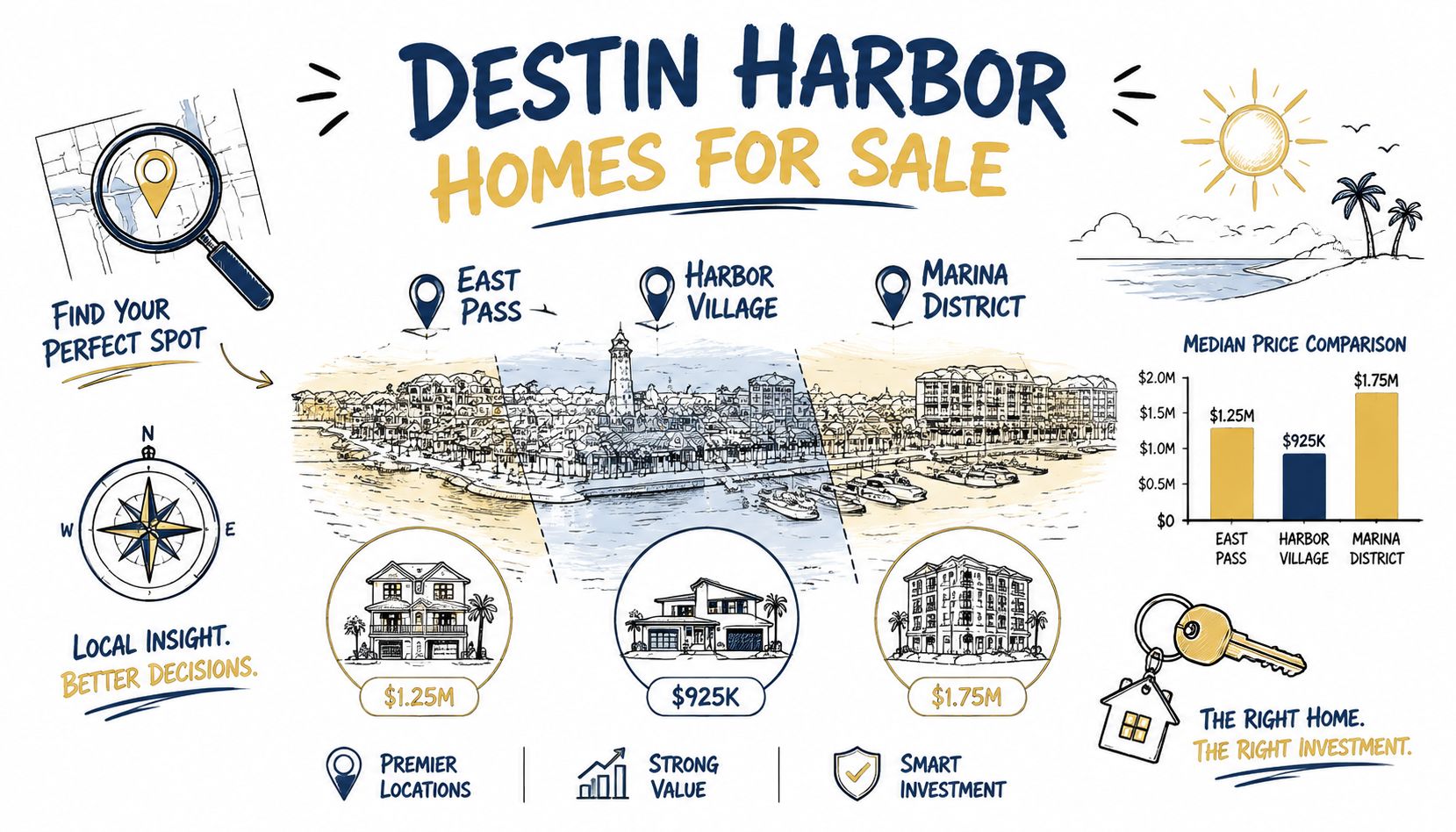
Destin is small enough that a citywide median can conceal substantial differences between nearby submarkets. The 2020 population was 13,931, and broader estimates place Destin at about 13,991 in mid-2024, according to Realtor.com's Destin market data. In a compact coastal city with an established housing base, a short distance can change the relationship to the harbor, beach access, boat routes, parking, and shared amenities.
The same market source reports a Destin median home price of about $672,000 and roughly 797 active listings. Nearby Destiny shows a much higher median listing price of $1.499 million and $543 per square foot, which demonstrates how micro-location and waterfront proximity can produce major valuation differences within the same city.
Compare the property, not just the neighborhood
A buyer comparing Destin Harbor with Miramar Beach, Santa Rosa Beach, Inlet Beach, Fort Walton Beach, or a 30A community should first define the physical feature driving the decision. Is it a walkable harbor setting, a specific boat route, beach proximity, a view, a private outdoor area, or an established residential address? Those features affect the purchase differently.
A citywide median can provide context, but it can't price a specific parcel with unusual frontage, a condominium with substantial association obligations, or a home requiring flood and wind coverage. The same caution applies to resale analysis. A property with documented access and sound records may appeal to a different buyer pool than a visually similar home where access is informal or shared.
Searchers who want a current comparison can review Destin luxury properties by Dream Destin Realty, then separate results by housing type, location, association structure, and documented access. That process is more useful than ranking properties by view quality alone.
Insurance, Flood Zones, and Regulatory Compliance
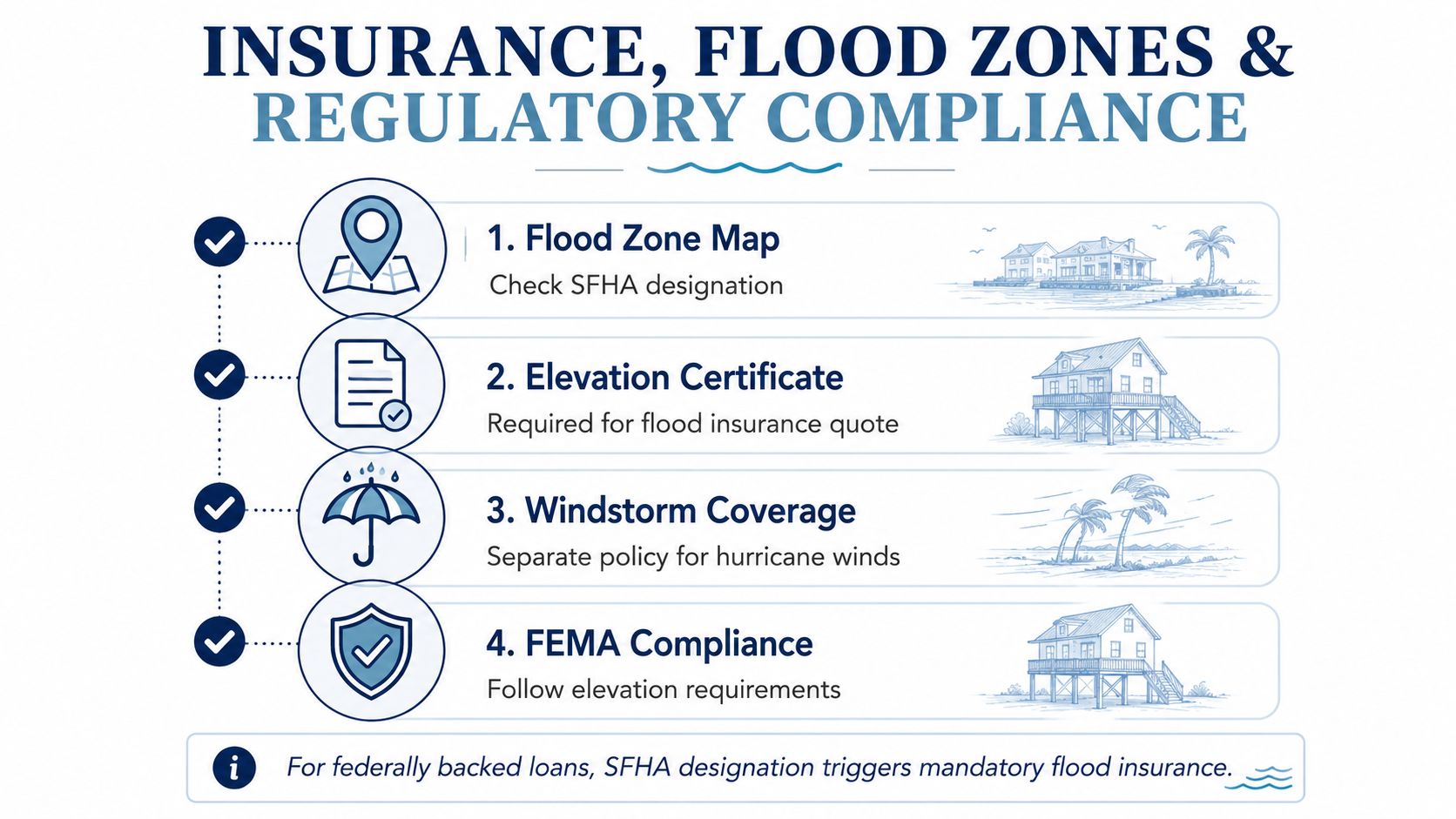
Waterfront ownership changes the underwriting conversation before a buyer ever reaches closing. Properties in a Special Flood Hazard Area, or SFHA, that use federally backed financing are generally subject to mandatory flood insurance. The City of Destin also states that its participation in the National Flood Insurance Program makes coverage available to city residents, with standard NFIP limits of $250,000 for a single-family dwelling structure and $100,000 for contents, as explained in the city's flood insurance information.
Those limits may not match the full replacement cost or contents value of a harbor-area property. A buyer should ask both the lender and insurance professional how flood, wind, property, contents, liability, deductibles, and any association master policy interact. A condominium owner also needs to understand what the association insures and what remains the unit owner's responsibility.
Four checks before an offer becomes expensive
- Confirm the flood designation. Ask for the current flood-zone information tied to the parcel, not a generalized neighborhood assumption.
- Request available elevation information. An elevation certificate may help an insurance professional evaluate the property, but the insurer determines what documentation and coverage terms apply.
- Obtain written insurance indications early. Quotes can change based on construction, roof condition, wind mitigation, elevation, replacement cost, claims history, deductibles, and location.
- Review association obligations. For condos and townhomes, examine budgets, reserves, assessments, master insurance, maintenance responsibilities, and any litigation or repair information provided in the association documents.
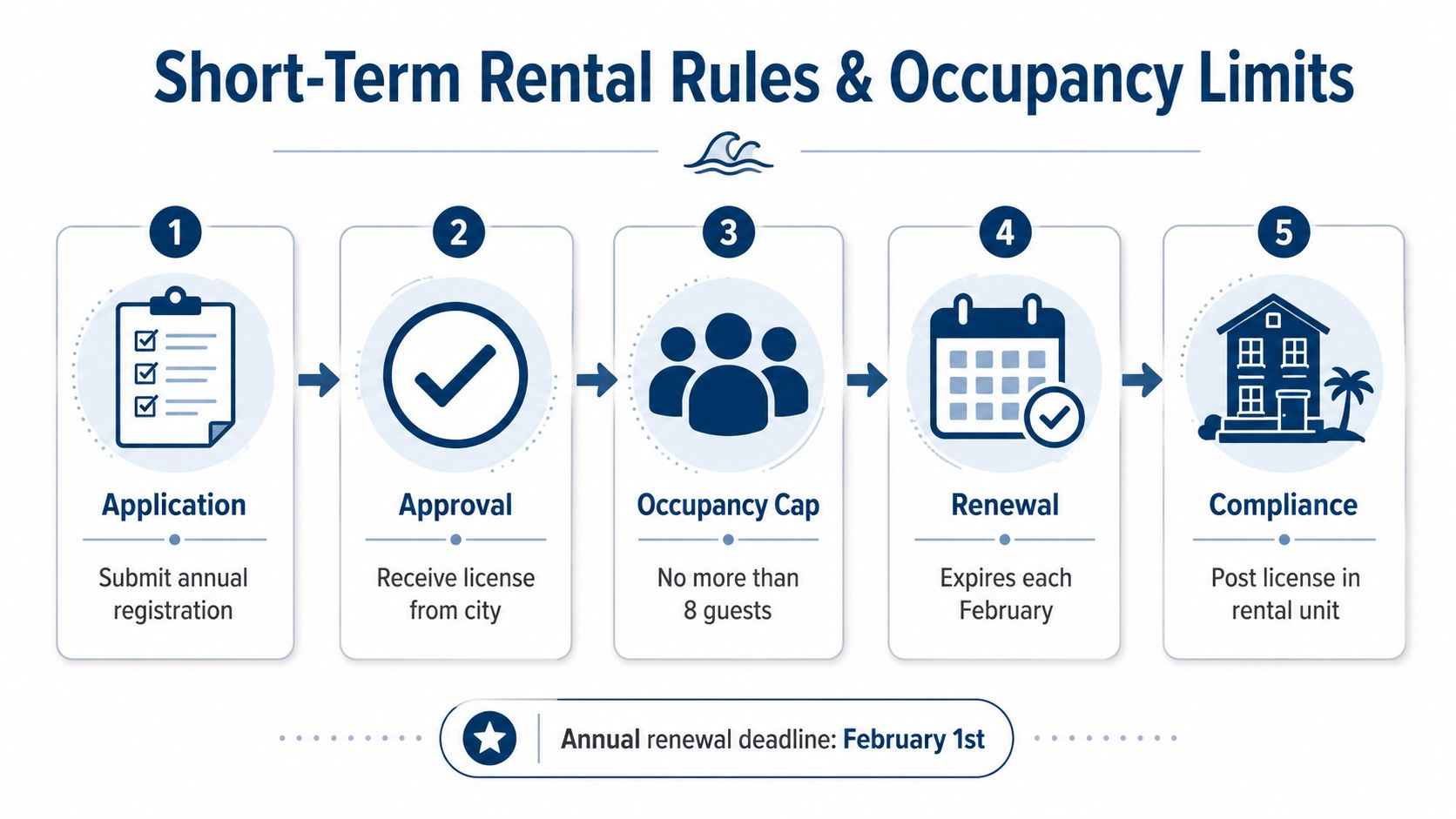
Short-term rental compliance adds another layer. The City of Destin requires annual registration for dwellings rented for fewer than 180 days. Registrations last no more than 12 months and expire on the last day of February, so a buyer relying on existing registration must verify its current status and transfer requirements.
The property also needs to pass the association and municipal use review. A prior rental, online advertisement, or seller statement isn't enough to establish that the exact home or unit can be rented for the buyer's intended duration. Buyers comparing other Emerald Coast properties can use this Dream Destin Realty buyer resource for broader purchase context, while keeping the insurance and regulatory review specific to the property under contract.
Short-Term Rental Rules and Occupancy Limits
Rental use can affect the purchase decision, but it should be treated as a permission question before it becomes a financial calculation. The City of Destin's rules require annual registration for dwellings rented for fewer than 180 days, with registration expiring on the last day of February. The city's short-term rental ordinance also sets a measurable occupancy formula.
The occupancy cap is two adults per bedroom plus four additional persons per property, with an overall maximum overnight occupancy of 24 people per house, regardless of bedroom count. That rule can affect how a buyer evaluates bedroom configuration, furnishing plans, parking needs, insurance disclosures, and any projected use.
The property-specific permission test
Before relying on rental use, obtain current written confirmation of all of the following:
- Association authority: Review the declaration, amendments, leasing rules, minimum-stay provisions, registration procedures, and any rental-management restrictions.
- Municipal eligibility: Confirm that the property's district and use comply with current city requirements.
- Registration status: Verify whether registration exists, whether it remains valid, and what happens at closing.
- Unit-level limitations: Check whether restrictions differ by unit, building, phase, parcel, or ownership structure.
- Operating limits: Match bedroom count, occupancy, parking, signage, and guest policies to the intended use.
Don't underwrite projected revenue, occupancy, cash flow, cap rate, or return from listing history or rental advertising. If the documents are missing, stale, conflicting, or restrictive, pause the rental analysis and obtain current written permission before proceeding. A general discussion of maximizing rental income on the coast can provide planning context, but it can't replace property-level approval.
The formula also matters for buyers considering a second home that may occasionally be rented. Personal use, guest arrangements, association rules, municipal registration, and insurance disclosures need to align. A property's location in Destin Harbor doesn't automatically answer any of those questions.
Financing for Out-of-State and International Buyers
A non-local buyer should build the financing plan around the property's physical and legal profile. Lenders may ask for income documentation, assets, reserves, identification, tax records, ownership structure, and the intended use of the property. Waterfront construction, flood exposure, insurance availability, association finances, and property condition can affect underwriting, so an early lender review is more useful than waiting until after an offer is accepted.
International buyers may need additional documentation and more time for verification. The lender should explain acceptable income records, currency conversion requirements, funds-transfer procedures, identification standards, and insurance conditions before the buyer commits to a closing schedule. Those requirements vary by lender and borrower profile, so they shouldn't be assumed from a general coastal purchase.
Section 1031 timing requires advance coordination
Federal Section 1031 treatment applies only when real property held for productive use in a trade or business or for investment is exchanged for like-kind real property held for productive use or investment. The standard mechanics include a 45-day identification deadline and a 180-day exchange deadline, or the tax return due date with extensions, whichever is earlier, according to the Section 1031 exchange explanation.
That timing makes preparation essential. A buyer considering Destin Harbor as a replacement property should speak with a qualified tax adviser and exchange intermediary before selling the relinquished property. The buyer also needs to confirm that the intended use qualifies, because a personal residence and an investment property don't automatically receive the same treatment.
The practical sequence is straightforward: arrange financing, identify the tax strategy, confirm property eligibility, coordinate the exchange deadlines, and keep the real estate contract aligned with professional advice. A 1031 structure can defer tax under qualifying conditions, but it doesn't prove rental permission or guarantee financial performance.
Buyer Consultation and Closing Checklist
A strong Destin Harbor purchase usually becomes clearer when the buyer works in the same order the risks arise. Start with the exact parcel, unit, or townhome, then verify the rights and obligations attached to it. That approach prevents a harbor view or attractive photograph from standing in for title, access, insurance, or association evidence.
From search to signed offer
Define the purchase use first. Decide whether the property is intended as a primary residence, second home, personal boating base, or potential rental property. If rental use matters, make the offer contingent on reviewing current governing documents and written confirmation of applicable permissions.
Confirm the physical asset. Match the listing to the legal description, parcel, unit number, survey, parking assignment, storage area, dock, slip, lift, and any stated easement. Ask specifically whether each feature is deeded, assigned, shared, leased, or merely nearby.
Build the offer around evidence. Review comparable properties carefully, but don't treat a citywide median or a listing count as a valuation for the specific home. The contract should allow time for inspections, title work, insurance review, association documents, financing, and any required municipal verification.
During inspections and document review
Coordinate general, structural, roof, electrical, plumbing, HVAC, moisture, seawall, dock, lift, and other inspections appropriate to the property. A coastal home may have systems or exterior improvements that need specialists, and the correct inspection scope depends on the structure and documented features.
For a condo or townhome, read the declaration, amendments, rules, budgets, reserves, assessments, master insurance, maintenance responsibilities, parking provisions, and leasing language. For a detached home, review the survey, title, flood information, permits, seawall or dock records, easements, and insurance terms.
Closing standard: If a feature affects value, access, financing, insurance, or use, get it in a document that survives beyond the listing description.
Before the final walkthrough, confirm agreed repairs, included personal property, access devices, parking, storage, dock equipment, and the condition of water-facing improvements. A practical final walkthrough checklist can help organize the visible condition review, but it doesn't replace inspections, title work, or specialist evaluations.
The final decision
Use a written record for every material answer. Confirm the title is clear, insurance is acceptable, financing is approved, association documents are understood, inspections are complete, and any rental registration or permission has been verified for the exact property.
For current Destin Harbor homes for sale, visit the Destin Harbor listings page. Buyers can also request a consultation through Dream Destin Realty to compare property types, documented access, insurance questions, association records, and closing requirements before selecting a specific home.
Dream Destin Realty helps buyers review current Destin Harbor listings and coordinate property-specific checks for title, harbor access, insurance, inspections, association documents, financing, and permitted use. Visit Dream Destin Realty to start with the exact property and build a purchase plan that reaches from offer to closing with the key facts documented.


