
Documents Needed to Sell a House in Florida: A Checklist
Documents Needed to Sell a House in Florida: deeds, surveys, disclosures, HOA records, payoff statements and tax forms, plus where to get each.

On this page
On this page
To sell a house in Florida, gather your deed and title policy, a survey, mortgage payoff information, recent tax and utility bills, permits for work you have done, and your disclosures, including Florida's flood disclosure. Condo and HOA sellers also need the association documents and an estoppel certificate, and homes built before 1978 need a lead paint disclosure.
That list reads like paperwork. In practice, it's a title review with a disclosure file attached, and two records decide whether yours passes. The first is the recorded deed, which the clerk's office keeps, not the seller. The second is the title search the closing agent runs, which can turn up a lien, a name change that was never recorded, or an open permit that no amount of tidy filing will fix. This guide sorts the records into stages and flags which missing item moves a closing date.
Table of Contents
- Your Seller Document Checklist by Stage
- Property Records and Permits to Gather Before Listing
- Which Disclosures Florida and Federal Law Require
- Condo and HOA Documents to Request Early
- What You Sign and Bring at Closing
- Which Missing Documents Can Delay Closing and What to Do First
- Florida Seller Document Questions Answered
Your Seller Document Checklist by Stage
| Document | When you need it | Where to get it |
|---|---|---|
| Recorded deed | Before listing | Okaloosa County Clerk of Court or Walton County Clerk |
| Owner's title insurance policy | Before listing | Seller's purchase file |
| Most recent survey | Before listing | Seller's file, or a surveyor for a new one |
| Building permits and final inspections | Before listing | City of Destin building division or county permit office |
| Elevation certificate, if one exists | Before listing | Purchase, insurance or lender file |
| Repair invoices and warranties | Before listing | Seller's file, confirmed with the closing agent |
| Flood disclosure | At or before contract | Seller, on the form described in section 689.302, Florida Statutes |
| Lead-based paint disclosure for pre-1978 homes | At or before contract | EPA pamphlet and seller records |
| Property tax disclosure summary | At or before contract | Section 689.261, Florida Statutes |
| Condominium association documents | At or before contract | Condominium association |
| HOA disclosure summary | Before contract | Seller, using the summary in section 720.401, Florida Statutes |
| Estoppel certificate | Before closing | Association, requested by the closing agent |
| Mortgage payoff statement | Before closing | Loan servicer |
| Recent property tax and utility bills | Before closing | Tax collector and utility provider |
| Government ID for each owner on the deed | At closing | Seller |
| Deed and closing affidavits | At closing | Prepared by the closing agent for the seller to sign |
The recorded deed comes from the clerk who recorded it. For a Destin address, request a copy from the Okaloosa County Clerk of Court; for Miramar Beach and Santa Rosa Beach addresses, use the Walton County Clerk. Compare every owner's name on that deed with that owner's government ID, because a middle initial or a former surname that no longer matches comes back at signing.
The owner's title insurance policy usually sits in the purchase file rather than a government office. It reflects the title as insured on the day it was issued, not the liens on the property today, so the closing agent orders a current title search. If the home is held in a trust or came through an estate, the seller needs the trust or probate authority in hand before listing rather than at the table.
Put the deed and the policy in one folder and note any name that differs from the deed, so the correction starts early.
Property Records and Permits to Gather Before Listing
Start with the most recent survey, which shows boundaries, easements and structures as recorded. A new survey costs money and time, so ask a surveyor for current pricing before ordering one; the survey you already have answers most buyer questions.
An elevation certificate may exist in your purchase, insurance or lender file. It records the building's elevation relative to flood risk and often helps a buyer's insurer. The explanation of how FEMA elevation certificates work covers when a new one is worth paying for.
Permits and final inspections cover work you had done. For a Destin address, request records from the City of Destin building division through cityofdestin.com; for a Walton County address in Miramar Beach or Santa Rosa Beach, the county permit office holds the same file. Collect the permit number, the scope of work and the final inspection sign-off for every project that required one.
A permit with no final inspection is an unfinished project in a title file, whatever the work looks like today.
A project finished without a permit or a final inspection raises title and disclosure questions that need their own review. Repair invoices and appliance warranties are optional records, so ask the closing agent which ones belong in the file.
Which Disclosures Florida and Federal Law Require
Four disclosure duties appear in most Florida residential sales.
Known material facts come from case law. In Johnson v. Davis, 480 So. 2d 625 (Fla. 1985), the Florida Supreme Court held that a home seller must disclose known facts that materially affect the property's value and are not readily observable to the buyer.
Flood history comes from statute. Under section 689.302, Florida Statutes, a residential seller provides a flood disclosure at or before contract execution. It asks about known flood damage during your ownership, flood insurance claims including National Flood Insurance Program claims, and flood assistance received from any source.
Lead-based paint is the federal piece, and it applies to housing built before 1978. For those homes you disclose known lead-based paint and hazards, give the buyer your available records and the EPA pamphlet, and include a warning statement in the contract. The EPA's real estate disclosure page describes the EPA and HUD rule under 42 U.S.C. 4852d, including the buyer's 10-day window to test for lead unless the buyer waives it.
Property taxes carry their own summary. A property tax disclosure summary under section 689.261, Florida Statutes, reaches the buyer at or before execution of the sales contract and warns against relying on the seller's current taxes, because a change of ownership or new improvements can trigger reassessment.
| Disclosure | Which properties it covers | Where the duty comes from |
|---|---|---|
| Known material facts | Florida residential sales | Florida Supreme Court holding in Johnson v. Davis |
| Flood disclosure | Florida residential sales | Section 689.302, Florida Statutes |
| Lead-based paint disclosure | Housing built before 1978 | Federal EPA and HUD rule, 42 U.S.C. 4852d |
| Property tax disclosure summary | Florida residential sales | Section 689.261, Florida Statutes |
The practical rule: write down every known problem before the home is listed.
The flood disclosure and the property tax summary are both due at or before contract execution, so they belong in the pre-listing packet rather than the closing folder.
Condo and HOA Documents to Request Early
Start here when the property is a condominium. Section 718.503, Florida Statutes requires the selling unit owner to give the buyer the listed association documents, such as the declaration, bylaws, rules, annual budget and financial statement, and the frequently asked questions document, plus the buyer's cancellation right. That packet takes time to compile, which is why the request goes out before the listing does.
A home in a homeowners association needs a different item: the disclosure summary described by section 720.401, Florida Statutes. Identify the property type first so the right paperwork goes to the buyer.
The closing agent usually orders the estoppel certificate, which states what the unit or lot owes the association. Ask for the association fee and turnaround in writing, because a slow estoppel can hold scheduling even when title, loan and insurance are ready.
Order early, then read the budget and assessment records before the listing goes live. A seller who takes time to review association financials before closing can catch a concrete problem, such as an approved roof assessment sitting in the current budget, and disclose it before offers arrive instead of reopening terms after contract.
If the home is neither a condominium nor in an association, these items likely do not apply.
What You Sign and Bring at Closing
The closing packet is mostly the closing agent's work, and that's the point: the seller supplies accurate source information early and signs what the agent prepares. Start with the mortgage payoff statement, requested from the loan servicer using the loan number, usually by authorizing the closing agent to ask for it. The statement carries a good-through date, so a moved closing date means ordering an updated figure.
Next come the most recent property tax bills, utility bills and association statements. The agent prorates taxes and dues from those same records.
Ask for the settlement statement or seller Closing Disclosure several business days before signing. Reconcile the contract price, earnest money, concessions, prorations, title charges, recording fees, payoff and wire amount line by line.
Check the legal description and vesting names against the title commitment before the pen comes out. If a trustee is signing, keep the trustee authority to sell Florida property documents in the same file, because the agent needs them before recording.
Bring government ID for every owner on the deed, and use a power of attorney only in the form the closing agent accepts. The agent generally reports the sale to the IRS on Form 1099-S, and where the seller is a foreign person, FIRPTA generally requires the buyer to withhold 15 percent of the amount realized. Confirm your reporting position with a tax professional, and confirm wire instructions by calling a number you already have.
Get written corrections before you sign the settlement statement.
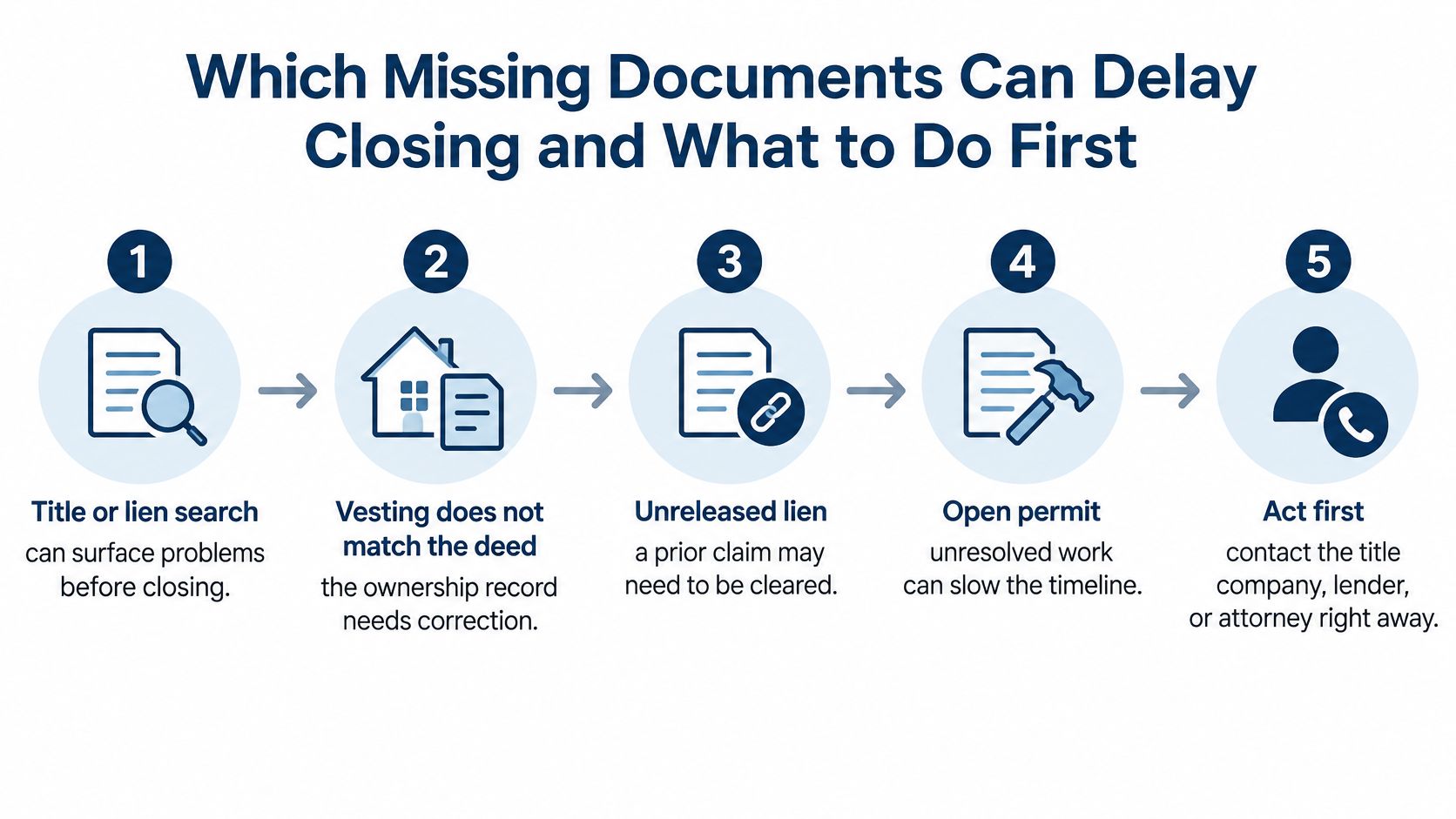
Which Missing Documents Can Delay Closing and What to Do First
A title or lien search finds what the seller's folder can't. Four records do most of that work: the recorded deed confirms vesting and the legal description, the lender name and loan number produce the payoff, the association contact orders the estoppel, and the permit file answers open municipal items. A defect in any of them, whether an unreleased lien, an expired permit or missing marital or trust authority, needs corrective documents before the deed records.
- Pull the deed, title policy and survey into one folder before the listing goes live.
- Request association documents and the estoppel certificate in the same week.
- Finish the disclosures before listing, including the flood disclosure and, for a pre-1978 home, the lead paint package.
- Send the loan number and payoff authorization to the closing agent at contract, so the statement is current when the file reaches the settlement table.
- Review the settlement statement and put corrections in writing rather than accepting a post-closing adjustment.
The order matters because the stalls land in different places. Missing disclosures and association paperwork slow the contract stage, while a stale payoff or an unreleased lien holds up the closing date itself.
Work that was finished without a permit deserves its own review before a buyer's inspector writes it up, and the permit advice from Dream Destin Realty covers how that conversation usually runs. Sellers who want the whole sequence laid out can review the selling process step by step, then set a starting number with a home valuation. When the deed and policy are in hand, reach the team through the contact page.
Florida Seller Document Questions Answered
A sale to a relative raises its own paperwork questions, and family sale tips from Dream Destin Realty covers those separately. Each answer below is the short version; the matching section above carries the detail.
Do I have to disclose known problems when I sell a house in Florida?
Yes. Florida law requires a seller to disclose known defects that materially affect the property's value and are not readily observable, and residential sales carry a separate flood disclosure. The disclosures section spells out what each form asks, and a Florida real estate attorney can confirm how the duty applies to your property.
What association paperwork does a condo seller need?
The unit owner owes the buyer a statutory package of association records, and the association issues an estoppel certificate on request.
When is a lead-based paint disclosure required?
For housing built before 1978, federal rules require the seller to disclose known lead-based paint and hazards, turn over available records and the EPA pamphlet, and place a warning statement in the contract. The buyer also gets a window to test unless it is waived; the disclosures section covers each element.
What tax forms come up when I sell?
The person responsible for closing generally reports the sale to the IRS on Form 1099-S. When the seller is a foreign person, federal withholding rules shift a withholding duty to the buyer, so confirming residency status early keeps that question off the closing table. A tax professional can say which reporting applies to your file.
Dream Destin Realty works with sellers across the Emerald Coast, from Destin to Santa Rosa Beach. Its seller guides walk through the document sequence, and the free home valuation service sets a defensible starting number before the first record gets pulled. Visit Dream Destin Realty to start the conversation about your own file.


