
How to Read Condo Financial Statements Before You Buy
Learn how to read condo financial statements, reserves and budgets under Florida law. Know which documents to request before closing.

On this page
On this page
Start with two documents a Florida condo buyer under contract is entitled to: the association's most recent annual financial statement and its annual budget. Compare what the association planned to collect and spend with what it did, then check the reserve balances against the repairs the building expects. Florida Statutes chapter 718 sets what each must contain.
A big reserve number on its own tells you almost nothing. It matters only when you set it against the repairs the building already expects, at the dates the association's own study lists. Reading a Florida association's paperwork in this order is how to read condo financial statements without an accounting background, one page at a time, with the statute that governs each check named beside it.
Table of Contents
- Which Documents You Can Request Before Closing
- Check the Report Type and How Current It Is
- Reading the Budget Against Actual Results
- Checking Whether the Reserves Can Cover Repairs
- Checking What One Unit Owes and Records to Request
- Read the Documents in This Order Before You Commit
- Frequently Asked Questions About Condo Financial Statements
Which Documents You Can Request Before Closing
Under s. 718.503(2)(a), Florida Statutes, a prospective purchaser under contract is entitled, at the seller's expense, to a current copy of the annual financial statement and the annual budget. The same paragraph adds the most recent structural integrity reserve study, or a statement that none has been completed.
The estoppel certificate is a separate request, and it reports what the individual unit owes.
Chapter 718 is statewide. A condo in Destin in Okaloosa County and a condo in Miramar Beach or Santa Rosa Beach in Walton County are read under identical rules. Nothing changes at the county line. What changes is the building, its components, its study, and its insurance line.
That insurance line is where the document check turns practical: the budget and the reserve study only make sense once you know which parts of the property fall to the association. Dream Destin Realty's condo responsibility breakdown covers what the association must maintain versus what belongs to your unit.
Check the Report Type and How Current It Is
Open the report and find total annual revenues before you read anything else. Under s. 718.111(13)(a) and (b)1. of chapter 718 of the Florida Statutes, that figure assigns the type of report the association was required to prepare, as read on November 13, 2026.
Required report type by total annual revenues
| Total annual revenues | Report type | Statute | What to check |
|---|---|---|---|
| Less than $150,000 | Report of cash receipts and expenditures | s. 718.111(13)(b)1. | Confirm receipts and expenses are identified by account or classification |
| $150,000 to less than $300,000 | Compiled financial statements | s. 718.111(13)(a)1. | Confirm the total revenue figure used to assign this tier |
| $300,000 to less than $500,000 | Reviewed financial statements | s. 718.111(13)(a)2. | Ask the association whether a lower report was approved for this fiscal year |
| $500,000 or more | Audited financial statements | s. 718.111(13)(a)3. | Confirm the report is the one delivered to owners for the fiscal year covered |
Owners may vote, by a majority of all voting interests, to prepare a lower level of report for a fiscal year. That vote is effective only for the fiscal year in which the vote is taken and not for consecutive fiscal years (s. 718.111(13)(d)), so the type printed on the cover is worth a second look. Note what you received and ask the association which type it prepared. A CPA is the right person to assess how much weight it carries.
Timing carries its own deadlines. The association prepares the report for the preceding fiscal year within 90 days after the fiscal year ends, or on the date its bylaws set, and must deliver it or a notice of its availability no later than 180 days after that date (s. 718.111(13)). Three date questions settle most of it:
- Find the fiscal year end. It's in the bylaws or on the face of the report.
- Confirm which year the report covers. A report for the year that just closed reads differently than one that's two years old.
- Check whether the latest report should already exist.
Write down the report type, the fiscal year covered, and the delivery date before you read a single number. A reserve balance means little until it is compared with the repairs the building expects, and condo repair insights from Dream Destin Realty covers the inspection side of that timing.
Reading the Budget Against Actual Results
The annual budget is a forecast. The board adopts it at least 14 days before the fiscal year starts under chapter 718 of the Florida Statutes, so every figure in it was an estimate made before the period it covers began. The report shows activity that has already happened. Read them side by side.
The budget must be detailed and show amounts by account and expense classification (s. 718.112(2)(f)1.). A report of cash receipts and expenditures must identify receipts and expenses by account or classification too, covering applicable categories such as insurance, building maintenance and repair, utilities, professional and management fees, lawn care, security, taxes, refuse collection, recreation facilities, administration, salaries, and reserve amounts accumulated or spent (s. 718.111(13)(b)). That shared structure is the whole reason comparison works.
Practical rule: compare line to line, never total to total. An association can finish with a small surplus while one line runs far ahead of plan.
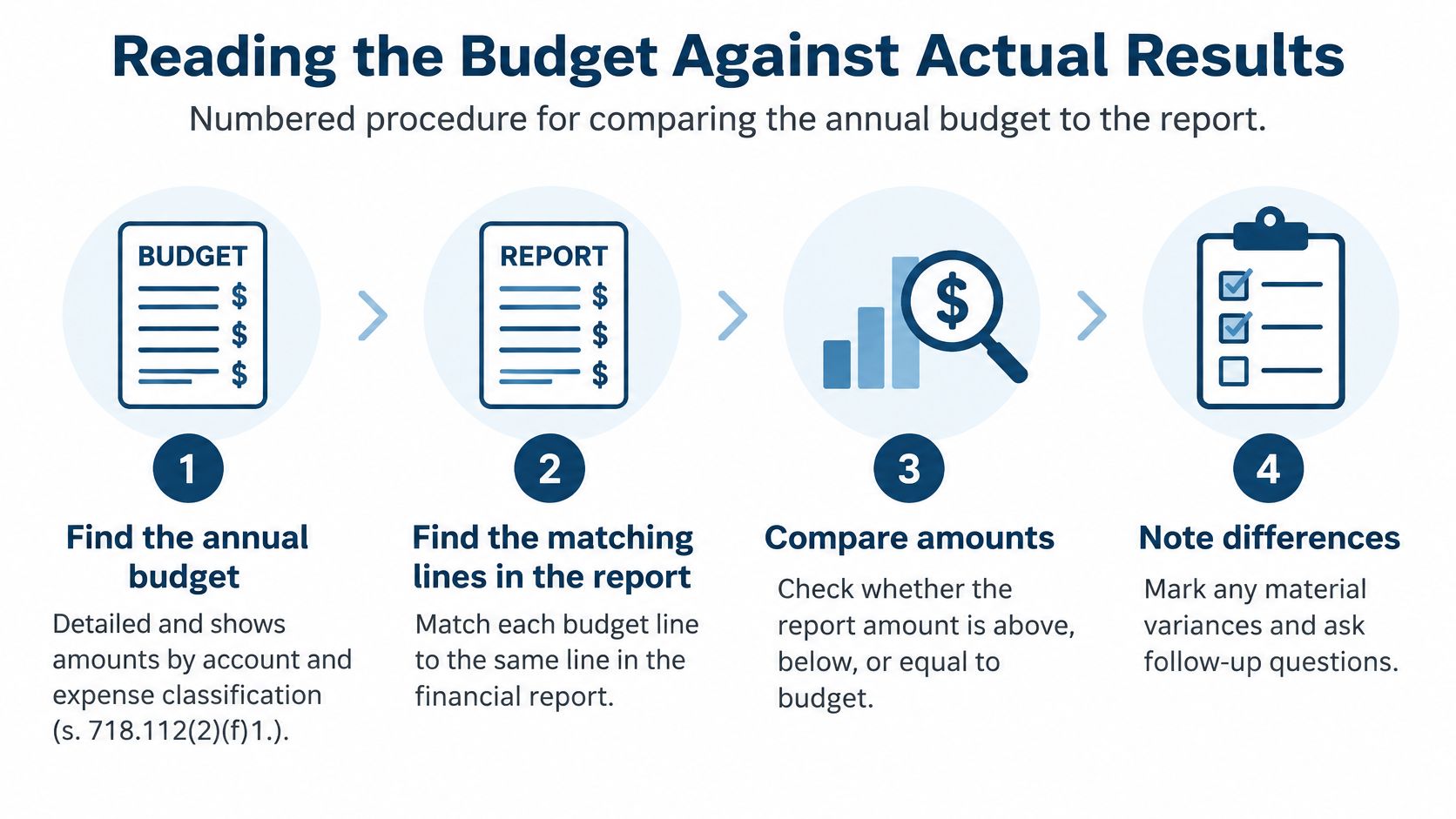
Work through five steps.
- Find the budget adopted for the same fiscal year the report covers.
- Find the matching line in the report for each budget line.
- Compare the amounts. Mark above, below, or on budget.
- Flag the material variances, where costs run above budget or assessments come in under plan.
- Ask why each flagged line moved and whether the cause carries into the next budget.
A line running well over budget can point to a cost that repeats.
A combined figure can hide a split. Where the association covers more than one building, read the notes explaining how shared expenses and reserves are assigned, and reconcile the cash total against the bank statements before you rely on it. For comparing dues across buildings once this is done, see HOA comparison tips from Dream Destin Realty.
Checking Whether the Reserves Can Cover Repairs
The budget must include reserve accounts for capital expenditures and deferred maintenance, including roof replacement, building painting, pavement resurfacing, and any other item whose deferred maintenance expense or replacement cost exceeds $25,000 or the inflation-adjusted amount set by the state, whichever is greater, computed from estimated remaining useful life and estimated replacement cost (s. 718.112(2)(f)2.a., as read on November 13, 2026). The statute is the chapter 718 reserve requirement.
| Where to look | What it holds |
|---|---|
| Budget reserve schedule | Each reserve item, the yearly contribution assigned to it, and any line funded below the required amount |
| Reserve study | Estimated remaining useful life and estimated replacement cost for each component |
| Board minutes and vote record | Whether members voted to fund less than the required amount, and for which components |
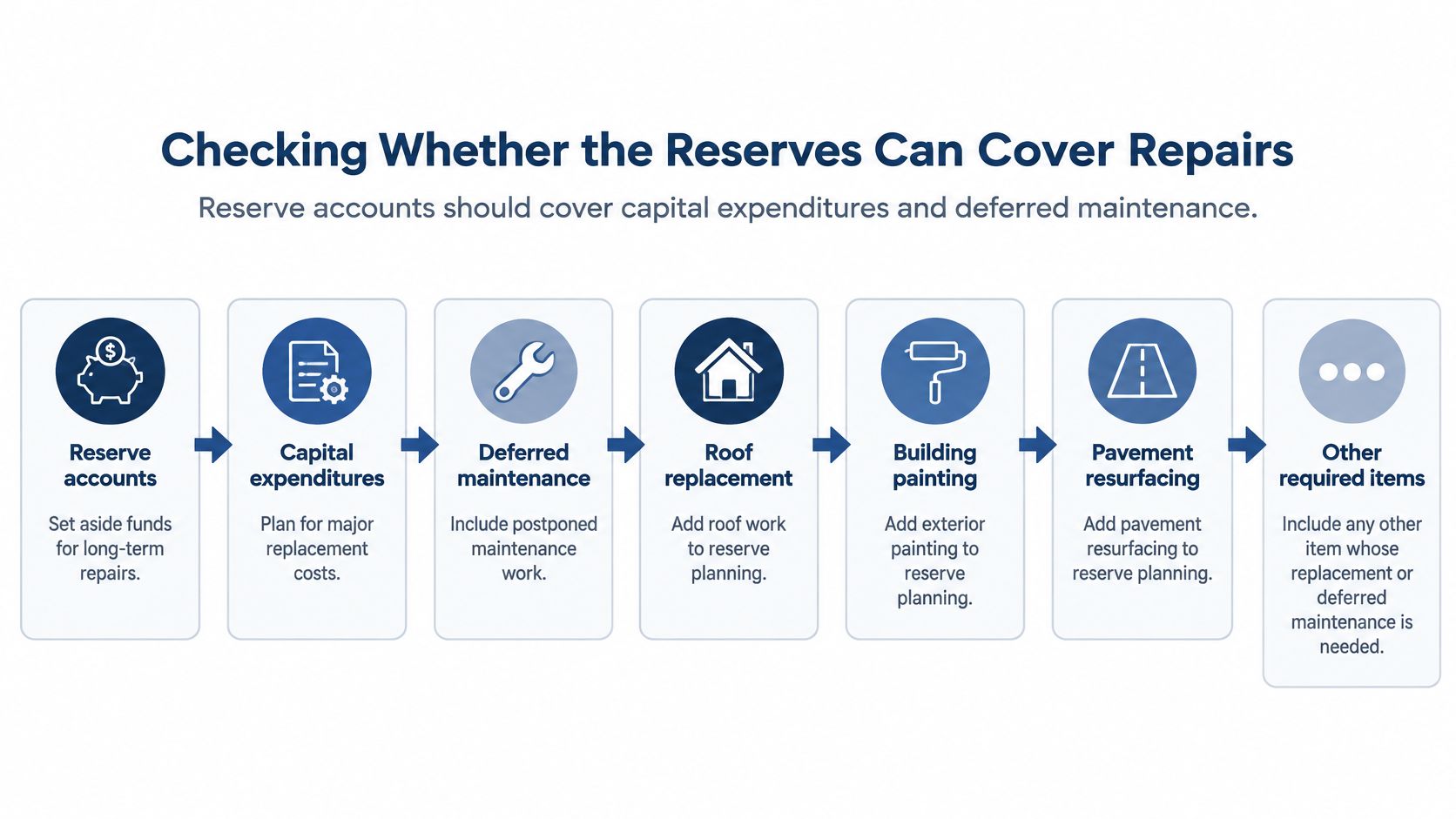
Members of a unit-owner-controlled association may vote, by a majority of the total voting interests, to provide no reserves or less than the required reserves. For a budget adopted on or after December 31, 2024, an association that must obtain a structural integrity reserve study may not do so for the components that study covers. The statute includes a narrow exception for multicondominium associations, which this guide does not cover (s. 718.112(2)(f)2.b.). Reserve funds and their interest stay in the reserve accounts and may be used only for authorized reserve expenditures unless a majority of all voting interests approves another use in advance; for a budget adopted on or after that same date, members of a unit-owner-controlled association that must obtain a structural integrity reserve study may not vote to use reserve funds for anything other than the replacement or deferred maintenance of the components the study covers (s. 718.112(2)(f)3.).
An illustration, with round numbers and no real building. Suppose the budget shows a roof reserve balance of $90,000 and the study puts roof replacement at $150,000 in four years. That's a $60,000 gap, and the question for the board is how the yearly contributions close it before the replacement date.
Run four checks in order. Find the roof, painting, and pavement lines in both documents. Compare each balance with the replacement timing in the study. Confirm the yearly funding closes the gap before the date. Then look for any waiver or reduced funding in the budget notes or vote record and write down what it covers.
For how a study is prepared and what it must address, see Dream Destin Realty's reserve study breakdown. Close with one question: how will the board fund the gap before the replacement date?
Checking What One Unit Owes and Records to Request
Every document so far describes the building as a whole. The estoppel certificate narrows the lens to one unit: under s. 718.116(8), the estoppel certificate provision lists the unit's regular assessment plus an itemized list of assessments, special assessments, and other moneys owed, and the association must issue it within 10 business days after a written or electronic request from the owner, the lender, or their designee.
Ask your closing agent to make the request. When the certificate arrives, compare the unit's figures against the association-level totals from the budget and report. The estoppel covers amounts owed on this unit, not the building's condition or insurance coverage.
Accounting records, bank statements, ledgers, audits, and reviews count as official records open to inspection by an association member or the member's authorized representative under s. 718.111(12), the official records provision.
Match the estoppel's figures to the totals you already have, and flag any line that doesn't reconcile.
Read the Documents in This Order Before You Commit
The packet works like a funnel: wide association-level numbers first, the unit's own balance last. No single figure means much on its own. A reserve total only becomes an answer when it is compared with the repairs the building expects, so the order of reading is what gives each number context.
- Send every request on the first day of the review window. Documents arrive at different speeds, and the deadline does not wait for the slowest one.
- Check the report type and the fiscal year covered, and note the delivery date.
- Compare budget to actual, line by line, and keep the marked variances.
- Test each reserve item against the repairs the building expects, writing down any gap and the date it lands.
- Confirm the unit's estoppel balance and ask the seller for the underlying records.
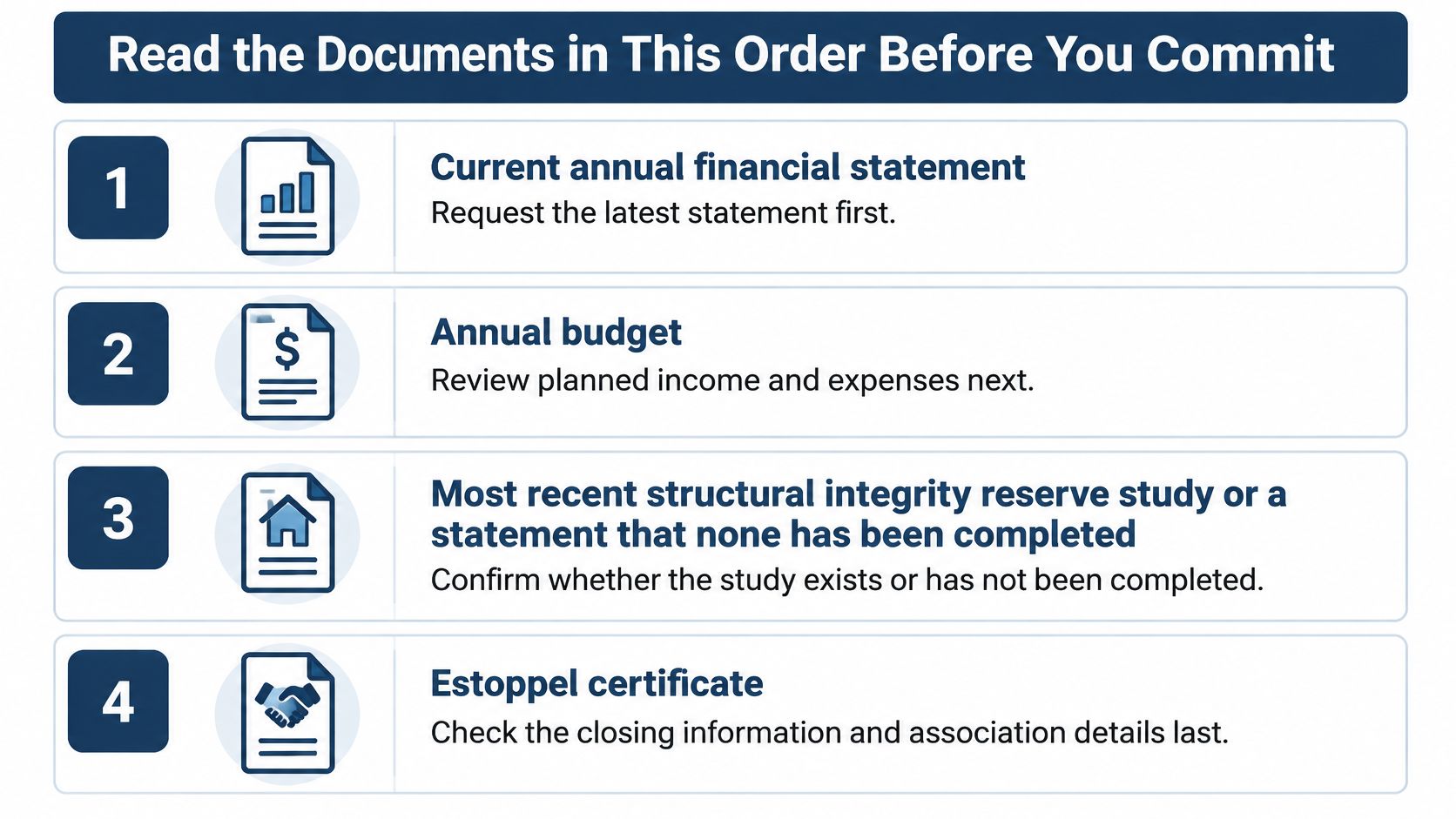
What these documents cannot show: they do not predict future fees or special assessments, they do not grade the association, and they do not prove the building's condition, insurance coverage, financing terms, or rental permission.
Put one date on the calendar now, the day the reserve test in step four must be finished, and work backward from there.
Frequently Asked Questions About Condo Financial Statements
Can a Florida condo association prepare a simpler financial report than its revenue level requires?
Yes. Under s. 718.111(13), Florida Statutes, as read on November 13, 2026, a majority of all voting interests can approve a lower level of report for one fiscal year, though not for consecutive years. If the packet in hand looks thinner than you would expect, ask the association which type it prepared and whether a membership vote reduced it.
Who pays for the association documents a buyer is entitled to?
The seller does. Under s. 718.503(2)(a), Florida Statutes, a prospective purchaser under contract receives a current copy of the annual financial statement and annual budget at the seller's expense, along with the most recent structural integrity reserve study or a statement that none has been completed. Confirm delivery and any cancellation deadline with your attorney or closing agent.
Which repairs must have their own reserve line in the budget?
Under s. 718.112(2)(f), Florida Statutes, as read on November 13, 2026, the statute names three by default: roof replacement, building painting, and pavement resurfacing. Any other item joins the list once its cost exceeds $25,000 or the state's inflation-adjusted amount, whichever is greater. A reserve balance only means something next to the work it is meant to fund, so ask the association or a CPA how each figure was calculated.
Who can request the estoppel certificate, and how fast must it arrive?
Under s. 718.116(8), Florida Statutes, the unit owner, the lender, or their designee sends a written or electronic request, and the association must issue the certificate within 10 business days. It lists the unit's regular assessment plus an itemized list of assessments, special assessments, and other moneys owed, so confirm your closing agent placed the request early enough to leave reading time.


