
Earnest Money vs Down Payment: How Buyers Track the Deposit
Earnest Money vs Down Payment: How Buyers Track the Deposit explains why the deposit is credited at closing, not added on top, and how to verify it.

On this page
On this page
Earnest money is the deposit paid under the signed purchase contract and held until closing. The down payment is the part of the price not covered by the loan. At closing, the deposit is credited against the cash still owed, so buyers should not add it twice.
The confusion starts when a buyer expects that money to come back as a separate refund. That single deposit is tracked on three records instead: the signed contract, the escrow holder's receipt, and the Closing Disclosure. Each record is a check against the others, and comparing them early leaves time to correct a mismatch before closing.
Table of Contents
- Is Earnest Money an Extra Cost on Top of the Down Payment?
- How Earnest Money and the Down Payment Differ
- How to Track the Deposit From Contract to Closing
- Who Holds the Deposit and How to Send It Safely
- What Happens to the Deposit If the Sale Changes
- What to Do When the Deposit Figures Do Not Match
- Common Questions About the Deposit at Closing
Is Earnest Money an Extra Cost on Top of the Down Payment?
No. The deposit is money you already paid toward the purchase, and the federal forms subtract it from the cash still due.
The subtraction happens in one place on the Loan Estimate, a table called Calculating Cash to Close. The Consumer Financial Protection Bureau's Loan Estimate explainer says Estimated Cash to Close includes the down payment and closing costs, minus any deposit already paid to the seller, any seller credits and other adjustments.
Estimated Cash to Close is the estimated total you would bring to the closing table. On the Closing Disclosure, the same credit appears on the line labeled Deposit, which is the label to check.
The rest of cash to close is separate money. Lender fees, prepaid interest and title charges all land in the same figure. Seeing the down payment beside them is what tempts buyers to add the deposit a second time. Keep the deposit on its own line in your notes and confirm it shows up as a reduction in the amount due.
How Earnest Money and the Down Payment Differ
Earnest money, in the words of the official interpretation of 12 CFR 1026.37(h)(1)(iv), comment 1, is the amount the buyer has agreed to pay to a party identified in the purchase and sale agreement, to be held until the transaction closes. Regulation Z's Loan Estimate rules define it because the deposit gets its own line on the federal forms.
The down payment is defined on those same forms as the difference between the sale price and the sum of the loan amount and any existing loans the buyer assumes, per comment 1 to 12 CFR 1026.37(h)(1)(iii). How large it needs to be depends on the loan chosen and the lender's requirements, as the CFPB explanation of a down payment sets out on a page last reviewed September 11, 2024.
Two different purposes, two different places on the paperwork.
| Feature | Earnest money | Down payment |
|---|---|---|
| What it is | Deposit paid under the purchase contract and held until closing | Part of the price not covered by the loan |
| What sets the amount | The purchase contract and the parties' agreement | Sale price minus the loan amount and any assumed loans; the CFPB says the amount varies by loan and lender requirements |
| Who holds it | The party named in the purchase agreement, such as an escrow holder | The buyer's own funds, paid at closing |
| Where it appears on the Closing Disclosure | Line labeled Deposit under Paid Already by or on Behalf of Borrower at Closing | Inside the cash-to-close figures, as the gap between sale price and loan amount |
| If the sale does not close | Depends on the signed contract and why the sale ended | Not a contract deposit; the signed contract and any amounts already paid decide the result |
How to Track the Deposit From Contract to Closing
The deposit enters the file early and stays on the record until settlement, and the Emerald Coast buyer's closing roadmap shows where that checkpoint falls among inspection, appraisal and loan approval. The five checks below keep one number consistent from first signature to last page.
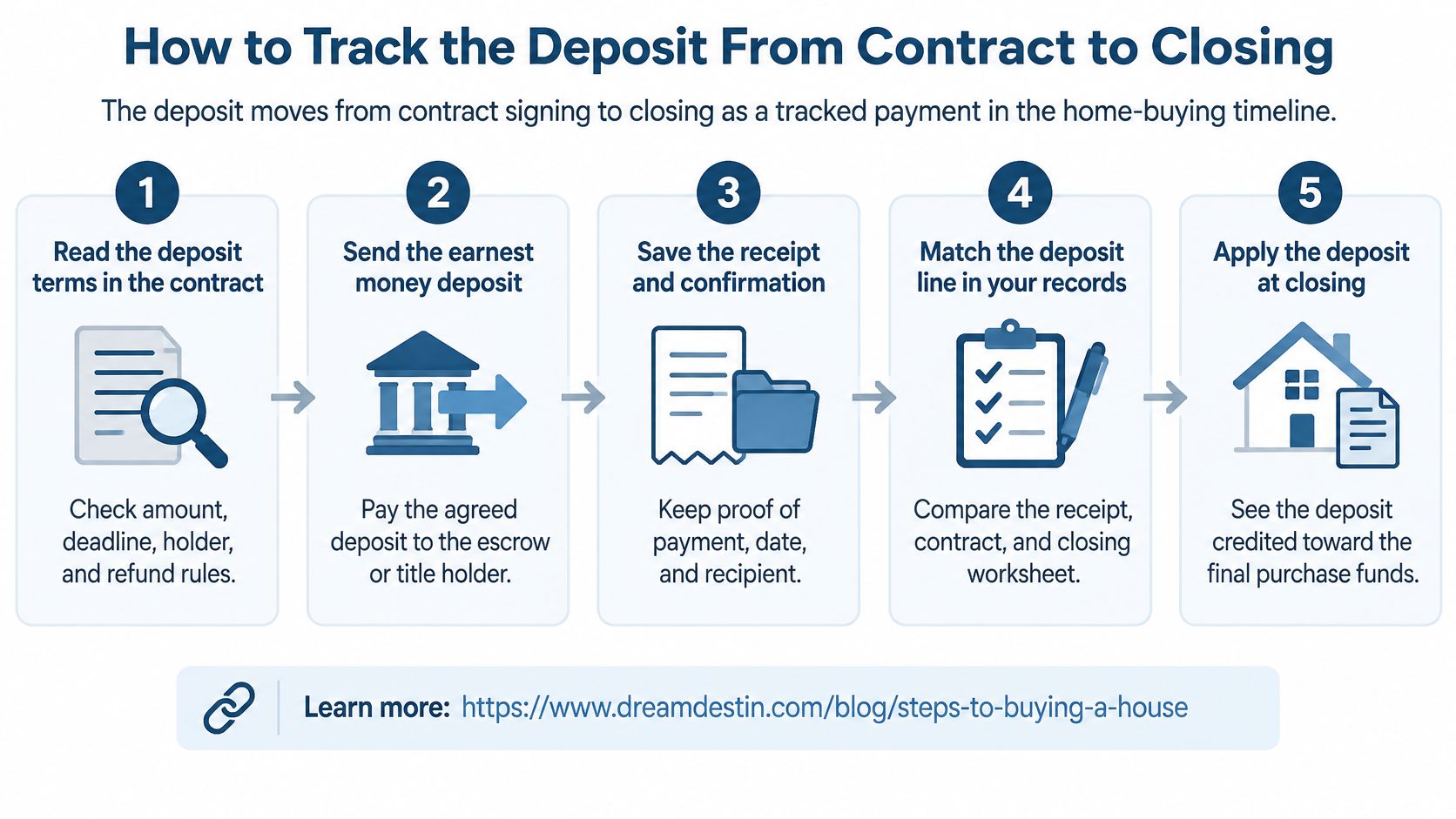
- Read the deposit terms in your signed contract. The amount, the date it's due, the party who holds it, and the conditions for its return are written there, and those terms control. Every later check is measured against that clause.
- Keep the escrow holder's written confirmation. A dated receipt or written notice that funds arrived is the proof you'll want weeks later, when memory has faded.
- Find the Deposit line on the Loan Estimate. It sits in the Calculating Cash to Close table that Regulation Z requires at 12 CFR 1026.37(h)(1)(iv). That's the first place the deposit is subtracted from the money you'd bring.
- Check both spots on the Closing Disclosure. The deposit appears under Paid Already by or on Behalf of Borrower at Closing (12 CFR 1026.38(j)(2)(ii)) and again in Calculating Cash to Close, which reports whether the figure changed from the Loan Estimate (12 CFR 1026.38(i)(5)). The Closing Disclosure requirements describe both.
- Treat Cash to Close as the amount to pay. It's what's due at closing, so the deposit line should pull it down. If the line and your receipt disagree, ask the closing agent to explain before closing day.
Who Holds the Deposit and How to Send It Safely
Florida's broker escrow rule applies statewide, whether the home is in Destin or Santa Rosa Beach. Under s. 475.25(1)(k), Florida Statutes (2025), a broker must immediately place a deposit entrusted to the broker in escrow with a title company, banking institution, credit union or savings and loan association in Florida, or in the broker's own escrow account, where the funds are kept until disbursement is properly authorized, as Chapter 475 provides. The signed contract names the escrow holder, so locate that name and match it to the receipt.
A deposit isn't always held by a licensee. The contract may place it with the seller or another third party such as a title company.
Check before you send: the party named as holder in the contract and the party on the receipt should be the same.
On sending it, the CFPB advises confirming payment instructions with trusted representatives in person or at a phone number agreed in advance, and never following instructions contained in an email, as its mortgage closing scam guidance states.
What Happens to the Deposit If the Sale Changes
A completed sale is the simplest ending. The deposit becomes a credit on the Closing Disclosure, and the Deposit line should match your receipt in amount. Every other ending depends on the contract rather than on a general rule.
The inspection contingency is the clearest example. The CFPB says a buyer whose purchase contract is contingent on a satisfactory inspection has the right to cancel without penalty when not satisfied with the inspection results, per its guidance on scheduling a home inspection. That protection lives in the contingency itself, so the wording in your contract and the notice it requires decide whether the deposit comes back. Read the clause for its deadline and for how cancellation must be delivered.
No universal refund rule covers every canceled purchase. The signed contract controls the deposit amount, the deadlines and the refund terms, and the closing agent, your lender or a Florida real estate attorney can confirm how they apply to a given deal.
What to Do When the Deposit Figures Do Not Match
Ask the closing agent for a written explanation of any deposit difference before closing day.
If Calculating Cash to Close shows the deposit changed from the Loan Estimate, ask which figure is final and why, using the changed-figure indicator that 12 CFR 1026.38(i)(5) requires. Keep the written explanation beside the receipt and the Closing Disclosure page, so the three records of one deposit stay in one file.
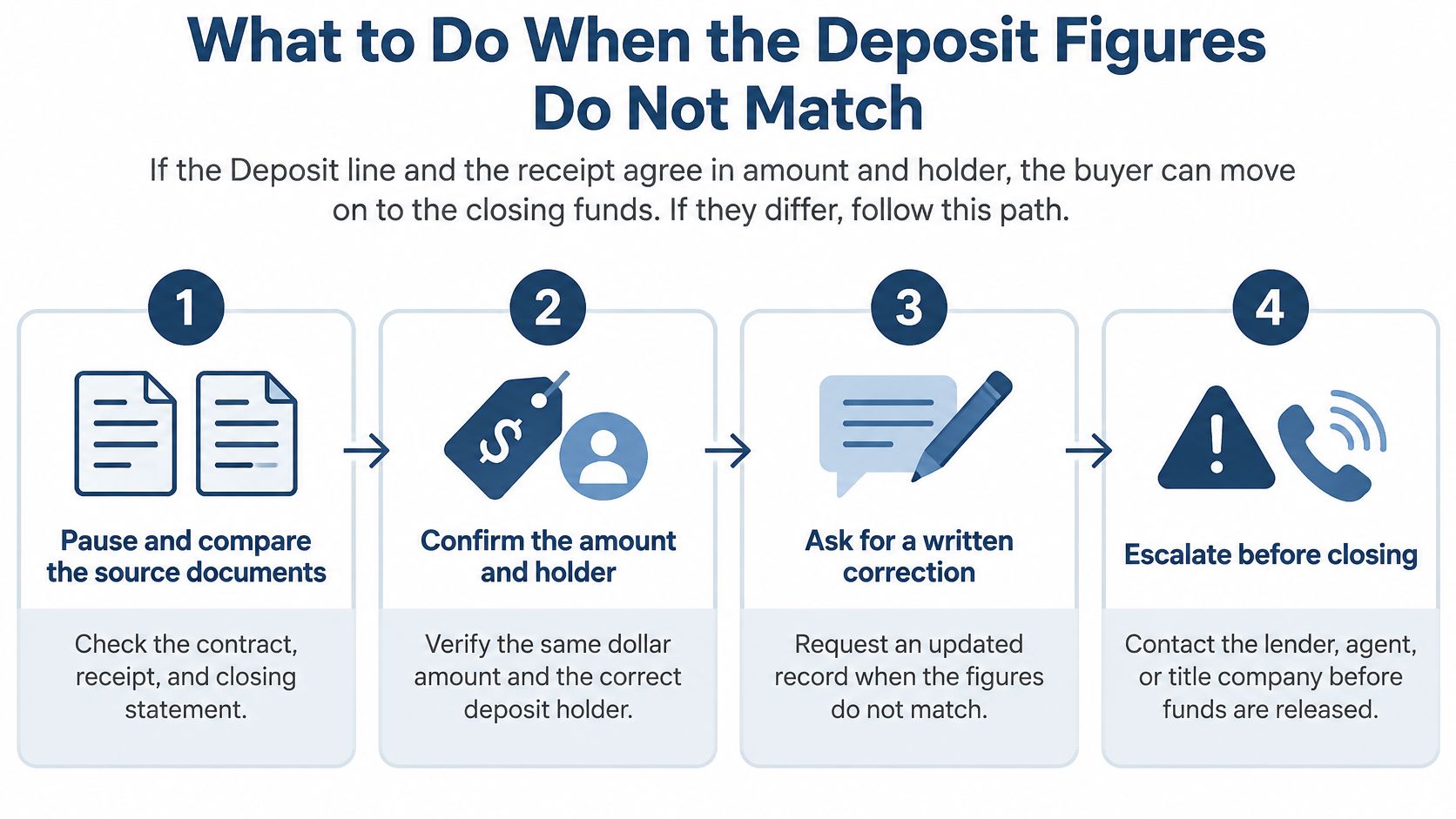
Reading the two federal forms side by side gets easier with the Emerald Coast buyer's closing document guide, which walks through the comparison line by line. Other cash items, from the moving truck to the first insurance payment, belong in a separate plan so they do not get tangled with the deposit question.
Common Questions About the Deposit at Closing
Is earnest money an additional charge on top of the down payment?
No. The deposit counts toward what the buyer already owes, per the CFPB Loan Estimate explainer, so its size changes the timing of the payment rather than the price of the home. A larger earnest money deposit means less cash due on closing day, and a smaller one means more. The subtraction itself is shown step by step under How to Track the Deposit From Contract to Closing.
Where should a deposit credit appear at closing?
On the Closing Disclosure, grouped with the other amounts paid already by or on behalf of the borrower. Federal Regulation Z, 12 CFR 1026.38(j)(2)(ii), treats money held in trust or escrow under the sale agreement the same as money handed directly to the seller, so a deposit sitting in a brokerage or escrow holder's trust account still belongs on the statement even though the seller never touched it.
Does every canceled purchase return the deposit?
No. The Consumer Financial Protection Bureau says a buyer who walks away at closing might lose any deposit given to the seller and could face other consequences from breaking the purchase contract, as the CFPB guide to closing explains. A Florida real estate attorney can confirm what the contingencies and deadlines in the signed contract allow before a buyer assumes the money comes back.
What happens when the buyer and seller both claim a deposit held by a Florida real estate broker?
Under s. 475.25(1)(d)1., Florida Statutes (2025), a licensee facing conflicting demands must promptly notify the Florida Real Estate Commission and promptly request an escrow disbursement order, submit the matter to arbitration with the consent of all parties, seek adjudication of the matter by a court, or submit the matter to mediation with the written consent of all parties.
Dream Destin Realty works with buyers across Destin, Miramar Beach, Santa Rosa Beach and the rest of the Emerald Coast, and its resources cover the due-diligence side of a purchase: available building records, association information, inspections, reserves, rental rules and insurance. Send a deposit question through the brokerage contact page.


