
How to Compare Mortgage Loan Estimates for a Second Home
How to Compare Mortgage Loan Estimates for a Second Home: match loan assumptions, weigh points and credits, and separate lender fees from other charges.

On this page
On this page
Two Loan Estimates measure the same loan only when every lender priced the same loan amount, purchase price, down payment, product, term, stated second-home use and rate-lock status. Match those items first, then read price. A lower rate built on different assumptions belongs to a different loan entirely, and it can end up costing more than the higher rate sitting beside it.
Table of Contents
- Match the Loan Assumptions Before You Compare
- Weigh Points and Lender Credits Against Cash to Close
- Adjust for Estimates Issued on Different Dates
- Separate Lender Charges From Third-Party and Prepaid Costs
- Budget Recurring Ownership Costs and Reserves
- Comparing Offers for an Emerald Coast Second Home
- Choose the Offer That Holds Up on Equal Terms
- Common Questions About Comparing Loan Estimates
Match the Loan Assumptions Before You Compare
A Loan Estimate is a standardized, three-page disclosure. The Consumer Financial Protection Bureau states that a lender must provide one within 3 business days of receiving six pieces of application information. That rule is why the form beats a phone quote, and why you should collect estimates from at least three lenders rather than comparing informal rate conversations.
None of those estimates is a loan approval. Each describes the terms a lender expects to offer if you proceed, so the form is a snapshot of assumptions rather than a promise.
A genuine vacation or occasional-use residence is evaluated differently from a primary home and from an investment property. State the same use to every lender, and ask each one to confirm in writing how it classifies the property. Don't settle the classification yourself before those answers arrive.
Timing matters as well. A lender may revise an estimate if you delay stating your intention to proceed, so record the date and assumptions printed on every form.
Practical rule: When two estimates disagree, check the assumptions before you check the rate. If one quote assumes a 30-year fixed product, the other an adjustable rate, or the occupancy was stated differently, those inputs explain the gap before price does.
Assumptions to match on every Loan Estimate
| Assumption | Why it matters | What to record |
|---|---|---|
| Loan amount and purchase price | Changes the financed amount, payment and cash needed | Exact figures from each request |
| Down payment | Changes the amount financed and cash to close | Dollar amount and percentage of price |
| Loan product and term | Fixed or adjustable rate and term length change the payment pattern | Product name and term in years |
| Second-home use | Occupancy classification affects how the loan is evaluated | Occupancy basis given to each lender |
| Points and lender credits | Move cost between upfront charges and the interest rate | Points paid or credit received, in dollars |
| Rate-lock status | A floating rate can change before closing | Locked or floating, and lock period if any |
| Estimate issue date | Market rates can change between dates | Date printed on each form |
Requesting three estimates works better once a lender has reviewed your file. Learn how to verify your Emerald Coast preapproval first, so all three lenders receive one version of your finances instead of three.
Weigh Points and Lender Credits Against Cash to Close
The CFPB Loan Estimate guide treats estimated cash to close and the recurring housing payment as separate liquidity tests. Copy that separation and the rest of the comparison gets simpler.
Points are an upfront charge that buys a lower interest rate. A lender credit goes the other way: it reduces closing costs and usually comes with a higher rate. Both shift cost between the day you close and the years that follow, so the main question is when you would prefer to pay.
| Option | Upfront effect | Loan effect | Question to ask |
|---|---|---|---|
| Pay points for a lower rate | More cash due at closing | Lower interest rate on the same loan | How many points, and what rate does each point buy? |
| Take a lender credit | Less cash due at closing | Often comes with a higher interest rate | What rate applies when the credit is used? |
| No points and no credit | Baseline closing cost | Quoted note rate | Is this the same product and term as the other offers? |
Cash to close is its own test
Estimated cash to close combines the down payment, closing costs, prepaid items, deposits, seller credits and other adjustments into one figure. A smaller total can hide a lender credit that raised your rate, so reconcile it line by line between offers instead of comparing the totals alone.
The break-even method
Take the extra cash one offer requires and divide it by the monthly payment difference printed on the two forms. The result is the number of months before the lower payment repays that upfront cost.
Hold the loan past that point and the lower rate wins. Leave earlier and the extra cash never comes back.
If you expect to sell or refinance before the break-even month, the offer with the lower rate costs you more.
A slightly lower rate is the weaker offer when it drains the cash you need after closing.
Adjust for Estimates Issued on Different Dates
A Loan Estimate dated earlier can look cheaper because rates moved after it was printed. The CFPB comparison guide notes that estimates issued on different days may reflect market movement rather than one lender underpricing another, so put the timing on equal terms before judging price.
- Start from the matched-assumptions table and add only two fields: issue date and lock status. Price, down payment, term, occupancy and property type should already match.
- Refresh the older offer to the same day. Ask each lender to rerun the identical assumptions as of the same cutoff time.
- Treat every floating rate as movable. If one offer is locked and the other is floating, request the same lock period or reprice both on the same day.
- Use the page 3 five-year test. Subtract principal paid by month 60 from total paid by month 60. Compare that result alongside the note rate.
- Keep APR in its lane. APR spreads loan charges across the full term, so it helps after dates and locks match, while the five-year figure fits plans that may change sooner.
Matching dates first keeps a market move from masquerading as a better lender.
Separate Lender Charges From Third-Party and Prepaid Costs
Only one block on the form shows what a lender charges to make the loan. Everything around it follows the property, the taxes and the services the loan requires. Fold them into a single total and lender pricing disappears.
The CFPB mortgage estimate page describes the form as reporting the estimated interest rate, monthly payment, total closing costs, taxes, insurance and any future payment changes.
| Charge group | What it covers | How to compare |
|---|---|---|
| Lender origination charges | Fees the lender charges for making the loan | Compare line by line across lenders |
| Taxes and government fees | Estimated taxes and fees shown on the form | Check that each offer lists them the same way |
| Insurance and prepaid items | Estimated insurance and prepaid amounts due at closing | Compare as property-related costs, not lender pricing |
| Initial escrow funding | Money held for taxes and insurance | Compare the amount and the basis each lender uses |
A lower tax or insurance estimate doesn't make an offer cheaper. Those figures track the property and the escrow setup, not the lender's pricing, and they can be revised as the file develops.
Check the special features even when the headline rate looks attractive. A prepayment penalty or negative amortization appears on the form and changes what the loan costs you later.
Ask each lender to label every line the same way before comparing totals.
Budget Recurring Ownership Costs and Reserves
The form covers some recurring costs and leaves others to you. Start with escrow, then work outward.

Ask each lender whether property taxes and homeowners insurance will be held in an escrow account and how the estimate treats them. Then separate coverage from the estimate. Homeowners insurance and any flood coverage the property requires depend on that specific home, so an estimate doesn't prove a policy exists or what it will cost. Confirm terms with an insurer before you lean on a monthly figure.
If the home sits in an association, ask how each lender counts dues in qualifying calculations, and keep dues on your own budget line rather than inside the estimate. Buyers weighing a condo should compare Emerald Coast condo HOA fees before that dues figure enters a qualifying calculation.
Fannie Mae's selling guide identifies a baseline requirement of 2 months of reserves for a second-home transaction under its automated underwriting framework, with additional reserves required when the borrower owns multiple financed properties. Reserves are measured against qualifying monthly obligations, which generally include principal, interest, taxes, insurance and applicable association dues. Rules vary with loan program, borrower profile, property type and lender overlays, so confirm the number with each lender.
Planning rule: Keep reserves and recurring ownership costs on a separate line from cash to close.
Comparing Offers for an Emerald Coast Second Home
A points offer against a credit offer. One lender quotes a lower rate with points, another a higher rate with a credit. The break-even division decides it, using the monthly payment difference the two forms print. If you plan to hold the home past that month, points can win. If the plan is a short hold, the credit usually does.
Estimates that arrived on different days. One form is older than the other and shows a different rate. Ask both lenders for current offers on matched assumptions before drawing any conclusion about which one prices better.
A buyer who hasn't chosen a property yet. The comparison waits until there's a price to finance. Buying steps come first. The Destin buying guide covers the local purchase sequence, Miramar Beach and Sandestin sets out the buying context for that stretch of coast, and Santa Rosa Beach walks through the steps for that area. Buyers leaning toward a condo can read buying an Emerald Coast vacation condo for the property-level questions that come before any application.
Those guides describe the buying process. They don't set lender requirements, occupancy rules or property conditions, and the comparison method works the same in each of these areas.
Choose the Offer That Holds Up on Equal Terms
One rule settles the choice. Take the offer with the lowest cost on matched assumptions that also fits your cash to close, leaves your reserves intact and discloses its special features in writing.
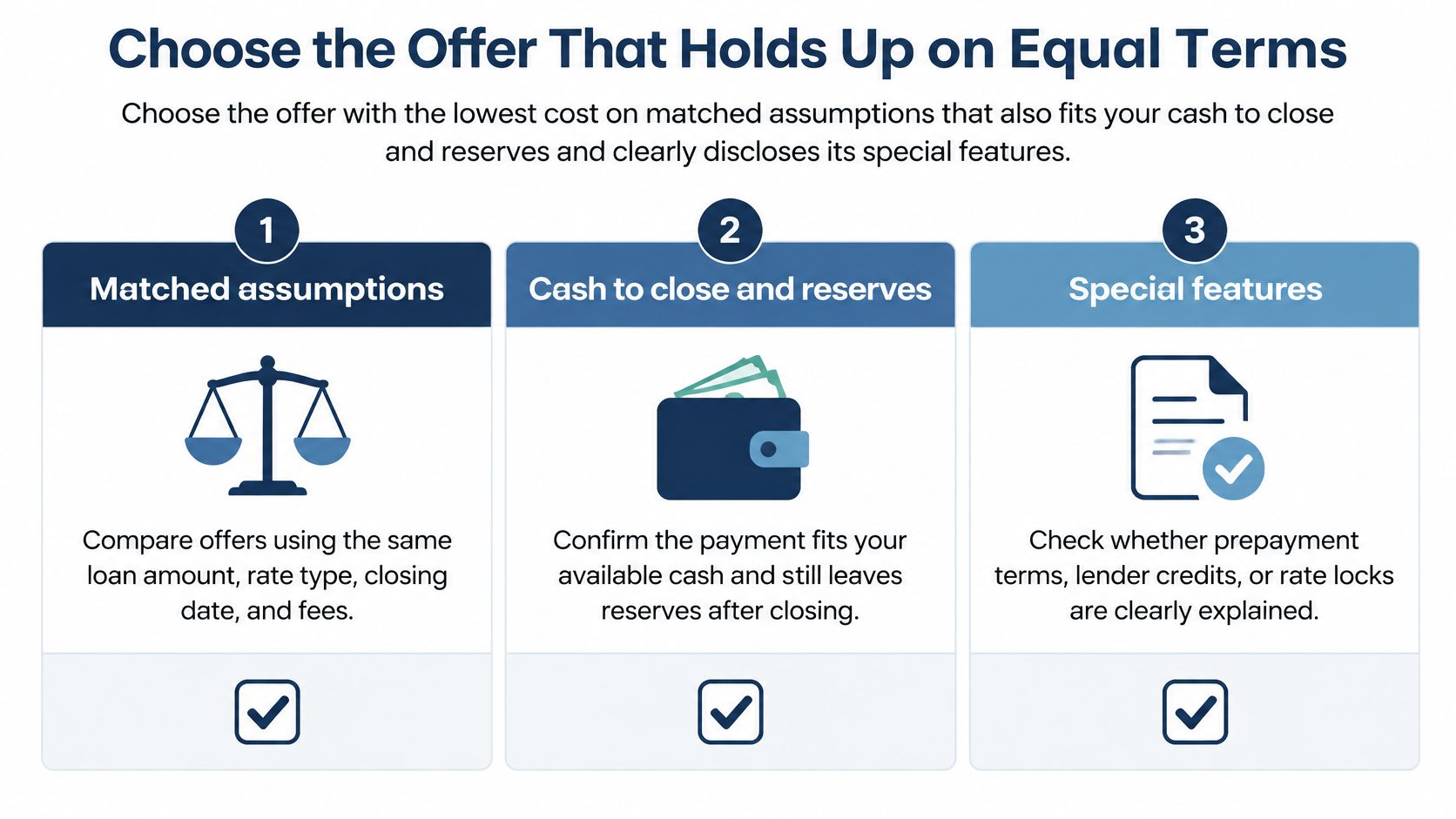
The grid below is the last step. By the time you reach it, every estimate already shares the same loan amount, product, term, occupancy basis and lock status. What remains is recording the numbers that decide the offer, side by side.
Blank comparison grid for each Loan Estimate
| Check | Lender offer 1 | Lender offer 2 | Lender offer 3 |
|---|---|---|---|
| Matched assumptions confirmed (amount, product, term, occupancy, lock status, issue date) | Write in | Write in | Write in |
| Points paid or credit received, in dollars | Write in | Write in | Write in |
| Five-year borrowing cost from page 3 | Write in | Write in | Write in |
| Estimated cash to close, reconciled line by line | Write in | Write in | Write in |
| Lender origination charges, itemized | Write in | Write in | Write in |
| Taxes, insurance, prepaids and escrow, listed separately | Write in | Write in | Write in |
| Prepayment penalty and negative amortization terms | Write in | Write in | Write in |
| Monthly payment and recurring costs to budget separately | Write in | Write in | Write in |
The winning column shows the lowest five-year cost that still fits the cash you bring to closing, keeps your reserves whole and carries no penalty or negative amortization you cannot accept. If a rate is floating, send that offer back for a lock before it earns a place in the grid.
For help organizing property due diligence on an Emerald Coast second home, use the brokerage contact page.
Common Questions About Comparing Loan Estimates
Which assumptions should match when comparing Loan Estimates?
Compare the same loan amount, product, term and purchase assumptions, including the intended second-home use given to each lender. Ask each lender to confirm the occupancy classification it priced, in writing. A quote priced as a primary residence or an investment property will not sit on equal terms with a second-home quote. Rate-lock status, points, credits and estimate dates all need to match before you judge which offer costs less.
How do lender credits differ from a lower interest rate?
Lender credits offset closing costs and usually come with a higher interest rate, while paying points lowers the rate at an upfront cost. To separate the lender's pricing from the structure, ask each one for the same loan quoted two ways on the same day: with no points or credits, and with the structure you prefer. Then compare both the initial cash requirement and the loan terms rather than treating a credit as free savings.
Why can estimates issued on different dates be hard to compare?
Market rates can change between estimate dates, so different dates can hide whether the gap comes from the lender or the market. Even the same lender's pricing can move from one day to the next, so an older estimate answers the wrong question. If one offer is several days old, ask that lender for a fresh quote on the day you receive the competing one, and verify each rate-lock status.
Which charges should I separate from the lender's own fees?
Separate lender origination charges from required third-party services, taxes, insurance, prepaids and initial escrow funding. Some third-party items are services you can shop for yourself, which is one reason two lenders can estimate the same cost differently. Judge each lender on the charges it controls first; the earlier section on third-party and prepaid costs explains why a lower tax or insurance line can be misleading.
For the costs that sit around the loan itself, Dream Destin Realty's buyer cost guide is a useful companion read before you sign anything.


