
Indian Oaks Destin Homes: A 2026 Buyer and Investor Guide
Indian Oaks Destin homes explained: subdivision history, housing types, price trends, HOA rules, insurance factors, and a buyer checklist for 2026.

Indian Oaks is a recorded Destin subdivision with Indian Oaks, Indian Oaks 1st Add, and Indian Oaks 2nd Add listed in the City of Destin's official plats index. A substantial portion of its homes, including 238 Indian Oaks Dr and 246 Indian Oaks Dr, was built in 1980, which makes the neighborhood's age, maintenance history, and property-specific documents central to any purchase decision.
That combination gives Indian Oaks a distinct position among Destin homes. It's an established residential community rather than a new coastal development, with compact single-family housing and a price profile that can look attractive beside newer Emerald Coast options. Public market records show one 3-bedroom, 2-bath home selling for $168,900 in 2014, while later sales included $288,000 in 2021 and another transaction in 2022. Current nearby listing data has reached the low to mid $300,000s, but the condition of each 1980s home matters as much as the asking price.
Table of Contents
- What Indian Oaks Is on the Ground and on the Plat
- Typical Homes, Lots, and Floorplans in Indian Oaks
- Price History and Where Indian Oaks Sits in Destin Today
- Short Term Rental Eligibility Under Destin's 2026 Rules
- Insurance and Inspection Priorities for 1980 Indian Oaks Homes
- Beach Access, Amenities, and Daily Convenience
- Financing, Offer Strategy, and the Closing Sequence
- Indian Oaks Buyer Checklist and Next Steps
What Indian Oaks Is on the Ground and on the Plat
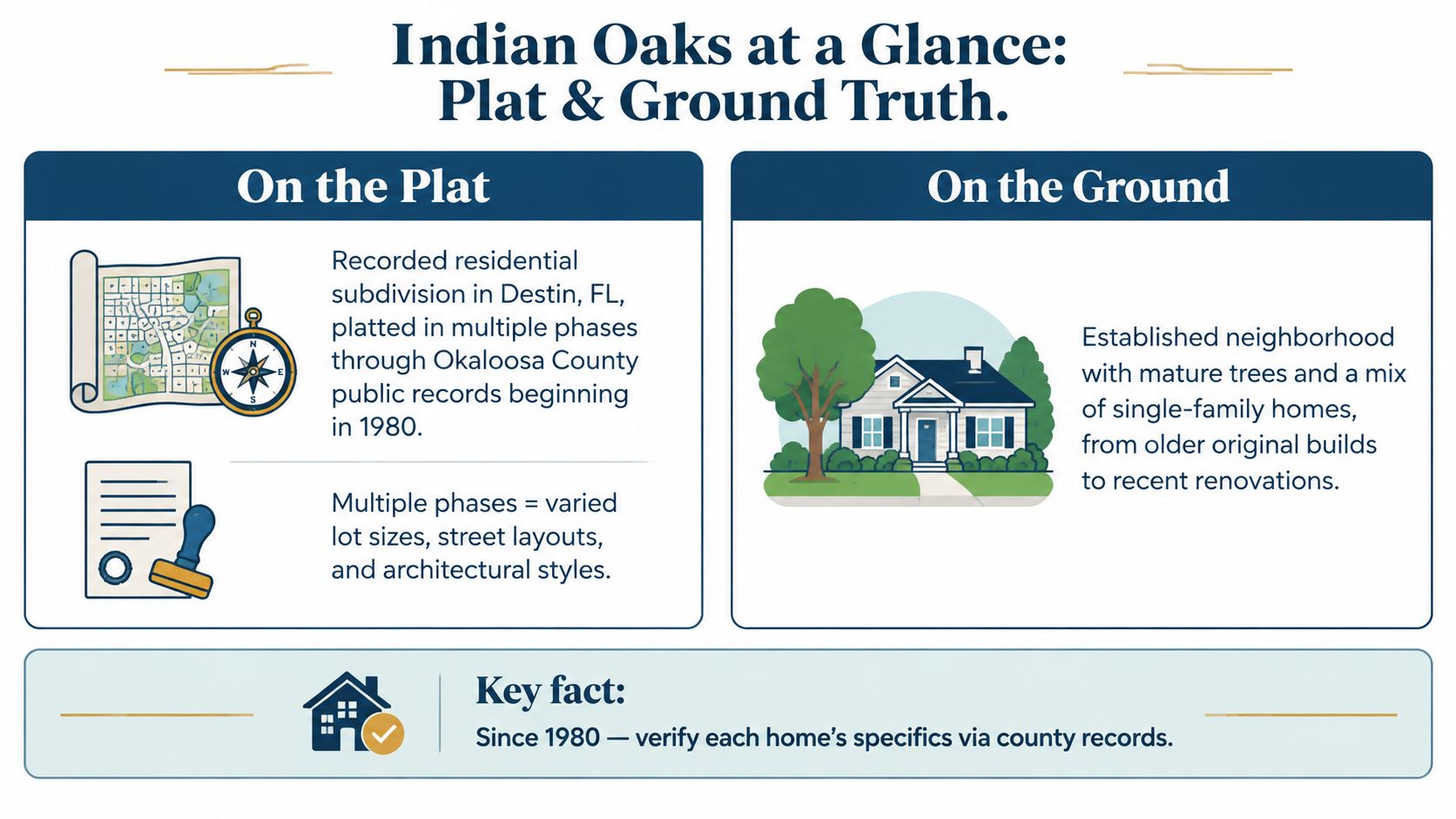
The first fact to establish is the neighborhood's recorded identity. Indian Oaks appears in the City of Destin's official subdivision plats index alongside Indian Oaks 1st Add and Indian Oaks 2nd Add. Those records show a community planned and formally platted through multiple phases, not merely a group of unrelated homes using a similar marketing name.
That history affects how buyers should investigate a property. A phase-specific plat may control easements, drainage areas, utility corridors, setbacks, and the location of the buildable envelope. A listing page can describe the house, but it usually won't show every recorded restriction that could affect a fence, addition, pool, driveway, or future redevelopment plan.
The neighborhood's core development era also matters. Public property records identify homes such as 238 Indian Oaks Dr and 246 Indian Oaks Dr as 1980 builds, while repeated deed transfers at properties including 238 Indian Oaks Dr are consistent with a mature subdivision that has passed through multiple ownership generations.
Documents that should shape your offer
Before writing an offer, request the current property record, applicable plat, title commitment, and any recorded covenants or deed restrictions that apply to the specific address. Don't assume every phase has identical language or that a restriction appearing in one document applies to every Indian Oaks parcel.
At minimum, confirm:
- Recorded phase: Identify which Indian Oaks plat contains the lot.
- Easements: Review drainage, utility, access, and setback areas.
- Restrictions: Check use, leasing, parking, exterior changes, and additions.
- Ownership history: Look for transfers, liens, or unresolved title matters.
- Physical match: Compare the survey and legal description with the improvements on site.
Buyers comparing established Destin communities can also review buying a home in Destin's Crystal Beach, but the two areas shouldn't be treated as interchangeable. Indian Oaks is an older, compact residential subdivision, while a newer or more tourism-oriented community may carry different construction, association, and leasing considerations.
Typical Homes, Lots, and Floorplans in Indian Oaks
Indian Oaks presents a low-density, small-footprint housing pattern. A current example at 238 Indian Oaks Dr is a single-family residence with 2 bedrooms, 2 bathrooms, 1,080 square feet, a 3,049-square-foot lot, and a 1980 build date. The listing data places the home at about $314 per square foot and reports no HOA fee in that listing. Those facts describe one property, not a universal profile for every home in the subdivision.
The practical lesson is simple. Buyers should compare Indian Oaks houses with similar existing homes, not with larger new construction or amenity-heavy coastal communities. Interior size, lot configuration, renovation quality, parking, roof age, and additions can vary meaningfully from address to address.
A useful property-by-property profile
| Feature | Typical Range |
|---|---|
| Construction era | Many homes date to around 1980 |
| Example home size | 1,080 square feet at 238 Indian Oaks Dr |
| Example lot size | 3,049 square feet at 238 Indian Oaks Dr |
| Housing type | Compact single-family residences |
| Bedrooms and bathrooms | Varies by address, with the cited example offering 2 bedrooms and 2 bathrooms |
| HOA obligation | Must be confirmed from current documents, one listing reports no HOA fee |
Older homes can have more usable character than a standardized new build, but renovations may have happened in stages. One owner may have replaced a kitchen while leaving original electrical components, windows, drainage, or HVAC equipment untouched. That's why a polished interior shouldn't be treated as evidence that the whole property has been modernized.
For comparison, buyers can browse Crystal Beach Destin homes for sale, then compare lot size, construction age, association obligations, and insurance documentation rather than focusing only on the listing price. Indian Oaks may appeal to someone who values an established street setting and a smaller home footprint, but those advantages only make sense after the property's repair profile is understood.
Price History and Where Indian Oaks Sits in Destin Today
Indian Oaks has occupied a relatively affordable segment of Destin's housing stock compared with many coastal Emerald Coast properties. The available records show how quickly that context can change over time. A 3-bedroom, 2-bath, 1,161-square-foot home at 199 Indian Oaks Drive sold for $168,900 on May 29, 2014. Later records show 237 Indian Oaks Drive selling for $288,000 on September 28, 2021, and a transaction at 221 Indian Oaks Drive on September 2, 2022. These records indicate a clear upward price movement across the period, though they don't establish a guaranteed future return.
Current public listing and estimate data also show variation. 238 Indian Oaks Dr was listed at $339,000 for 2 bedrooms, 2 bathrooms, and 1,080 square feet, or about $314 per square foot, while 215 Indian Oaks Dr has an estimated value range of $236,000 to $315,000 and a reported last sale price of $165,000. Review the Indian Oaks sold records for address-level context, then have an agent verify current comparable sales and condition differences.
How to interpret the price position
Indian Oaks shouldn't be evaluated as though every home has the same renovation standard. A lower-priced property may need major work to the roof, HVAC, electrical system, windows, or moisture protection. A renovated home can command a different price, but the buyer still needs permits, inspection findings, insurance quotes, and comparable sales to support the premium.
The broader Destin market provides useful context without replacing subdivision-level analysis. Current Destin market data reported a median sale price of about $560,000 and a 2.0 percent year-over-year increase over the three months ending July 2026. Indian Oaks examples sit below that broader median, but median figures combine different property types, locations, sizes, and waterfront exposure.
Use find homes in Destin to compare current alternatives, then separate the asking price from the cost of ownership. For an Indian Oaks purchase, a sound offer reflects the home's actual condition, insurability, legal documents, and resale position.
Short Term Rental Eligibility Under Destin's 2026 Rules
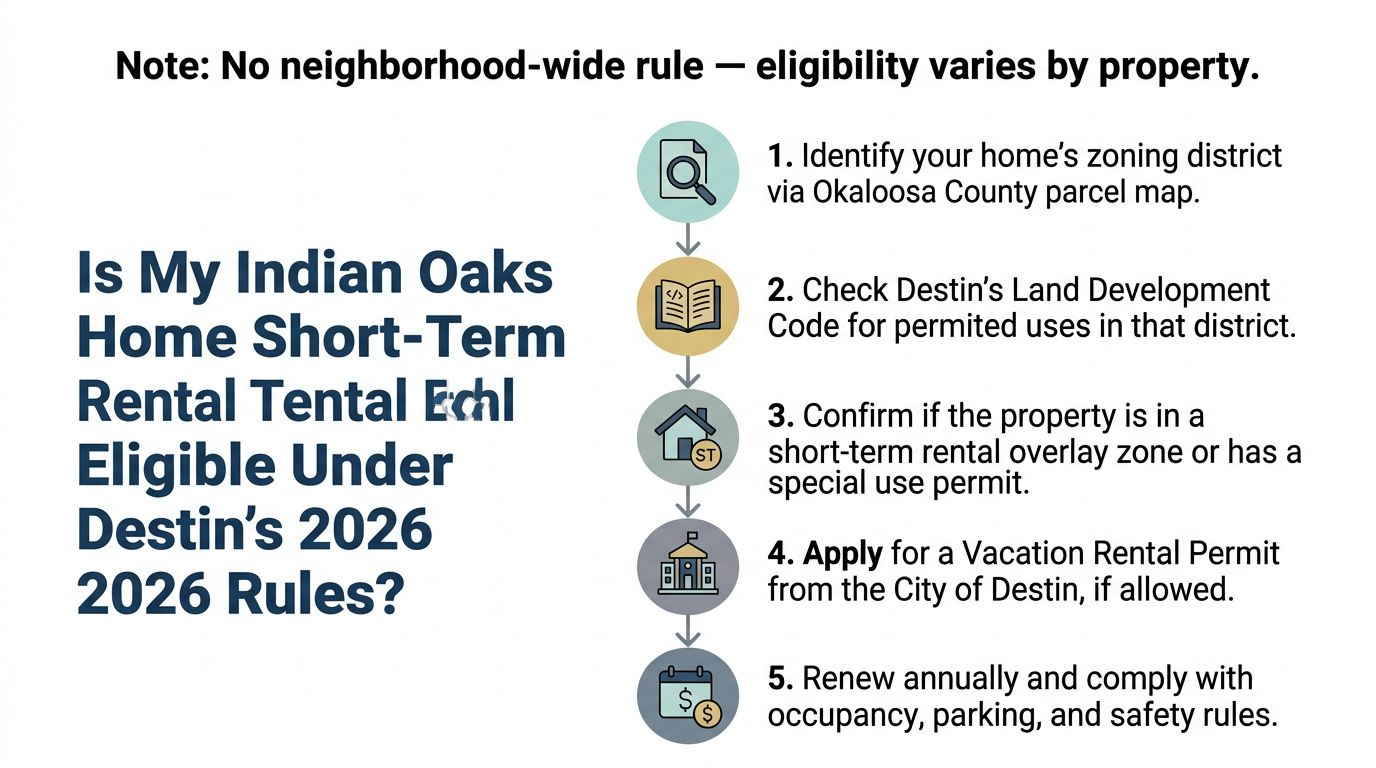
Indian Oaks homes can't be treated as automatically eligible or ineligible for short-term rental use based only on the subdivision name. Destin regulates short-term rentals through zoning and registration requirements, so the address, zoning district, permitted use, and current property documents all matter.
The City of Destin short-term-rental guide states that registrations must be renewed annually and are non-transferable after an ownership change. A buyer therefore can't assume that a previous owner's registration, permit, or operating history transfers with the deed.
The eligibility sequence
Start with the exact parcel. Confirm its zoning district and whether the intended rental duration is a permitted use. The city's short-term-rental information page states that rentals of single-family homes, duplexes, townhomes, and condominiums for less than 180 days must register as an STR, and that residential homes must complete a Change of Use process before operating as a short-term rental.
Then review the recorded declaration, amendments, bylaws, leasing rules, and any written association confirmation. Even if municipal rules allow the use, private restrictions may limit leasing, impose minimum stays, require approval, or prohibit short-term occupancy. Listing remarks, prior rental advertisements, and seller statements aren't enough.
Destin also publishes a specific occupancy rule. Nighttime occupancy is limited to 2 adults per bedroom plus 4 additional persons per property, with an overall overnight cap of 24 people per house, from 10:00 p.m. to 7:00 a.m., as explained in the City of Destin occupancy FAQ.
Practical rule: Don't underwrite rental income until written property-specific permission, zoning approval, registration requirements, licensing, occupancy, parking, and insurance have all been confirmed.
Buyers who are comparing property types can use the Dream Destin Realty condo guide for a separate discussion of association and unit-level issues. For Indian Oaks, the correct approach is address-specific documentation, not a neighborhood-wide assumption.
Insurance and Inspection Priorities for 1980 Indian Oaks Homes
A 1980 home can be financially attractive while still requiring more technical review than a newer property. Cosmetic updates don't answer the questions insurers and lenders may ask about the roof, electrical service, plumbing, HVAC, windows, storm protection, drainage, and moisture intrusion.
Order a full home inspection early in the contract period. The inspector should document visible roof condition, flashing, exterior doors, windows, stucco or siding, drainage paths, attic ventilation, HVAC operation, water heating, electrical panels, outlets, GFCI protection, plumbing fixtures, and visible supply lines. A licensed roofing review may be appropriate if the roof's age or condition is uncertain.
What deserves special attention
| Priority | What to Inspect | Potential Buyer Action |
|---|---|---|
| Roof and flashing | Covering condition, penetrations, flashing, remaining service life | Obtain a licensed roofing opinion and insurance response |
| HVAC and water heater | Age, operation, leakage, service records | Price replacement risk into reserves or negotiations |
| Electrical | Panel type, service capacity, wiring, GFCI protection | Request licensed evaluation if concerns appear |
| Moisture and drainage | Interior staining, crawlspace or slab signs, grading, gutters | Identify the source before accepting cosmetic repairs |
| Windows and doors | Seals, operation, storm resistance, installation quality | Ask the insurer what documentation is required |
| Termites and wood damage | Prior treatment, visible damage, conducive conditions | Order a pest inspection and review treatment history |
| Flood and wind exposure | Property-specific flood designation and mitigation features | Get insurance quotes before the inspection period ends |
Insurance is not a closing formality. Wind coverage, roof condition, construction details, flood exposure, claims history, and replacement-cost assumptions can change the ownership budget. A wind-mitigation inspection may support available credits, but it doesn't guarantee coverage or premium savings.
A four-point inspection alone shouldn't replace a full evaluation. Buyers should also ask for permits for additions, enclosed patios, electrical work, roof replacement, and other material changes. The Indian Oaks property listing details illustrate why age and condition deserve attention alongside square footage and asking price.
Beach Access, Amenities, and Daily Convenience
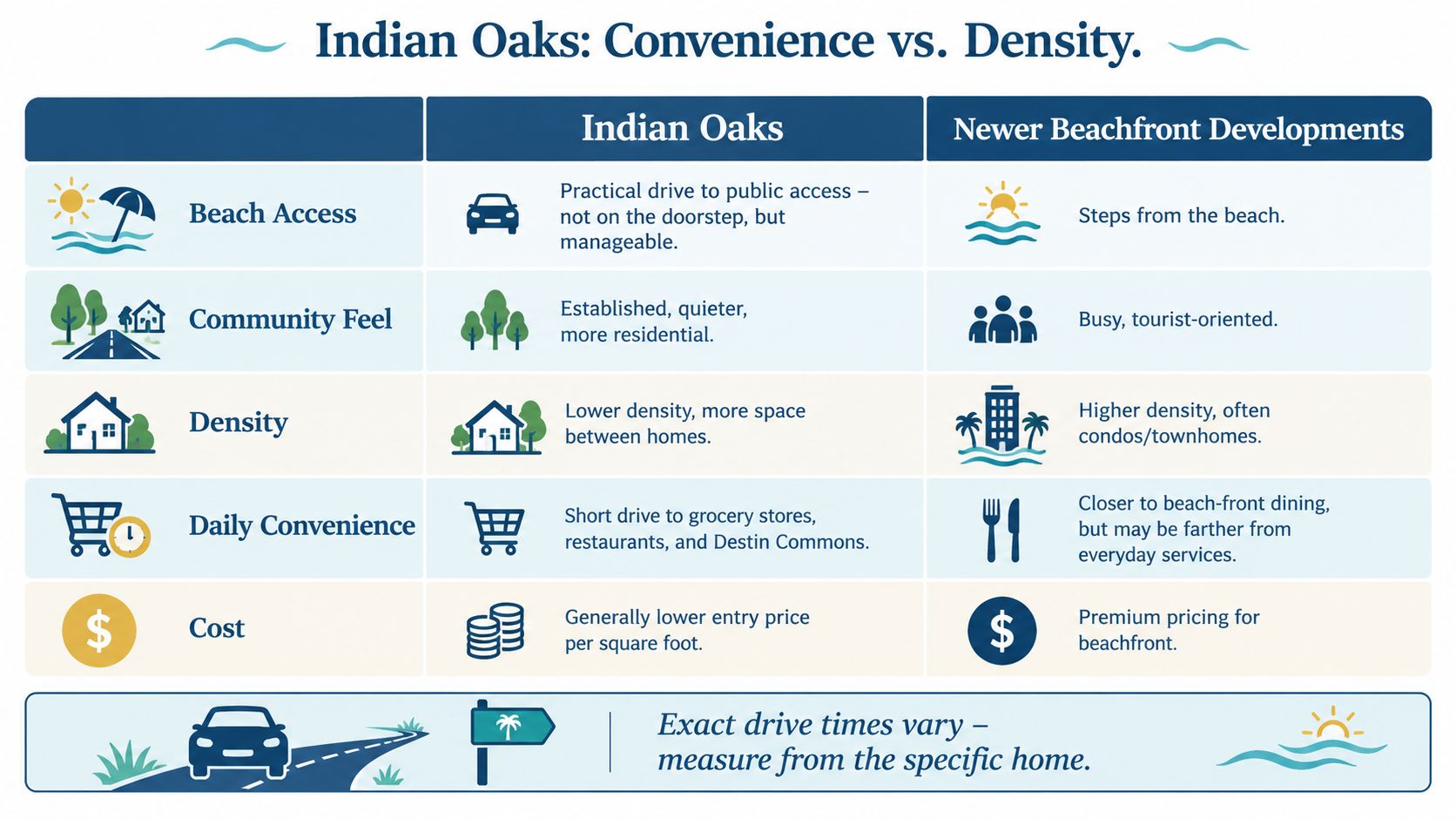
Indian Oaks offers an established Destin setting rather than a beachfront building environment. The neighborhood isn't uniformly beachfront, so buyers should verify the nearest maintained public access, parking arrangements, current access rules, and any private rights claimed in association or deed documents.
Route testing is more useful than a generic proximity statement. Drive from the actual home during morning and afternoon traffic, then repeat the trip during a busier coastal period. The same route can feel very different depending on the time, destination, and parking conditions.
Compare the daily-use trade-offs
Indian Oaks can provide practical access to grocery stores, restaurants, pharmacies, banks, medical services, parks, and everyday shopping along Destin's main corridors. Destin Commons, HarborWalk Village, and the Gulfarium are also part of the wider local amenity network, but buyers should measure actual routes from the specific address rather than relying on a neighborhood label.
Newer beachfront developments may offer a shorter walk to the sand or more concentrated on-site amenities. They may also bring higher density, shared facilities, and different association obligations. Indian Oaks homes may offer more separation from large multifamily structures, but that doesn't establish a universal privacy level or guarantee any specific view, access right, or community facility.
Measure the route from the front door, not from the subdivision name.
For second-home buyers, convenience often comes down to the balance between owner use, maintenance access, parking, storage, and travel time to the beach. For an investment-oriented buyer, those same factors must be considered only after rental permission and operating requirements have been documented. A convenient location can't cure an uninsurable roof or an unauthorized rental plan.
Financing, Offer Strategy, and the Closing Sequence
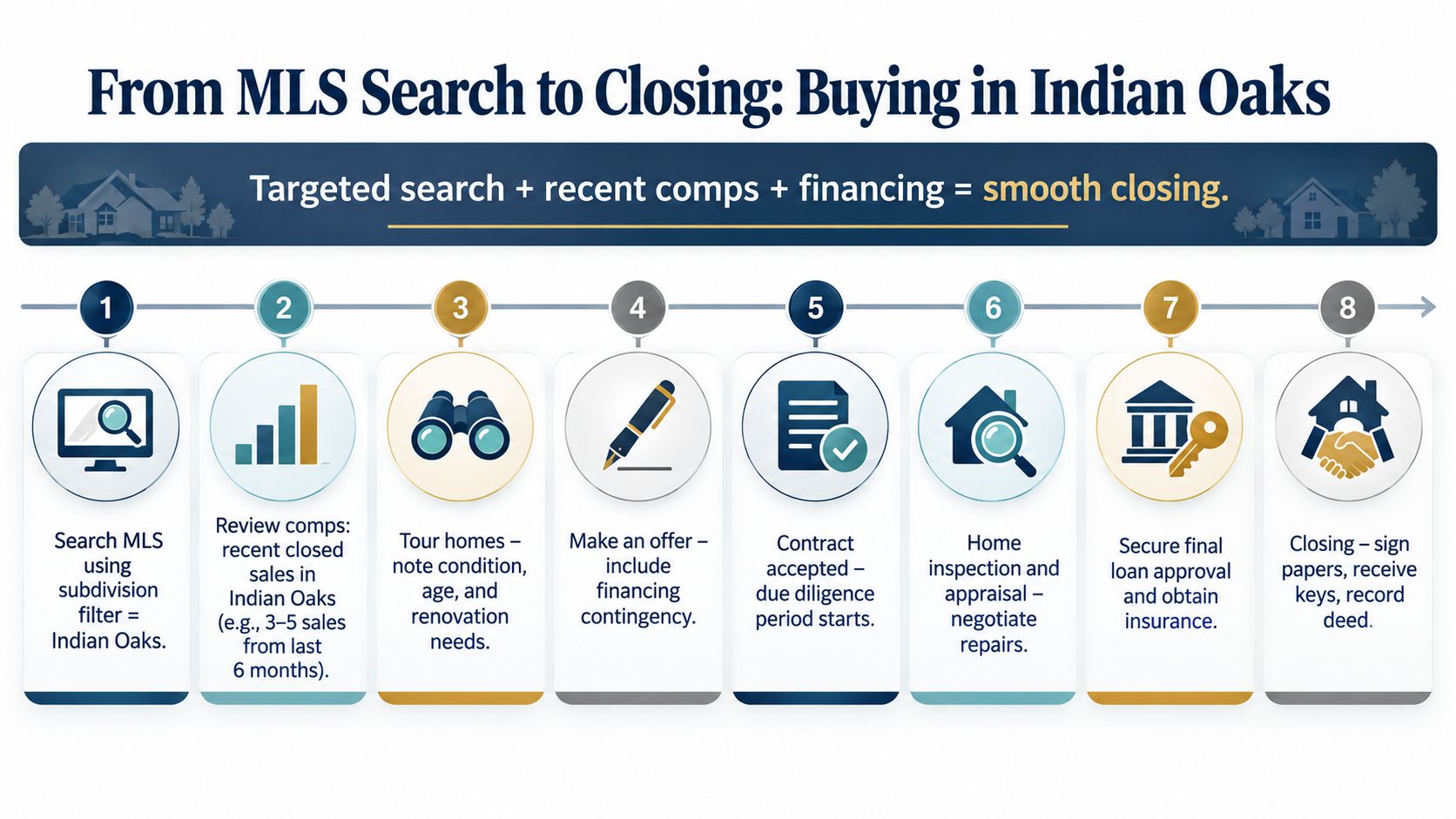
An Indian Oaks purchase should begin with a subdivision-filtered search and a property-specific comparison set. Review closed sales within the subdivision, current competing listings, condition, size, lot configuration, renovation quality, and the time each property has spent on the market. A similar-looking house may have a materially different roof, electrical system, addition history, or insurance profile.
The age of the housing stock can also affect financing. Appraisers may have fewer directly comparable renovated homes, and a lender may require repairs or additional documentation if the inspection, appraisal, or insurance review identifies concerns. Renovation financing can be worth discussing with a lender, but the correct loan depends on the borrower, scope of work, property condition, and lender guidelines.
A workable offer-to-close sequence
- Search the exact subdivision: Use the Indian Oaks subdivision filter and confirm the legal description.
- Review comparable evidence: Compare closed sales and active alternatives by condition, size, lot, and improvements.
- Tour with a maintenance lens: Look beyond finishes to roof lines, drainage, windows, HVAC age, and signs of moisture.
- Write protective terms: Include financing, inspection, insurance, title, survey, and document-review protections appropriate to the contract.
- Order inspections immediately: Schedule the full inspection, pest review, roof assessment, and any needed specialty evaluations.
- Get insurance responses: Provide inspection and wind-mitigation documents to insurers before contingency deadlines expire.
- Review title and restrictions: Confirm easements, setbacks, leasing rules, assessments, and any association obligations.
- Complete the final walkthrough: Verify agreed repairs, included items, utilities, and property condition before closing.
Termite history deserves its own file. The Pestless Inc. closing inspection tips provide useful context for understanding why pest documentation can affect negotiations and closing preparation.
Use Dream Destin Realty listings to monitor current inventory, but don't rely on the search page alone for legal, insurance, or rental conclusions. Those conclusions require current property documents and written confirmation from the appropriate parties.
Indian Oaks Buyer Checklist and Next Steps
Indian Oaks rewards a disciplined purchase process. The neighborhood's recorded multi-phase identity, older housing stock, changing ownership history, and Destin's property-specific rental rules mean the buyer should evaluate the address, not just the community name.
Before the search
- Define the financial limit: Include inspection, insurance, repairs, reserves, and possible financing costs.
- Study the plat: Identify the phase, lot boundaries, easements, setbacks, drainage areas, and apparent additions.
- Compare the right homes: Separate compact original homes from substantially renovated properties.
- Decide the intended use: Primary residence, second home, or possible rental use requires different document checks.
Before the offer
- Request the records: Obtain the recorded plat, title information, covenants, amendments, survey, permits, and any applicable association documents.
- Check rental feasibility: Confirm zoning, Change of Use requirements, registration, occupancy, leasing restrictions, and insurance compatibility before modeling income.
- Review comparable sales: Ask for address-level comparisons that account for condition and improvements.
- Confirm financing: Get lender feedback on the home's age, roof, appraisal support, and proposed renovations.
During due diligence
- Inspect the full structure: Review roof, HVAC, electrical, plumbing, windows, drainage, moisture, termites, and storm-related features.
- Obtain insurance quotes: Do this before inspection deadlines expire, using property-specific construction and mitigation information.
- Verify improvements: Match additions, enclosed spaces, pools, fences, and structural changes against permits and setbacks.
- Read restrictions: Check leasing, parking, exterior modifications, assessments, maintenance responsibilities, and enforcement provisions.
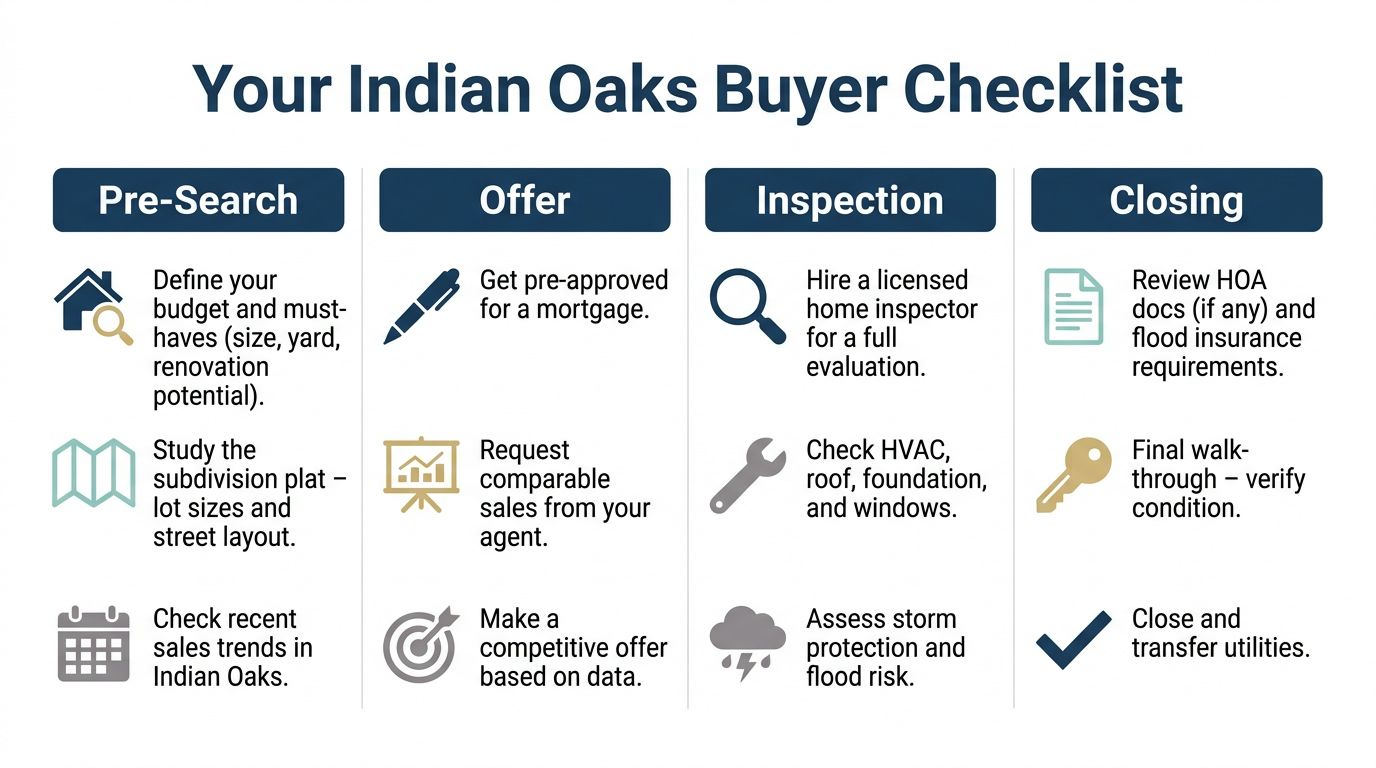
At closing and after
- Review final documents: Confirm title, survey, insurance, association information, prorations, and agreed repairs.
- Complete the walkthrough: Verify the home's condition and included items.
- Transfer services: Arrange utilities, maintenance, insurance, and any required city registration.
- Keep the file: Store permits, inspections, warranties, insurance reports, and written rental confirmations for future resale or refinancing.
For current Indian Oaks homes for sale, request an agent-curated search and ask for help retrieving the applicable plat packet, title and restriction documents, estoppel information if relevant, insurance materials, and rental-permit documentation. That property-level review is the clearest way to compare Indian Oaks with newer options in Crystal Beach, Miramar Beach, Santa Rosa Beach, Inlet Beach, Fort Walton Beach, and 30A.
Dream Destin Realty helps buyers compare Indian Oaks homes, current inventory, recorded documents, inspections, insurance questions, financing, and property-specific rental requirements. Visit Dream Destin Realty to begin a focused search and request guidance from offer through closing.


