
Buying a House in a Flood Zone: What to Verify First
Buying a house in a flood zone? Learn how to check FEMA maps, elevation records, flood insurance costs and lender rules before you make an offer.

On this page
On this page
A flood zone label is a map category that settles one question well: whether a federally backed lender must require flood insurance on the building. It doesn't tell you how high water would reach your door, what a policy costs, or whether the map will change while you own the home. The familiar advice to check the zone and relax if the answer is Zone X inverts the order of the work. The label is the first record to pull, not the last.
Table of Contents
- What a Flood Zone Label Tells You and What It Misses
- Flood Records to Request in Order Before an Offer
- How Flood Insurance Affects Your Budget and Loan
- Building Checks Beyond the Flood Map
- Confirm Current Rules Before You Make an Offer
- Common Questions About Flood-Zone Purchases
What a Flood Zone Label Tells You and What It Misses
FEMA's flood insurance rate maps reduce every parcel to a single letter. Zones beginning with A or V are Special Flood Hazard Areas, the high-risk band where a 1% annual chance flood is expected to reach. The V and VE zones add wave action and appear on coastal parcels, while Zone X sits outside that band at moderate or low risk. A 1% annual chance means a 1% probability in any single year, and the same probability applies in every year the home stands.
That gap between a technical probability and the way buyers hear it is wider than it looks. Run a constant 1% annual chance across a 30-year mortgage, assuming independent years, and the cumulative chance of at least one flood comes to about 26%. That 26% is arithmetic, and it is a useful one: it is the difference between treating a flood zone as a paperwork detail and treating it as a budget line.
Height is what insurance prices and water reaches, and height belongs to the structure itself. Two neighboring homes can share a zone letter and carry different premiums because their lowest floors sit at different elevations. That makes when buyers need elevation documentation the natural next question after the map.
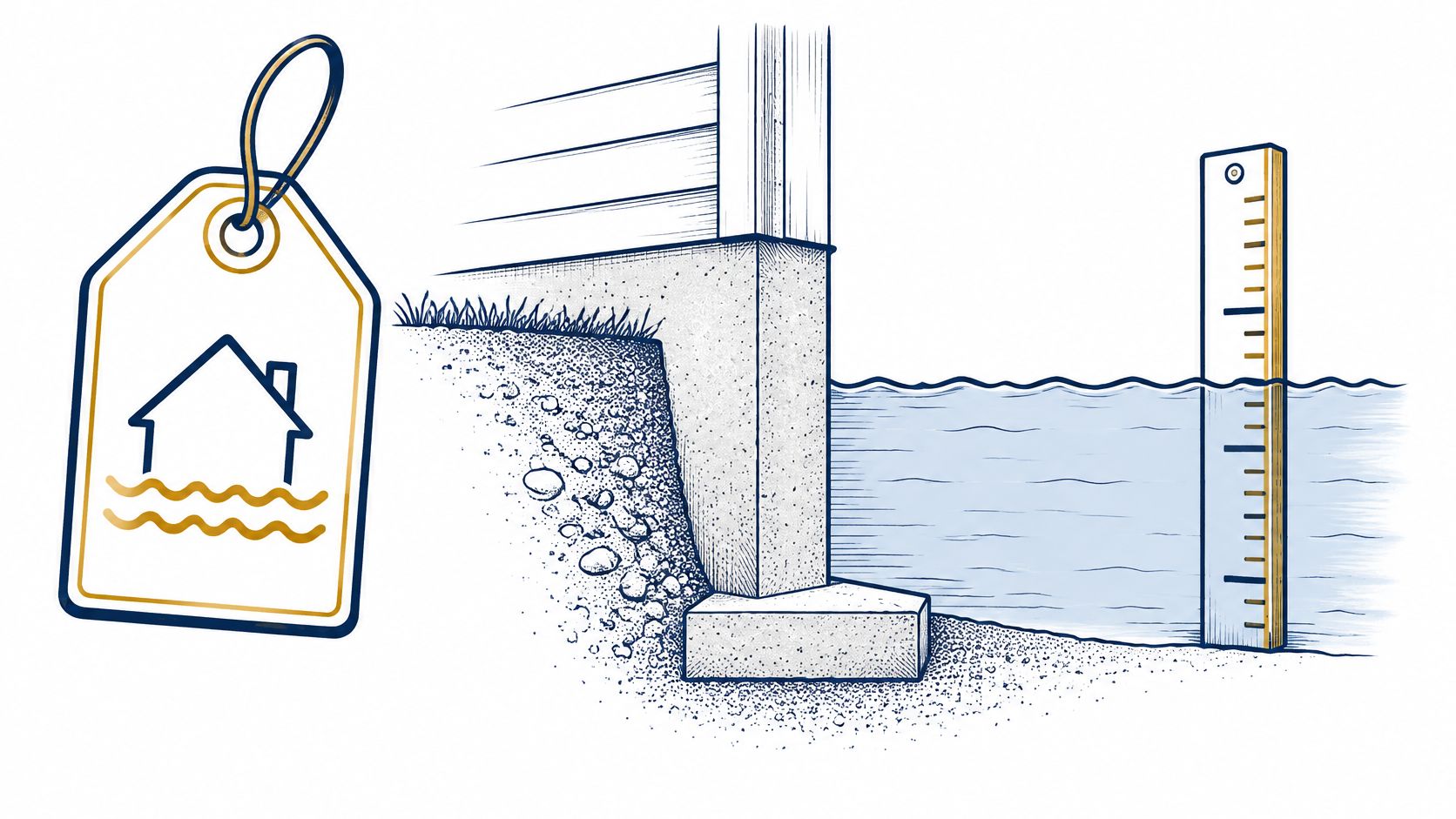
The label's job is narrow. It sets the lender rule. It says nothing about depth at the door.
The federal purchase rule follows that same narrow logic. When a building sits in a Special Flood Hazard Area and the financing is federally related, FEMA's floodplain management guidance states that flood insurance is required on the building, with the required amount tied to the building's value excluding land, the loan amount, or the maximum coverage available. Three things follow for a buyer.
- Mandatory coverage can still fall short. A required policy may leave a gap when a home's replacement cost exceeds the federal limit.
- A Zone X result still needs an insurance review.
- The map starts the record search. Elevation, claims history, drainage and a written quote carry the rest of the decision.
Flood Records to Request in Order Before an Offer
Six records decide whether a flood-zone purchase works, and the sequence protects your deadlines. Request all six in writing, and note the date and issuer on each one.
| Record | What It Shows | Who Can Provide It | Why It Matters |
|---|---|---|---|
| Effective FEMA flood map | Zone label for the parcel and whether it is in a Special Flood Hazard Area | Local floodplain administrator or FEMA flood map resources | Sets the baseline for lender and insurance rules |
| Base Flood Elevation (BFE) | Height floodwater is expected to reach in a 1% annual chance flood | Effective flood map or local floodplain administrator | Gives the benchmark the elevation certificate is compared against |
| Elevation certificate | Lowest floor and equipment elevations for the building | Seller, or a licensed surveyor | Drives insurance pricing and retrofit exposure |
| Local floodplain ordinance | Required height above BFE, including any freeboard | Local building or floodplain office | Affects permits for repairs and improvements |
| Prior flood claims or disaster history | Past losses, repairs and related permits | Seller disclosure and insurer loss records | Shows exposure a map label may not show |
| Written flood insurance quote | Premium, deductible and coverage limits | Licensed insurance agent or insurer | Tests affordability before any contingency is waived |
Each record answers a different question, and the timing of each one matters as much as the document itself.
- The effective map, including any pending revision, comes from the local floodplain administrator.
- The BFE gives you the height the building is measured against, and every later comparison uses it.
- The elevation certificate may already sit in the seller's closing file, so ask before paying a surveyor, because its lowest floor and equipment heights turn a zone letter into a number.
- The floodplain office can tell you what the community requires for repairs and improvements, which governs what you can do to the house later.
- Claims history fills the gaps a seller may not know about, since an unrecorded loss leaves no trace on a disclosure form.
- The written quote arrives last but must land before any waiver, so pair it with inspection and contract deadline tips while you can still renegotiate.
The comparison that decides most purchases is height against the BFE. FEMA's guidance on elevating a home explains that NFIP-participating communities generally require homes undergoing substantial improvement, or carrying substantial damage, to be built or raised to at least the BFE.
How Flood Insurance Affects Your Budget and Loan
Under the National Flood Insurance Program, a one-to-four-family residential building can carry up to $250,000 in building coverage and up to $100,000 in contents coverage, and those are separate limits, as FEMA's NFIP coverage summary sets out. The building limit applies to the structure. Contents coverage protects eligible personal property. Compare both caps against replacement cost and the value of what sits inside.
Lenders read the effective FEMA map to decide whether coverage is mandatory. Pricing has also moved past the zone average. Under Risk Rating 2.0, FEMA weighs flood type and rebuilding cost alongside elevation.
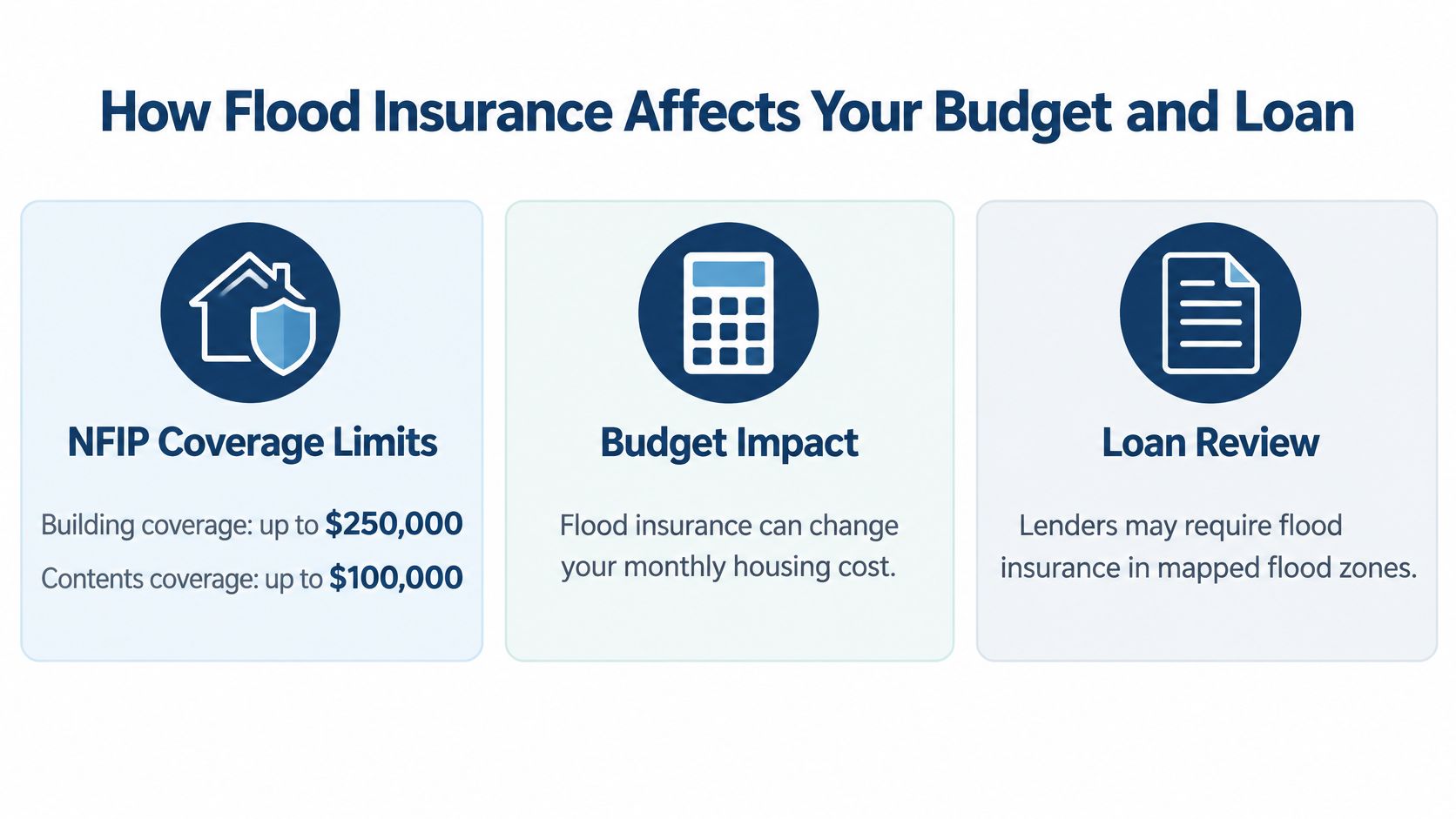
List each monthly cost as a placeholder first, then fill in the figures as quotes and statements arrive: mortgage principal and interest, property tax, homeowners insurance, wind or hurricane coverage, flood premium and deductible, association dues, and a reserve for elevation or floodproofing work. For the flood line, use a written quote for the specific address. A zone-wide average hides the address-level pricing that Risk Rating 2.0 produces.
| Item | Limit or Rule | What It Means |
|---|---|---|
| Building coverage | Up to $250,000 | Applies to the structure only, separate from contents |
| Contents coverage | Up to $100,000 | Applies to eligible personal property, a separate limit |
| Increased Cost of Compliance | Up to $30,000 | Funds eligible elevating, floodproofing, demolishing or relocating after substantial or repetitive damage, as FEMA's ICC chapter describes |
| Standard waiting period | Generally 30 days after purchase | Mortgage exception: when the initial purchase is in connection with a loan, there is no waiting period |
Timing trips up more buyers than price does. NFIP policies commonly carry a 30-day waiting period, but FEMA's flood insurance guidance describes a mortgage exception: when the initial purchase of flood insurance is in connection with making, increasing, extending or renewing a loan, there is no waiting period. Outside that loan exception, plan on the full 30 days between purchase and the first day of coverage. Ask the insurer and the lender to confirm the start date in writing before you schedule closing, and add the premium to the same worksheet you use to budget for closing costs and insurance.
Building Checks Beyond the Flood Map
The map stops at the parcel line. These items sit in the building file, and each one changes what a flood loss costs.
| Item | Why It Matters for Flood Exposure | Where to Verify |
|---|---|---|
| Condo or HOA master policy | Shows whether the association carries flood coverage and what deductible applies | Association documents and insurance certificate |
| Drainage and grading | Shows whether water collects on the lot after rain | Property inspection and seller disclosure |
| Foundation and enclosed areas below flood elevation | Shows whether living space or storage sits low to the ground | Property inspection and elevation certificate |
| Wind or hurricane deductible | Changes the out-of-pocket cost of a storm loss | Written insurance quote |
| Reserves and repair plans | Shows whether elevation or drainage work is funded | Association financial statements and contractor estimate |
| Permit history for prior repairs | Shows whether past work was permitted and inspected | Local building department |
| Standard homeowners policy | Generally does not cover flood damage | Insurance agent or insurer |
That last row is the one buyers most often assume is already covered. Standard homeowners and renters policies generally do not cover flood damage, so an ordinary policy won't protect against rising water, storm surge or other qualifying flood losses, as FEMA's flood insurance fact sheet explains. NFIP building coverage addresses items such as foundations, electrical and plumbing systems and water heaters, while contents coverage can address clothing, furniture, personal electronics and portable or window air conditioners. The two are priced and claimed independently, so read the terms and exclusions separately for the building and for the contents before closing.
For a condo purchase, read the master policy row and the reserves row together. Coverage on paper answers whether a flood policy exists; funded reserves answer whether the association can act on drainage or elevation work without delay.
Mark each row on the table as documented, missing or disputed for the specific property. A row marked missing is a request to send, not a defect to accept. Map tools, listing badges and marketing material prove nothing about coverage, condition or permission for a given use. When a row comes back disputed, the guide to negotiating repairs after a home inspection shows how to carry those findings into the negotiation.
Confirm Current Rules Before You Make an Offer
Maps get revised, insurers reprice and lenders adjust requirements, so the last check before an offer is confirming what applies on the date you sign.
- Newly mapped into a high-risk area. The property may trigger lender-required coverage that didn't apply before, according to FEMA's guide to flood zone changes.
- Moved from Zone A to Zone X. The federal purchase mandate drops away, and the underlying flood risk does not. A voluntary policy still prices that remaining exposure, so get the quote rather than assuming the cost disappeared with the requirement.
On offer day, confirm four things in writing: the effective map date, the lender's flood requirement for this loan, the insurer's quote date and terms, and any pending floodplain revision from the local office. Keep each record dated in one file, and treat a verbal "you're fine" as nothing at all.
Write down and date every number before you rely on it. A premium quoted months ago, a map that took effect last week and a lender condition added in underwriting are three separate facts, and only the dated versions hold up when terms shift. An undated figure tells you what someone believed at some point, and that is a different thing.
This guide is general information, not legal, tax, insurance or lending advice. A licensed insurance agent, lender, attorney or closing agent should confirm the terms that apply to the specific property. For the wider sequence, from preapproval to closing shows where these checks fit before deadlines compress.
Common Questions About Flood-Zone Purchases
Can you buy a house in a flood zone?
Yes. A high-risk zone label changes the loan file, the insurance budget and the resale conversation; the purchase itself stays legal in any zone.
Does a Zone X result mean flood insurance isn't needed?
No. The opening section of this guide covers why the zone letter and the flood risk are separate questions. A voluntary policy remains available either way, and it still carries a premium worth pricing before you offer.
Is flood insurance required when only part of the lot is in the zone?
The question is where the building sits on the lot, since a partly affected parcel can hold a fully exposed structure. Your lender's flood determination for the structure settles it for your loan.
Can the flood zone change after closing?
Yes, and the section on confirming current rules walks through the map events that matter. The step that holds regardless of the outcome is asking the local floodplain administrator about pending revisions before you commit, so a mapped change does not arrive as a surprise after you own the house.
Flood-zone purchases reward buyers who gather records early and read them closely, and that's the part of the file Dream Destin Realty helps organize: map status, elevation documentation, insurance quotes and the deadlines that surround them. The brokerage serves buyers across Destin, Miramar Beach, Santa Rosa Beach, Fort Walton Beach and Panama City Beach, and it publishes buyer guides that keep each step in order. Visit Dream Destin Realty to start with the records that decide the purchase.


