
Condo vs Townhouse Pros Cons: Which Fits Your Goals
Condo vs Townhouse Pros Cons explained: compare fees, insurance, maintenance duties and rules, and see which option fits your situation.

On this page
On this page
The usual advice that condos mean less maintenance and townhouses mean lower fees misses the decision: who pays each repair bill. A condo generally puts shared building work under an association, while a townhouse may leave that work with the owner. Neither is automatically cheaper. On Florida's Emerald Coast, the governing documents and association finances matter more than the property's label.
Table of Contents
- Condo and Townhouse Basics Side by Side
- Fees, Repairs and Who Pays for Roofs
- Insurance and Storm Exposure on the Emerald Coast
- Rules, Inspections and Financing Checks
- Pros and Cons at a Glance
- Choosing Between a Condo and a Townhouse
Condo and Townhouse Basics Side by Side
A condominium is an ownership structure involving an individual unit and shared common elements. A townhouse describes an attached home that may include ownership of its lot or may be legally organized as a condominium. The exterior appearance doesn't establish the owner's obligations.
Condo and townhouse ownership compared
| Feature | Condo | Townhouse |
|---|---|---|
| Typical ownership | Individual unit plus a share of common elements | Often the home and lot, though condominium ownership is also possible |
| Who maintains the exterior | Usually the association, as established in the declaration | Owner or association, as assigned by governing documents |
| Shared spaces | Often hallways, elevators, pools and grounds | Roads, gates or amenities where provided |
| Governing documents | Declaration, bylaws, budget and reserve study | Declaration or covenants and any association budget |
| Milestone inspection rules | Apply to qualifying condominium buildings | Legal form and building characteristics establish applicability |
Senate President Kathleen Passidomo's August 16, 2024 memorandum on condominium safety and affordability notes that costs for ongoing maintenance and repairs are supposed to be shared among owners, along with savings set aside for long-term structural needs.
A townhouse-shaped property can therefore carry condo-style obligations. Conversely, a townhouse owned with its lot can still have substantial association responsibilities.
Pages such as Magnolia Park, a Destin neighborhood in Okaloosa County with a townhome phase, provide a starting point for property discovery, not proof of maintenance rights. Start with the exterior-responsibility row, especially the roof, because those obligations drive much of the later cost comparison.
Fees, Repairs and Who Pays for Roofs
Association fees are separate from mortgage payments. Fannie Mae's homeowners association guide explains that fees vary with location, the age and condition of the property, its value and its amenities, and that a portion of the fees should go toward a reserve fund for major shared expenses, such as a condo roof replacement.
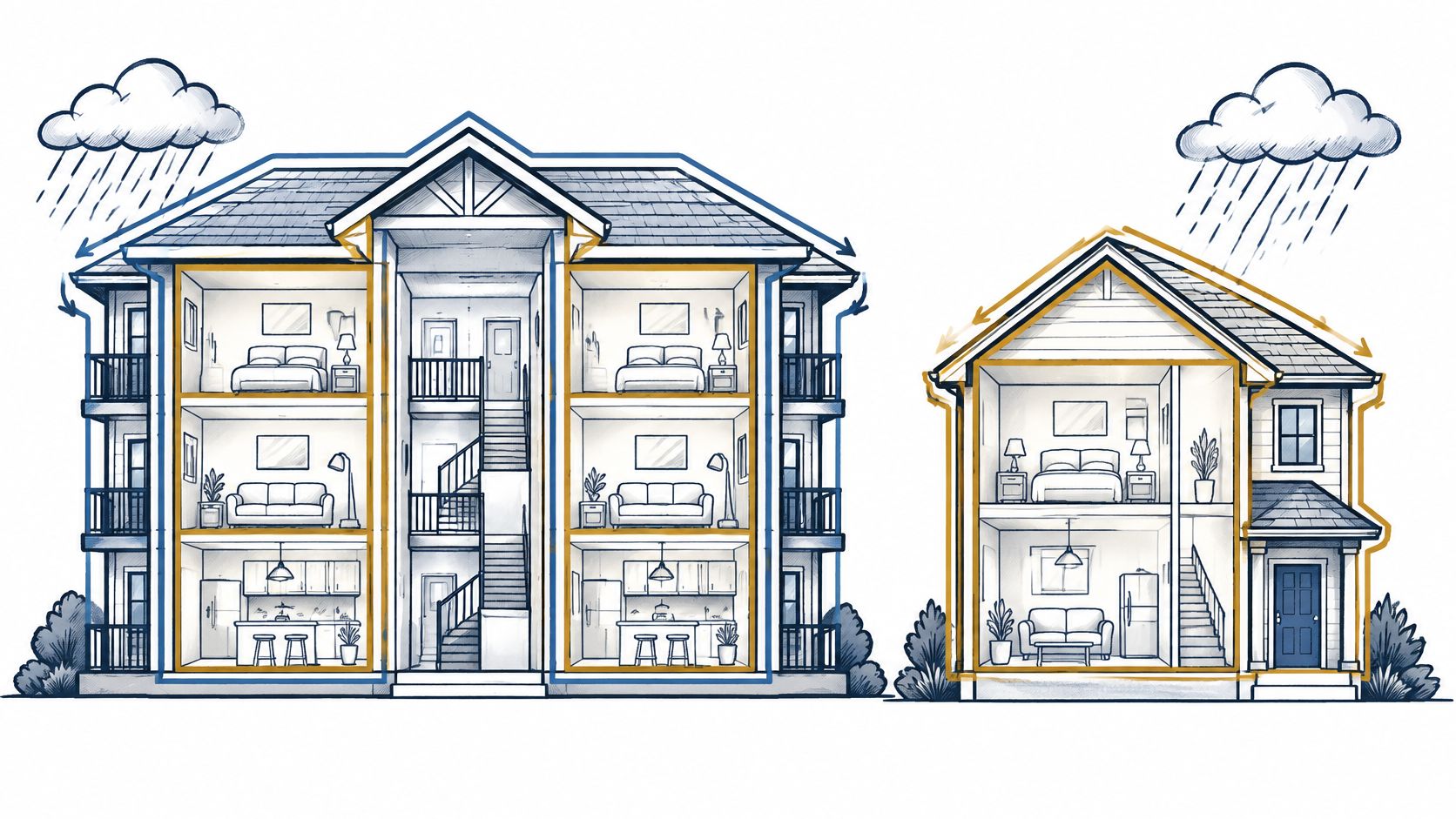
Consider a storm-damaged roof. In a condominium, the association may arrange repairs and fund its obligations through insurance proceeds, reserves or an assessment. A townhouse owner may instead receive the contractor's bill directly, unless the association maintains that roof.
Recurring and one-time costs compared
| Cost item | Condo | Townhouse |
|---|---|---|
| Monthly association fee | May bundle building upkeep, shared services and reserve contributions | May cover a narrower scope, with more work paid directly by owners |
| Special assessments | Possible when repairs or other obligations exceed available funds | Possible in association-governed townhouses too |
| Owner-paid interior and contents | Owner budgets for interior responsibilities and personal property | Owner budgets for the interior and other items outside association responsibility |
| Mortgage payment | Paid separately from association fees | Paid separately from association fees |
The maintenance-responsibility chart, when available, should identify who handles roofs, windows, exterior walls and foundations. A chart may omit a component or summarize the declaration imperfectly. An unanswered item needs clarification rather than an assumption that the other party pays.
Build a Comparable Annual Budget
- Request current costs. Obtain the budget and fee schedule.
- Separate responsibilities. List covered services and every owner-paid component.
- Check funding pressure. Review reserves, pending special assessments and recent fee increases.
- Calculate the annual total. Combine association fees, insurance and a realistic allowance for owner-maintained items.
Practical rule: A lower fee can represent a smaller maintenance package rather than a cheaper property.
A higher fee can support more predictable funding, but it doesn't guarantee freedom from assessments. Buyers can compare condos, townhomes and houses on the Emerald Coast while keeping the annual ownership budget separate from the advertised monthly payment.
Insurance and Storm Exposure on the Emerald Coast
Two policies decide who pays after a storm: the association's master policy and the owner's own coverage. Under Florida Statutes section 718.111(11), a condominium's master policy must exclude personal property inside the unit and items such as floor, wall and ceiling coverings, appliances, water heaters, and built-in cabinets and countertops, and that property and its insurance are the unit owner's responsibility. A townhouse buyer should ask the association and an insurance agent which parts of the building each policy covers.
Those are typical arrangements, and the declaration plus the actual policies establish where each responsibility falls. Master-policy deductibles or exclusions can leave owners facing additional costs after a covered event. A lower association fee paired with a high master-policy deductible can shift more storm expense to the owner than a higher fee would, so the fee alone cannot rank one property against another.
The property-specific insurance review should include:
- Association certificate of insurance.
- Master-policy deductibles and exclusions.
- Recent claims history.
- Board minutes discussing repairs or assessments.
- An insurance quote for the exact unit and ownership form.
Written confirmation of flood-coverage status, and of which property interests each policy covers, belongs in the same review. No assumption about coastal location, building appearance or an association certificate should replace that confirmation.
Dream Destin Realty helps clients review available building records, including association information, inspections, reserves, rental rules and insurance, as part of purchase due diligence, including flood considerations. Confirm coverage with the declaration and the actual policies. The Gulf-front condo buying checklist offers a focused starting point for organizing those questions.
Rules, Inspections and Financing Checks
Building inspections can create repair obligations that matter more than the advertised fee. Florida Statutes section 553.899 sets Florida's milestone framework for condominium and cooperative buildings three habitable stories or more in height: inspection by December 31 of the year the building reaches 30 years from its certificate of occupancy, or 25 years where the local enforcement agency requires it for conditions such as proximity to salt water, followed by inspections every 10 years, performed by a qualified Florida-licensed architect or engineer.
Applicability and timing should be confirmed for the exact building rather than inferred from its marketing description. Qualifying condominium buildings and townhouse-style dwellings aren't interchangeable categories.
Under the same statute, an association must notify members within 14 days after receiving local enforcement notice, and the first-phase visual inspection must be completed within 180 days after the association and other building owners receive notice.
Preliminary Stage
Confirm the legal ownership form, building height and governing association. Ask the lender what project review applies before treating a property as a financing match.
Property Stage
Review the declaration, budget, reserve study, inspection findings, recommendations, meeting minutes, litigation information and insurance. Obtain related repair plans and assessment records rather than relying on a seller's description of completed work.
Rental-use review should address recorded declarations and amendments, association rules and local requirements for the exact property. A listing remark or market average doesn't establish permission.
Final Stage
Confirm that the documents remain current and unresolved repairs have been addressed in the transaction review. A completed inspection isn't equivalent to completed corrective work.
Buyers planning to compare Destin vacation condos should keep intended use, building obligations and lender review as separate checks.
Pros and Cons at a Glance
A useful comparison of condo and townhouse pros and cons separates control over maintenance from responsibility for funding it. Two monthly fees cannot be ranked until each major repair bill is assigned to an owner or an association.
| Repair or cost | Condo: who typically pays | Townhouse: who typically pays | Record that decides it |
|---|---|---|---|
| Roof, siding and exterior walls | Association budget and reserves | Owner, unless declared common | Declaration and maintenance provisions |
| Planned component replacement | Reserve-funded collective plan | Owner savings or direct payment | Reserve study and owner maintenance plan |
| Funding shortfall | Special assessment divided among owners | Irregular bills carried in full | Budget, delinquency and assessment records |
| Services left out of the fee | Fewer items, broader fee coverage | More items paid as they arise | Operating budget line items |
A reserve balance can look adequate while still falling short of the work it is meant to fund. For buildings three habitable stories or higher, a Florida structural integrity reserve study must estimate each covered component's remaining useful life and replacement cost or deferred-maintenance expense and include a recommended funding plan, as described in the Florida condominium and cooperative FAQs. Those estimates matter more than the balance on its own.
The arithmetic shows why the fee alone misleads. In a hypothetical example, an owner paying $250 a month contributes $3,000 a year, and a single $4,000 special assessment would exceed that total on top of the regular payments. A townhouse owner carrying a smaller fee faces the same math in reverse: lower fixed costs, with roof and exterior bills arriving whole instead of divided among neighbors.
Each row resolves the same way. The declaration names the payer, and the budget, reserves and assessment history show whether that payer can carry the cost.
Choosing Between a Condo and a Townhouse
A condo may suit a buyer who wants the association to arrange exterior work and accepts collective budgeting and assessment exposure. A townhouse may suit a buyer who wants direct control over covered owner-maintained components and can fund irregular repairs.
Let the records decide the winner.
A townhouse governed as a condominium may offer little of the exterior control its appearance suggests. A condo with a credible repair plan may offer more predictable budgeting than a property with a small fee and extensive owner obligations. The monthly fee alone cannot rank the two, because the decisive question is who pays each repair bill.
A practical shortlist starts with comparable properties rather than a property-type verdict:
- Select candidates. Choose two condos and two townhouses with relevant physical features and intended uses.
- Request equivalent records. Compare the same categories of financial, maintenance, insurance and use information.
- Resolve the differences. Mark each major component as association-paid, owner-paid or unresolved before ranking the annual budgets.
Out-of-area buyers can organize this comparison before arranging visits, and buyers needing a specific rental use should establish that permission before treating the property as a match. The Emerald Coast Communities Directory supports location research alongside that property-level review.
Dream Destin Realty provides live listings, local property resources and assistance reviewing available building and association records. Contact Dream Destin Realty to identify condo and townhouse candidates, then organize a side-by-side comparison of roof responsibility, annual costs and unresolved due-diligence questions.


