
Pre-Construction vs Resale Condos: How Buyer Due Diligence Differs in 2026
Pre-Construction vs Resale Condos: How Buyer Due Diligence Differs, with the documents, reserves, renderings and closing terms to check.

On this page
On this page
A resale condo can be checked against records the building already has, including inspection reports, reserve studies, budgets, meeting minutes, and insurance information. A pre-construction condo is checked mainly against the developer's disclosure package, plans, purchase agreement, and projections. The split is observable condition versus future delivery.
Table of Contents
- Why Resale and Pre-Construction Due Diligence Start From Different Evidence
- Documents Developers and Resales Hand You
- How to Separate Proposed Terms From Recorded Terms
- Resale Records That Reveal Future Costs
- What a Rendering Can and Cannot Show
- Completion and Cancellation Terms to Review
- Local Insurance, Coastal, and Rental Checks Before You Commit
- Decide Only After Confirming These Four Points
Why Resale and Pre-Construction Due Diligence Start From Different Evidence
Florida's condominium statutes set disclosure duties for both sale types, and each package is built for a different contract. Review the package that applies to your contract, then read the records that exist today.
Consider one concrete case. A brochure promises a rooftop pool, and the draft declaration even sketches it in. If no recorded amendment or filed plan confirms it, the pool remains a proposal, and the signed contract and recorded documents decide whether it ever gets built. The same split runs through every page. On a resale, a reserve study shows what the association has saved toward future repairs. On pre-construction, the equivalent figure sits inside a projected budget the developer wrote, a proposal to reconcile against executed terms rather than a verified balance.
Records like the recorded declaration, the reserve study, and the completion language each answer a different question, as do local insurance and rental checks for buyers starting in Destin, Miramar Beach, or Santa Rosa Beach. Dream Destin Realty publishes buyer resources for the Emerald Coast and helps clients review available building records, including association information, inspections, reserves, rental rules, and insurance, as part of purchase due diligence.
This guide does not predict appreciation, delivery dates, deposit outcomes, or cancellation deadlines. Your records and your signed contract control.
Documents Developers and Resales Hand You
Each row below names a record, what a resale file usually contains, what a pre-construction file usually contains, and what to confirm before you rely on it.
| Document or record | Resale condo file | Pre-construction file | What to confirm |
|---|---|---|---|
| Structural integrity reserve study | Latest study or the association's statement on its status | Developer states the most recent study or that none has been completed | Study date, scope, and whether it is current |
| Milestone inspection report | Report and engineer summary where one applies | Statement on required inspections; no completed report yet | Inspection date, findings, and when the summary went to owners |
| Budget and reserve schedule | Adopted budget and reserve contributions | Developer's projected budget and estimates | Whether each figure is adopted, proposed, or estimated |
| Governing documents | Recorded declaration, bylaws, amendments, and rules | Declaration and amendments as drafted or filed | Recorded version and any amendments after signing |
| Insurance | Master policy declarations and claims history where available | Projected coverage described in developer materials | Named coverage, deductibles, and exclusions in writing |
| Special assessments and loans | Minutes, assessment notices, association loans, and delinquency information | Projected assessments disclosed by the developer | Approved amounts versus pending amounts |
| Purchase agreement and plans | Resale contract and seller disclosures | Purchase agreement, specifications, plans, and permitted changes | Delivery, change, assignment, and cancellation terms |
The Florida condominium filing requirements list the association's most recent Structural Integrity Reserve Study (SIRS), or a statement that the association has not completed one, and a copy of the inspector-prepared summary of the milestone inspection report, if applicable.
A resale buyer should verify the association's actual records rather than a seller's summary. A pre-construction buyer should identify what hasn't been created yet and which future studies may still be required. A draft isn't the same as a document that is adopted, executed, or recorded.
For every row, ask one question. Is this the version the contract refers to, and is it current as of a stated date?
How to Separate Proposed Terms From Recorded Terms
One file can mix proposed, signed, and recorded material. A budget estimate, a brochure amenity list, and a draft declaration can look as settled as a recorded amendment.

- Sort each document into proposed (estimates, drafts, plans, and marketing), executed (signed by the parties, such as the purchase agreement and any signed amendment), or recorded (filed in the public record, such as a declaration and its amendments). The label tells you what kind of proof you have.
- Write the date and version number beside each item so a later reprint doesn't replace the copy you reviewed.
- Check whether the purchase agreement names a specific version of the plans, budget, or declaration, or allows later changes, and note the exact clause.
- Mark every estimate or proposed feature that is written as a finished condition, a final operating expense, or an existing amenity. Ask the developer or seller to confirm that status in writing.
- Request a written list of changes since signing. Check whether each change needs your consent, notice, or a new disclosure.
A proposed budget is an estimate until it is adopted under the association's governing documents.
Run that test against the recorded governing documents. Confirm the adoption step there rather than assuming it.
| Document | Status (proposed, executed, or recorded) | Version and date | Clause that refers to it | Confirmed in writing |
|---|---|---|---|---|
| Budget and reserve schedule | Enter proposed, executed, or recorded | Enter the printed date and version | Enter the contract section that names it | Yes or no, with the reply date |
| Plans and specifications | Enter proposed, executed, or recorded | Enter the printed date and version | Enter the contract section that names it | Yes or no, with the reply date |
| Declaration and amendments | Enter proposed, executed, or recorded | Enter the printed date and version | Enter the contract section that names it | Yes or no, with the reply date |
| Purchase agreement | Enter proposed, executed, or recorded | Enter the printed date and version | Enter the contract section that names it | Yes or no, with the reply date |
| Amenity and feature list | Enter proposed, executed, or recorded | Enter the printed date and version | Enter the contract section that names it | Yes or no, with the reply date |
Fill each cell from the actual document before you rely on it.
Resale Records That Reveal Future Costs
A structural integrity reserve study is a visual inspection and a budget-planning tool. For Florida condominium buildings that are three habitable stories or higher, that study must generally be completed at least once every 10 years after the condominium's creation, as described in the Florida condominium and cooperative FAQs.
The minimum scope includes the roof, structural systems and load-bearing elements, fireproofing and fire-protection systems, plumbing, electrical systems, waterproofing and exterior painting, windows, and exterior doors. The study must estimate each component's remaining useful life, estimate replacement cost or deferred-maintenance expense, and provide a recommended funding schedule.
The cost-transfer test
Compare the budget's annual reserve contribution with the study's recommended funding for each major component. A low monthly fee can conceal deferred repairs or underfunded reserves. Check minutes for projects that were discussed but not approved. Request the full study, assessment notices, association loan records, and delinquency information, not only minutes that mention them.
A milestone inspection report, where one applies, is a separate record from that funding study. Read the report itself. Don't treat a mention in the minutes as the findings.
On a pre-construction purchase, ask how the developer's projected budget will fund those same components over time. The Gulf-front condo buying checklist is a useful place to line up those building questions with the coastal file you are reviewing.
What a Rendering Can and Cannot Show
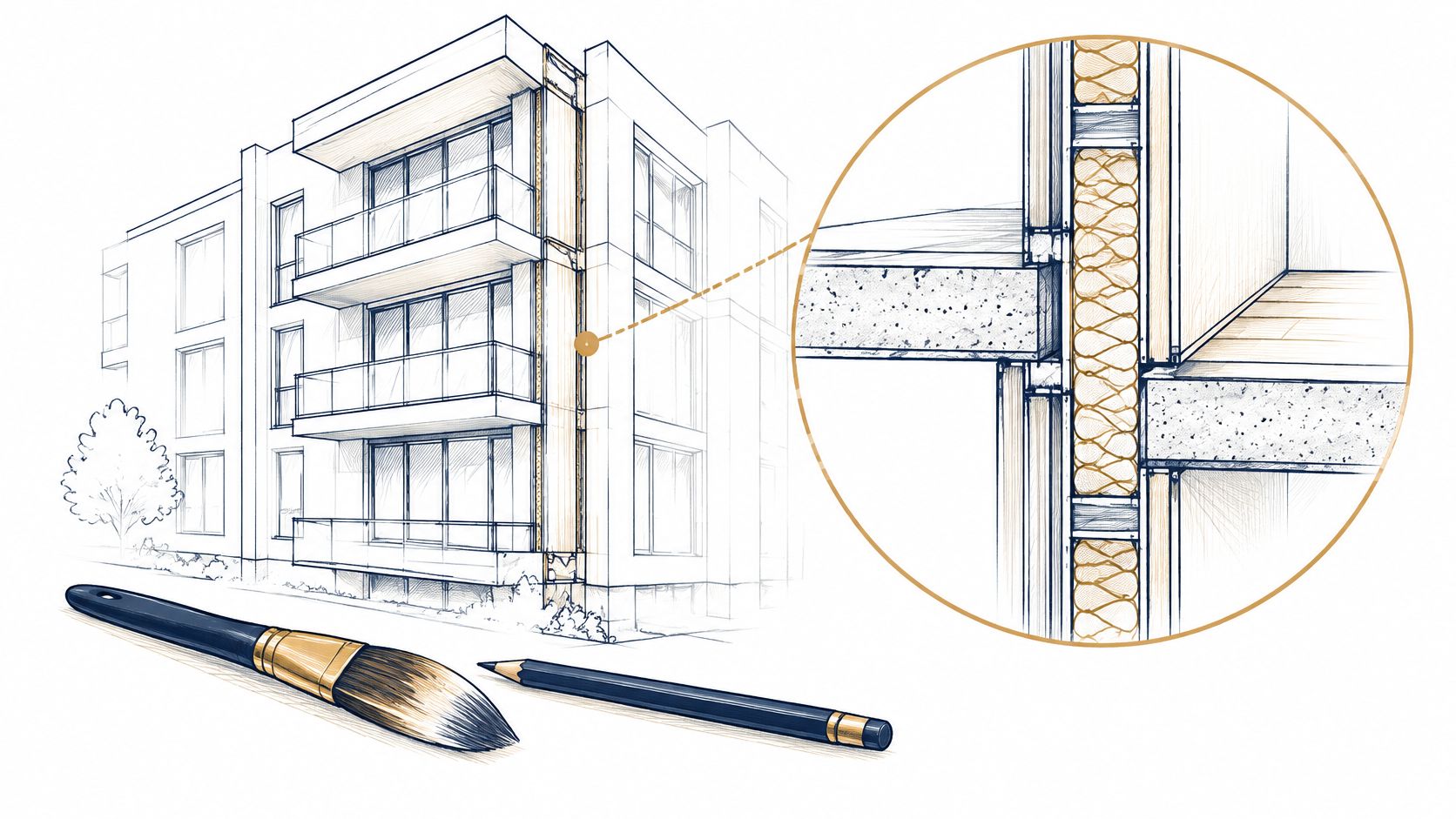
A rendering is a marketing image that shows design intent: proposed finishes, layout and unit boundaries, balconies or terraces, amenities, parking, views, and nearby features. None of those details is confirmed until it appears in the executed contract or a recorded document. Treat the image as a proposal and reconcile it against the terms that will bind the developer.
- Find the part of the purchase agreement that describes the unit, amenities, and materials.
- Compare the rendering with the plans and specifications in the offering documents.
- Read the permitted-change clause, including any notice, substitution, or equivalent-quality language.
- Confirm whether the recorded declaration and any recorded condominium plans describe the unit boundaries and common elements the image appears to show.
The sales gallery picture is the proposal. The written terms are the record.
Here is where buyers get surprised. A rendering may show open water from a corner balcony on a high floor, while the recorded condominium plans place that balcony on a different side of the building or the permitted-change clause lets the developer reduce its depth. Check the purchase agreement's unit description against the rendering before relying on either.
Any difference that matters to your decision deserves review before you rely on the image. Buyers who want to verify Gulf views in Destin condos should match the image to the plans and the recorded description, because the sales view alone cannot settle what the finished unit will look out at.
Completion and Cancellation Terms to Review
Your cancellation clock depends on two dates: when you sign and when the developer's documents arrive. Under Florida Statutes section 718.503, a buyer may cancel a contract with the developer by written notice within 15 days after both signing the contract and receiving all of the items the developer must deliver under that section, and also within 15 days after receiving an amendment that materially changes the offering in a way that is adverse to the buyer. Record when each document arrived, confirm the notice method your contract names, and don't assume the period starts when you sign.
Read every clause the same way you reconciled the developer's rendering and budget: as a proposal measured against executed terms. The contract language governs. The sales timeline does not.
- Completion or outside date: Find the date the contract uses, not a sales timeline.
- Extensions: Read developer extension and force-majeure rights, including any notice the developer owes you.
- Deposits: Read deposit-release and refund terms in the agreement you signed.
- Changes: Read material-change and substitution remedies.
- Exit and close: Read assignment limits, inspection or punch-list rights, and any financing condition.
These terms need transaction-specific legal review. This guide doesn't state a universal deadline, a deposit percentage, or a delivery date, because each contract sets its own. A lender's project review is a separate workstream from the unit file, so confirm that lender's requirements before you waive a contingency.
Place each document's delivery date next to the closing date on one calendar, and pair that schedule with the Florida closing costs you still need to verify for your contract.
Local Insurance, Coastal, and Rental Checks Before You Commit
A coastal listing can look simple until the insurance declarations, milestone timing and rental file point in different directions. Use the Destin, Miramar Beach and Sandestin, and Santa Rosa Beach buyer guides for local purchase steps, then confirm the rules for the specific building and its recorded documents.
Insurance. Request the master policy declarations and claims history where available, and ask for deductibles and exclusions in writing. Read a resale policy for future cost transfer: a high deductible or unresolved claim can become the next owner's assessment.
Coastal location. Building location and the certificate-of-occupancy date can affect milestone inspection timing. Confirm that date from records rather than the listing's construction year, and verify the current statute before relying on any age or distance threshold.
Rental eligibility. Market pages may display rental-use remarks from MLS listing data; treat them as research leads for a separate property-specific check. Rental-use due diligence considers recorded declarations and amendments, applicable association rules, and local requirements for the exact property. Use those records, and check Destin vacation rental registration only as it applies to that property.
Ask your lender early whether the project and building documents meet its requirements; that answer sits outside the association file.
Decide Only After Confirming These Four Points
By this stage you hold two kinds of paper: proposals and settled terms. A rendering, a projected budget, and a marketing summary belong to the first group. A recorded declaration, an executed contract, and a current association budget belong to the second. The final step is to put them in one place and force each claim to face its counterpart. Four checks do that work.
- Set up a three-column worksheet. For each item you care about, record what the proposal shows, what the executed agreement says, and what the recorded documents establish. An amenity that appears only in the rendering column remains a proposal until an executed or recorded document matches it.
- Reconcile the developer file in order. Start with the image, then the plan, then the contract, then the recorded declaration. Each layer either confirms the last or flags a difference to resolve. Florida law on developer contracts and Florida law on the prospectus describe what the offering materials must cover, so gaps between those materials and the contract stand out quickly.
- Read the resale file as a cost forecast. Reserves, insurance terms, and association records show which expenses the current owner carries and which may shift to you after closing. A low monthly fee paired with thin reserves is a future cost, and a high deductible is a future cost, even though neither appears in the list price.
- Count what is still unconfirmed. Before signing, list every item the worksheet could not settle. Each one needs a document, a written answer, or professional review specific to your transaction. Any point still open after those three requests is a reason to pause before signing.
The worksheet gives you a file you can hand to anyone advising you. Brian Burgett, Broker/Owner, can help you gather the records and organize the questions. The documents and the signed contract settle the points themselves.


