
Closing Escrow vs Mortgage Escrow: Why the Two Are Different
Closing Escrow vs Mortgage Escrow: Why the Two Are Different. See who holds your deposit, what each account pays and when each one ends.

On this page
On this page
Closing escrow and mortgage escrow are two separate accounts. Closing escrow is temporary: a third party such as a title company holds the earnest money deposit and closing funds until the sale closes. Mortgage escrow is ongoing: the loan servicer collects part of each monthly payment and pays property taxes and homeowners insurance from it.
Both accounts can appear on the same Closing Disclosure and still never merge.
Table of Contents
- Two Escrow Accounts With Different Jobs
- Side-by-Side Comparison of the Two Accounts
- Who Holds Closing Funds Under Florida Rules
- What Mortgage Escrow Pays and What It Leaves Out
- How Mortgage Escrow Starts and Changes After Closing
- Confirm Your Holder and Escrow Bills Before Closing
Two Escrow Accounts With Different Jobs
Earnest money is the deposit a buyer pays to show good faith on a signed contract to buy a home. The CFPB mortgage key terms explain that it may be held by the seller or by a third party such as a real estate agent or title company, and that if the transaction closes, the deposit can be applied to closing costs or the down payment.
Your purchase contract names the holder. That makes the escrow or deposit clause the first thing to read, ahead of any loan paperwork.
Here is where readers get stuck. The contract says the deposit goes into escrow. The lender says the monthly payment includes escrow. Both sentences are accurate, and they describe accounts with different holders, different money and different end points. Closing escrow protects funds tied to one purchase contract. Mortgage escrow is a servicing account tied to the loan itself.
The comparison that follows runs through purpose, holder, inputs, payouts, end point, contacts and governing rules. Your own purchase contract and loan documents control your transaction. If the sale does not close, the purchase contract decides where the deposit goes, so read that clause before signing anything.
Side-by-Side Comparison of the Two Accounts
Treat closing escrow vs mortgage escrow as a row-by-row comparison rather than a choice between two versions of one account. The row that separates them fastest is the holder.
| Feature | Closing escrow | Mortgage escrow |
|---|---|---|
| Purpose | Holds earnest money and closing funds for one purchase contract until the sale closes or the funds are disbursed | Collects part of each monthly payment to pay property taxes and homeowners insurance over the life of the loan |
| Who holds the money | Seller, real estate agent, title company, attorney or other party the purchase contract names | Mortgage lender or loan servicer establishes or controls the account |
| What goes in | Earnest money deposit and closing funds the contract requires | Monthly escrow portion of the mortgage payment, plus any initial escrow payment shown on the Closing Disclosure |
| What is paid out | Applied to closing costs or the down payment when the sale closes, or disbursed as the contract and applicable law require | Property taxes, homeowners insurance, flood insurance and other permitted property charges the servicer pays when due |
| When it ends | When the sale closes and funds are disbursed, or when the contract ends without closing | Continues while the loan has an escrow account and the servicer issues annual statements |
| Who answers questions | Real estate agent or settlement agent such as a title company, escrow officer or attorney | Lender or loan servicer |
| Governing source | Purchase contract terms, plus Florida Statutes sections 475.25(1)(k) and 626.8473 for brokers and title insurance agencies | Regulation X, 12 CFR 1024.17, for federally related mortgage loans |
Both columns borrow one word, which is why the holder row deserves the first look. Two qualifiers belong beside those rows. The closing side covers funds tied to a single purchase contract, and the mortgage side covers federally related mortgage loans governed by Regulation X.
No dollar figures appear in the table because amounts depend on your contract terms and on the escrow analysis your lender runs for your loan.
A buyer can hold both accounts at once. Closing escrow ends at disbursement, and mortgage escrow starts with the loan. For how the deposit and the initial escrow payment sit side by side on the settlement statement, see Dream Destin Realty's closing disclosure comparison.
Who Holds Closing Funds Under Florida Rules
Your deposit can sit with a broker, a title insurance agency or an attorney, and Florida law treats each holder differently.
A Florida real estate broker who accepts a deposit must act fast. Under section 475.25(1)(k), Florida Statutes, the broker must immediately place the deposit in escrow with a title company, banking institution, credit union or savings and loan association located and doing business in Florida, or in the broker's own trust or escrow account. The money stays there until disbursement is properly authorized. Authorized disbursement is where the closing holder's role ends.
A title insurance agency follows a separate rule. Under section 626.8473, Florida Statutes, funds the agency receives for a real estate closing are trust funds held in a fiduciary capacity. They remain the property of the persons entitled to them, they are not subject to the agency's debts, and they may be used only in accordance with the escrow, settlement or closing instructions under which they were accepted. The written instructions, not the agency's preference, control the release.
These two statutes name brokers and title insurance agencies. If an attorney holds the closing funds, ask the attorney which rules apply.
Both are statewide statutes. A closing in Destin or elsewhere in Okaloosa County follows the same rules as one in Miramar Beach or Santa Rosa Beach in Walton County, with no local variation attached.
Ask the holder in writing: who holds the deposit, where the funds are kept, and which written instructions govern release.
What Mortgage Escrow Pays and What It Leaves Out
After closing, the loan servicer collects part of each monthly mortgage payment into an escrow account and uses it to pay property taxes and homeowners insurance when the bills come due. For federally related mortgage loans, flood insurance and other permitted property charges can be collected the same way under 12 CFR 1024.17(b).
An annual property tax bill spread across twelve monthly payments means one-twelfth is collected each month. An insurance premium builds in the account until the servicer sends payment when the bill comes due.
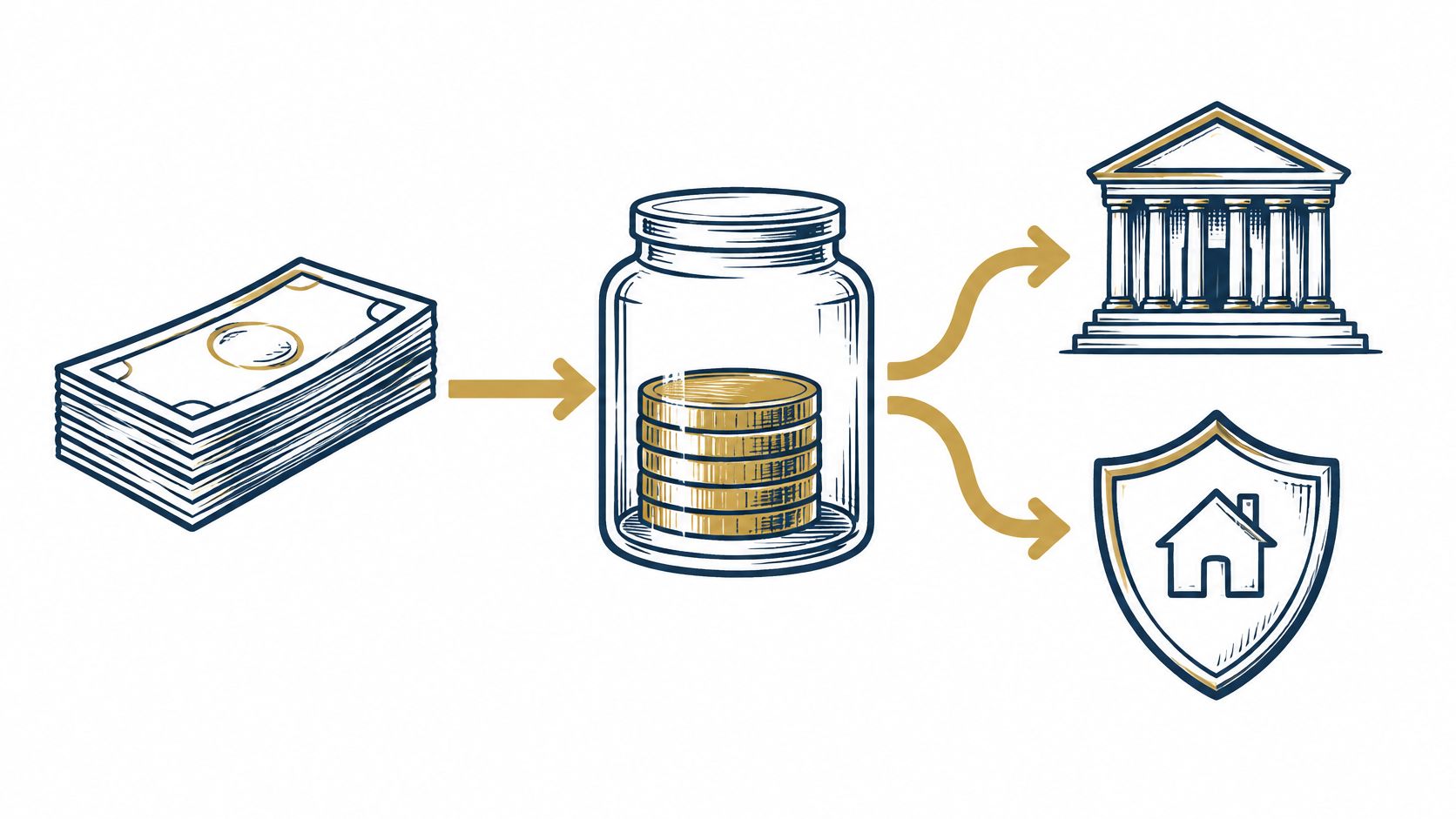
The escrow account section of the Closing Disclosure states whether the loan has an escrow account, which homeownership expenses are included, and the estimated costs, as the CFPB Closing Disclosure explainer sets out. It also notes that homeowners association fees are often not included.
Condo and townhome buyers should read that section closely and budget for any association cost it does not list. Do not assume an association's fees are escrowed or excluded. Confirm it with the lender.
List each annual property bill, then mark whether escrow covers it or you pay it directly. For the costs that never touch escrow, Dream Destin Realty's homebuying cost guide covers what buyers pay outside the loan.
How Mortgage Escrow Starts and Changes After Closing
The closing holder's role ends at authorized disbursement. Once the funds are paid out at settlement, the title company or closing agent has finished its part, and the servicer's part begins. The line Initial Escrow Payment at Closing on the Closing Disclosure establishes the starting balance of the mortgage escrow account, and it is a separate item from the earnest money deposit. From the first monthly payment onward, the servicer answers for that account.
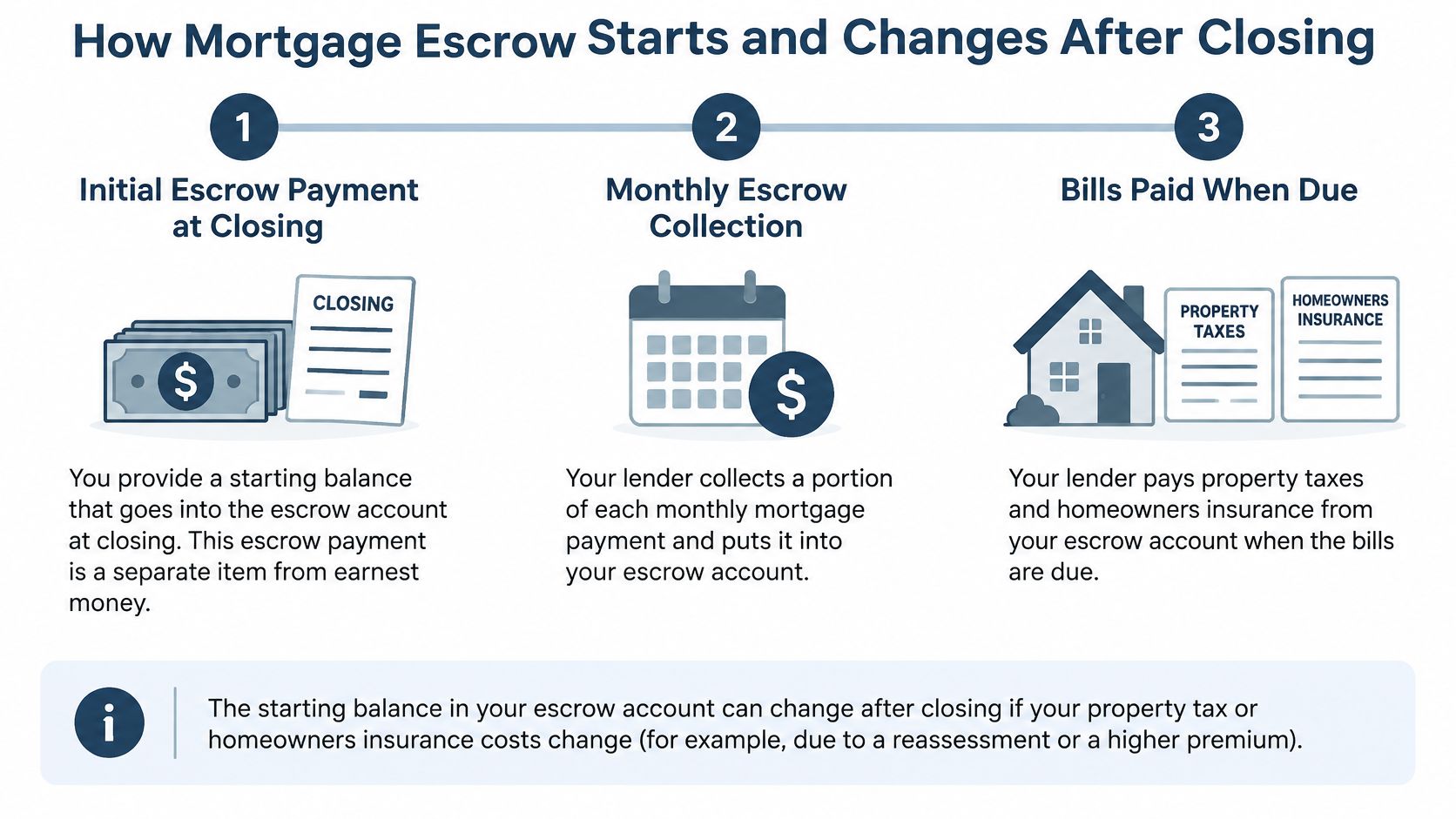
The account then runs on a yearly cycle. Once per escrow account computation year, the servicer analyzes it and sends an annual statement covering what was collected, what was paid out and what the next year's payment will be. Property taxes and insurance premiums change from year to year, so the escrow payment and the total monthly payment change with them. The escrow figure moves with your tax and insurance bills.
The escrow portion can move even when the interest rate cannot.
For federally related mortgage loans, Regulation X, 12 CFR 1024.17 sets the schedule and limits for that cycle.
| Rule | Timing or limit |
|---|---|
| Initial escrow account statement | At settlement or within 45 calendar days of settlement (12 CFR 1024.17(g)) |
| Cushion limit | No greater than one-sixth of the estimated total annual payments from the account (12 CFR 1024.17(c)) |
| Annual escrow statement | Sent within 30 days of the end of the escrow account computation year (12 CFR 1024.17(i)) |
| Surplus refund | 50 dollars or more, refunded within 30 days of the analysis when the borrower is current (12 CFR 1024.17(f)) |
The loan documents control the exact amounts for your loan. The escrow portion is only part of the monthly payment question; for the rate side, see questions to ask before choosing a mortgage.
Confirm Your Holder and Escrow Bills Before Closing
One moment divides the two accounts: disbursement. The holder named in your purchase contract, often a title company, keeps the deposit until closing releases the funds under the contract's instructions, and that role ends there. The servicer's role starts after, with the first escrow payment folded into your monthly mortgage payment, and continues for as long as the loan carries the account. Those are two separate jobs that never merge.
The checklist below condenses the steps that usually settle the matter.
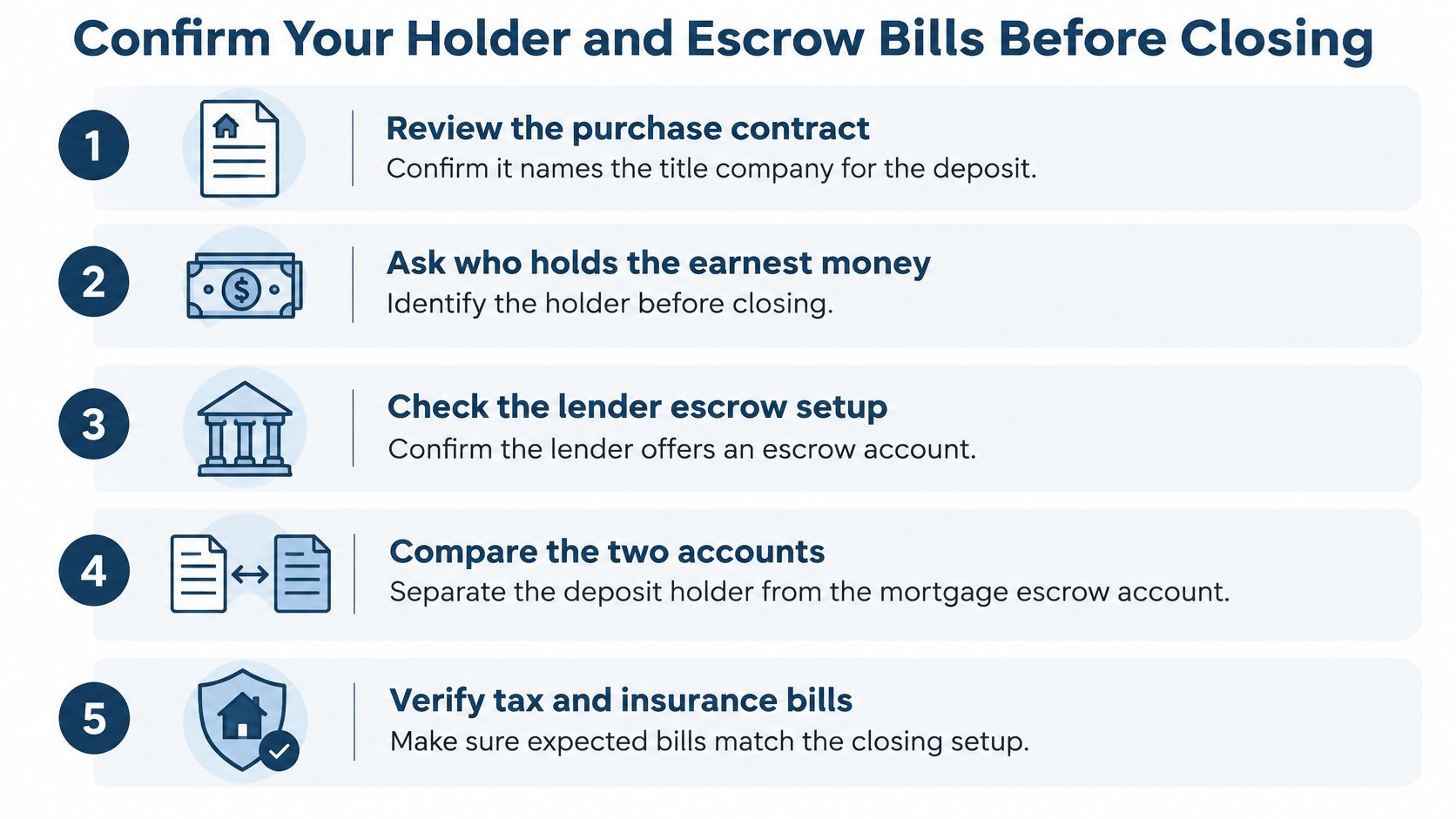
Before disbursement, direct questions to the holder named in the contract. After it, direct them to the servicer. One case breaks the pattern entirely: a loan with no mortgage escrow account. You then pay property taxes and homeowners insurance directly, and if those bills go unpaid, the CFPB explanation of escrow and impound accounts notes that the lender may add the amounts to the loan balance, add an escrow account, or buy force-placed insurance and bill you for it. The Closing Disclosure also shows whether an escrow waiver fee is charged.
Three Actions Before You Sign
- Name the holder. Ask the closing agent who holds the deposit and the closing funds, and get a written receipt that names that party.
- Read the escrow section. Mark on the Closing Disclosure which homeownership expenses the mortgage escrow account covers.
- Time the first statement. Ask the lender or servicer which bills the servicer will pay and when the first annual statement is expected.
Route questions about the terms of the sale to your real estate agent or settlement agent, including a title company, escrow officer or attorney. Route questions about the loan to the lender, as the CFPB guide to closing the deal sets out.
Your purchase contract and loan documents control, and your closing agent, your lender or servicer and a Florida real estate attorney confirm how the rules apply to your transaction. For the budget side of the same closing, see Florida closing costs. Questions about a specific transaction can go to Dream Destin Realty through the Dream Destin Realty contact page.
For how these checks fit the wider purchase sequence, see Dream Destin Realty's plain guide to buying a house.
Dream Destin Realty publishes buyer resources for Destin, Miramar Beach, Santa Rosa Beach and the rest of the Emerald Coast, including plain explanations of the settlement documents where both escrow accounts appear. If you want help locating the deposit clause in a contract and the escrow account section on a Closing Disclosure before you commit, the brokerage can point you to the right page and the right person to ask. Visit Dream Destin Realty to review the buyer guides, then bring your questions to the contact page.


