
What Happens on Closing Day When Buying in Florida
Learn what happens on closing day in Destin, Miramar Beach and Santa Rosa Beach: who attends, what you sign, and when the home is yours.

On this page
On this page
On closing day the buyer and seller sign the final documents, the buyer's funds and any loan proceeds are paid through the closing agent, and ownership passes to the buyer. The deed is then recorded with the county Clerk of Court. If the contract provides for a final walkthrough, it comes before signing. Keys change hands as the contract provides.
Table of Contents
- What Happens on Closing Day, Start to Finish
- What You Should Receive Before the Day
- Who Is in the Room and Who Represents You
- What You Sign and Who Signs It
- How the Money Moves at Closing
- When Is the Deed Recorded and When Is the Home Yours?
- Closing Day Questions Buyers Ask
- Ask for Your Closing Documents a Few Days Ahead
What Happens on Closing Day, Start to Finish
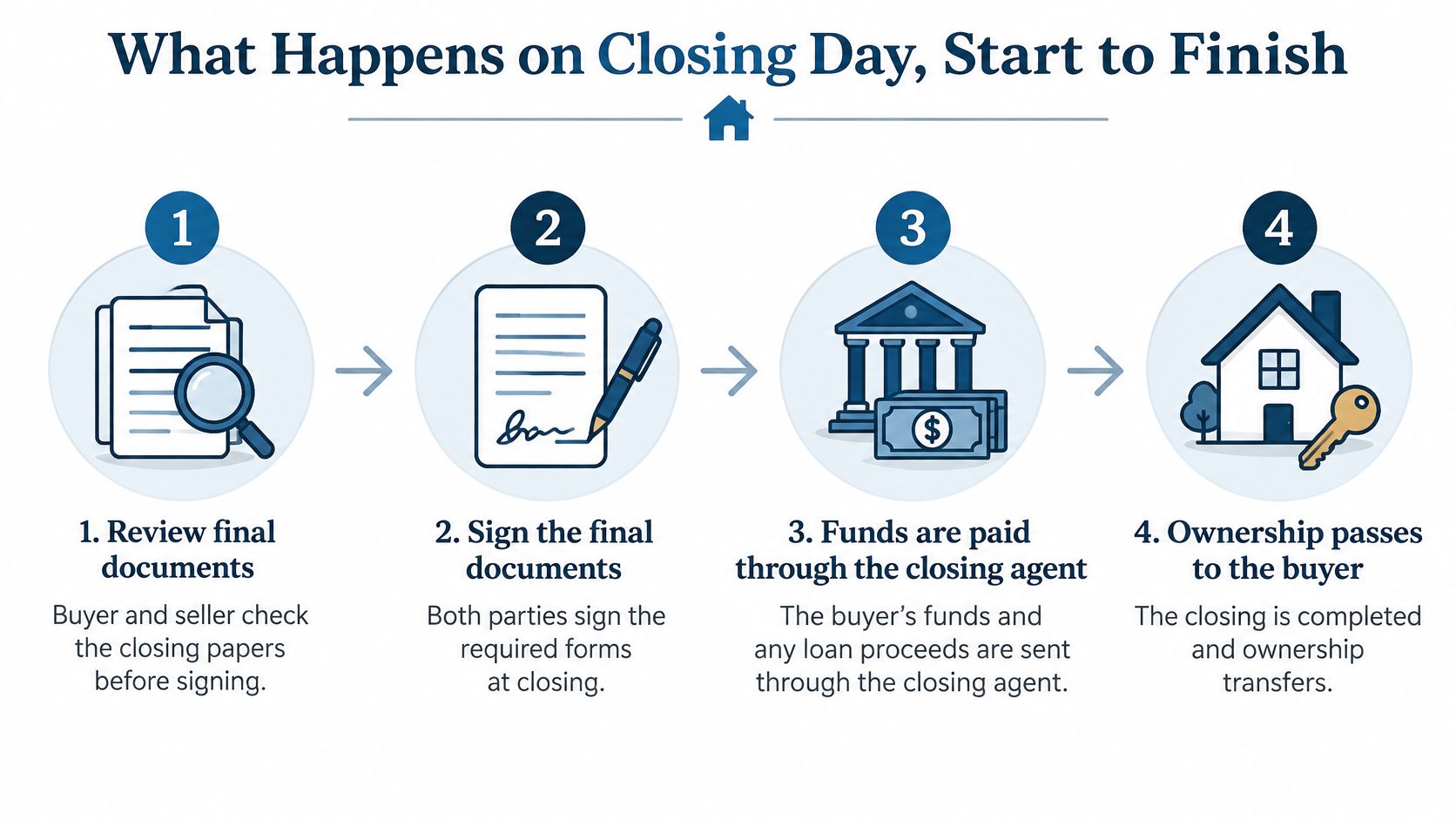
The Consumer Financial Protection Bureau's explanation of a mortgage closing uses two names for one appointment. Closing, also called settlement, is when you and the other parties sign the necessary documents. With a mortgage, the loan closing and the purchase closing, the moment you become the owner, typically happen at the same time.
- Final walkthrough, if the contract provides one. It happens before any signing.
- Loan documents. The buyer with a loan signs the note and the security instrument.
- The deed. The seller signs the transfer of title.
- Funds. The buyer's money and any loan proceeds move to the closing agent.
- Disbursement. The closing agent pays the charges the documents list.
- Recording. The deed goes to the Clerk of Court once it meets Florida's recording requirements.
- Keys. Possession changes hands as the contract provides.
The longer path from first search to this table, including the checkpoints that come before closing day, sits in home buying checkpoints explained.
What You Should Receive Before the Day
The three-business-day rule is the fixed point on the calendar. Under CFPB guidance on when you get a Closing Disclosure, most buyers with a mortgage must receive the form at least three business days before closing. That page names exceptions, including reverse mortgages and home equity lines of credit, so confirm with your lender which rule applies to your loan.
Paying cash changes the picture. Ask the closing agent for the settlement statement well ahead of the appointment anyway, because the same careful review the rule protects for borrowers is worth giving yourself on a cash deal.
Review the figures, not just the form. Compare the Closing Disclosure against the Loan Estimate and the terms you already agreed to before you sit down at the table.
One line on the disclosure deserves a second read before anything else: Cash to Close. The cash to close comparison guide works through that reconciliation line by line.
Who Is in the Room and Who Represents You
Expect the buyer and any co-borrowers, the seller or the seller's agent, and the closing or settlement agent who handles the legal transfer of title, according to the CFPB's list of who attends a mortgage closing.
Ask who is on your side. Unless you hire an attorney to represent you at closing, no one else participating in the closing exclusively represents your interests, as the CFPB states directly.
A neutral coordinator can still be a good source for logistics. Before the appointment, ask the closing agent, “Which party do you represent in this file, and which questions should I take to my lender or attorney?” The answer separates help with process from advice about your interests. Whether a Florida residential closing requires an attorney is a different question; ask a Florida real estate attorney whether to hire one for the purchase.
What You Sign and Who Signs It
Everything in this section happens at the table, before anything is recorded. The order is simple: the buyer signs the loan package, the seller signs the deed, and the closing agent watches each signature land where it belongs.
If you are buying with a loan, two of your documents do the heavy lifting. The promissory note is your written promise to repay what you borrowed. The security instrument, called a mortgage or a deed of trust depending on the document, pledges the property as security for that promise.
The seller signs the deed, the document that transfers ownership to you. Florida requires a deed to be in writing and signed in the presence of two subscribing witnesses (s. 689.01, Florida Statutes), which is why those extra signatures appear on that one page.
| Document | What it does | Check before you sign |
|---|---|---|
| Promissory note | Records your promise to repay the loan | Loan amount, rate and payment schedule match your Closing Disclosure |
| Security instrument (mortgage or deed of trust) | Pledges the property as security for the note | Legal description and your name match the property and your ID |
| Deed | Transfers ownership from seller to buyer | Names of all parties and the legal description are correct |
Read each page before you sign it. Ask the closing agent for copies of anything you do not understand.
How the Money Moves at Closing
Payment usually happens one of two ways: a cashier's check delivered to the closing agent, or a wire transfer, per the CFPB Closing Disclosure explainer. The closing agent tells you which method the office accepts and the exact amount due, so confirm both a few days ahead rather than on the morning of signing.
Once your funds and any loan proceeds are in the agent's account, the agent pays the charges the documents list.
Florida also charges documentary stamp tax on the deed under s. 201.02, Florida Statutes, and that charge appears on the settlement statement. Who pays it is a contract term, so read your purchase contract rather than assuming the seller covers it.
Each charge is broken down in Florida closing costs. The rule that protects your payment is simpler.
Call a known number before you wire.
When Is the Deed Recorded and When Is the Home Yours?
Under s. 695.01, Florida Statutes, a conveyance of real property isn't good against creditors or later purchasers for value without notice unless it's recorded according to law.
The clerk of the circuit court records the deed once it meets the recording requirements of s. 695.26, Florida Statutes. For a Destin purchase, that clerk is the Okaloosa County Clerk, whose official records are searchable at okaloosaclerk.com. For Miramar Beach and Santa Rosa Beach, it's the Walton County Clerk.
Don't plan around a fixed recording time or a fixed key time. Possession follows the contract rather than the signature.
Ask two questions before the day. When will the deed be submitted for recording, and how will the recorded deed reach you afterward?
Closing Day Questions Buyers Ask
What if the amount I'm asked to pay doesn't match the Closing Disclosure?
Pause before you pay. Compare the line items side by side. Ask the closing agent to explain the difference, and hold off on signing or sending funds until both figures agree.
What if I spot an error in a document at the table?
Speak up before you sign. A misspelled name or a wrong number is easiest to fix at the appointment, while the closing agent can still correct and reprint the page.
What costs should I have budgeted for before today?
The amount due at the table is the last charge in a longer line of them. The Emerald Coast home buying cost checklist sets out the charges that arrive before the closing table, so you can compare what you planned against what the settlement statement shows.
Ask for Your Closing Documents a Few Days Ahead
One short call a few days before closing removes most of the uncertainty from the day itself. Ask the closing agent for the closing documents and the amount due, and confirm when you will receive both. Then read what arrives line by line, while there is still time to ask questions and have errors corrected before the appointment.
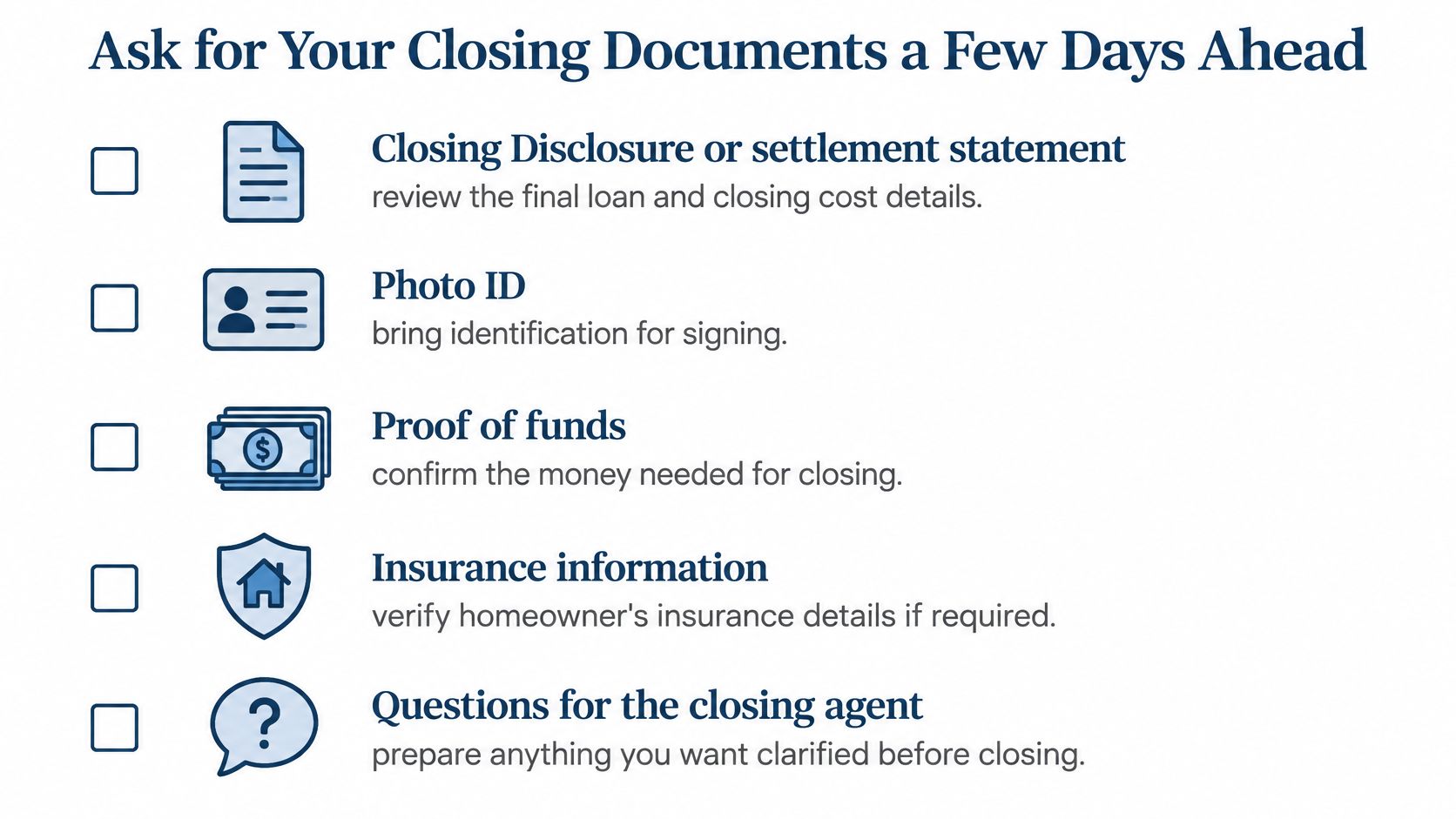
- The Closing Disclosure or settlement statement. Read the loan and closing cost details, not only the bottom line.
- The amount due and the payment method. Confirm the figure, the payee and whether the office accepts a cashier's check or a wire.
- The deed signing requirements. Ask how the two-witness requirement will be met for your file.
- The recording plan. Ask when the deed goes to the Clerk of Court and how the recorded copy reaches you.
Take questions about the contract itself to a Florida real estate attorney. Your contract and your lender control the specifics of your transaction, and the paperwork you reviewed ahead of time is what those specifics look like on paper.
Dream Destin Realty provides live listings, local market intelligence and the ability to connect with a local expert. Send questions about a specific property or about preparing for your appointment through the brokerage contact page.


