
Condo Fees vs HOA Dues in Florida: What Each Must Cover
Condo fees vs HOA dues in Florida: see which law governs each, what each must cover and what owners still pay separately.

On this page
On this page
Condo fees and HOA dues pay for different things. In Florida, a condominium association under Chapter 718 maintains the common elements, insures the building and must budget reserves, so the fee carries those costs. A homeowners' association under Chapter 720 maintains shared common areas, while each owner usually insures and maintains the house.
Two Destin properties can carry the same monthly association charge and leave an owner with entirely different bills. The reason sits in the statutes, not in the amount.
Table of Contents
- What Separates a Condo Fee From an HOA Due?
- Which Florida Statute Governs Each Charge?
- What Must a Condo Fee Pay For and What Do Owners Insure?
- What Does an HOA Due Pay For and What Do Owners Maintain?
- How Do Reserve Rules Differ Between a Condo and an HOA Budget?
- What Documents Does a Buyer Receive and When?
- What Should You Confirm Before Comparing Two Charges?
- What Are the Answers to Common Condo Fee and HOA Due Questions?
What Separates a Condo Fee From an HOA Due?
Start with what each charge is built to cover, and the dollar figure becomes the last question instead of the first. A homeowners' association, or HOA, and a condominium association look similar on a listing sheet and act nothing alike once you read the law behind each one.
| Point | Condo association | HOA |
|---|---|---|
| Governing law | Chapter 718, Florida Statutes; common expenses are defined in s. 718.115 | Chapter 720, Florida Statutes; s. 720.302(4) says Chapter 720 does not apply to an association regulated under Chapter 718 |
| Building insurance | The association must carry adequate property insurance (s. 718.111(11)), and its cost is a common expense (s. 718.115(1)(f)) | The owner usually insures the house; confirm the covenants |
| Maintenance | Operating, maintaining, repairing, replacing or protecting the common elements and association property (s. 718.115(1)(a)) | Shared common areas as defined in the recorded covenants; the owner usually maintains the house |
| Reserves | The budget must include reserve accounts for capital expenditures and deferred maintenance (s. 718.112(2)(f)) | The budget may include reserve accounts (s. 720.303(6)) |
| Buyer documents | Declaration, articles, bylaws, rules, annual financial statement and budget, and the most recent structural integrity reserve study (s. 718.503(2)) | A disclosure summary before the contract is signed (s. 720.401) |
| Owner pays separately | Personal property and items inside the unit, including floor, wall and ceiling coverings, appliances, water heaters and built-in cabinets (s. 718.111(11)(f)) | The house, its upkeep and its insurance, usually, plus any condominium or master association due on the property |
Read the table by column and the pattern holds. Every row describes a duty, not a price. That's why two monthly amounts can't be read as the same kind of cost. The same figure buys building insurance in one column and shared landscaping in the other.
Which Florida Statute Governs Each Charge?
Chapter 718, Florida Statutes, governs condominium associations. Chapter 720 governs homeowners' associations, and s. 720.302(4) states plainly that Chapter 720 does not apply to an association regulated under Chapter 718. The line between them is legal, not visual.
Condominium is a form of ownership under s. 718.103, not a building style. A townhome can be a condominium. A detached house in a gated community can sit under an HOA. Nothing about the roofline or the mailbox cluster settles it.
Ask the document, not the sign: the association's name and the look of the property don't decide which chapter applies. The recorded declaration does.
Three confirmation steps settle it for a specific address.
- Find the recorded declaration. Pull it from the county public records for the parcel, usually through the clerk's official records search.
- Read the opening pages. The declaration describes what the association owns and maintains.
- Ask which assessments apply. Some properties pay a condominium association and a separate master or homeowners' association, and both collect. Request a list of every association charging the property.
The law is statewide. It works the same way in Destin, Miramar Beach and Santa Rosa Beach, and no local rule changes which chapter governs a given association.
What Must a Condo Fee Pay For and What Do Owners Insure?
A condo fee does two jobs under one statute. s. 718.115 defines common expenses in subsection (1)(a) as operating, maintaining, repairing, replacing and protecting the common elements and association property, and subsection (1)(f) puts the association's insurance costs on that same list. s. 718.111(11) requires every condominium association to carry adequate property insurance.
The statute then draws the line inside the unit. The association's policy excludes personal property and named interior items: floor, wall and ceiling coverings, appliances, water heaters and built-in cabinets. Subsection (11)(f) assigns those to the unit owner.
The common elements come from the declaration, not from assumption. Check its definition before deciding a roof, an exterior wall or a shared mechanical system is the association's cost.
From there, confirm the unit-owner side with a licensed insurance agent, since no statute here says what a particular building's policy covers. For the association's half of the same list, check condo association duties.
What Does an HOA Due Pay For and What Do Owners Maintain?
The HOA budget is the list. s. 720.303(6) requires the annual budget to set out annual operating expenses, and subsection (6)(a) requires fees paid for recreational amenities to be listed separately. That separation lets a reader see amenity spending apart from administration and common-area upkeep.
Read the lines as categories of work: amenity-center operations, pool service, maintenance and irrigation for entrances or medians, management, legal, and any reserve contribution the association includes.
To find the split in a specific community, open the recorded declaration's maintenance section and match each item to a budget line: roof, siding, yard, fence, private road, exterior paint. Ask whether a special assessment is pending. For shared structures, Dream Destin Realty's balcony maintenance breakdown shows how that owner-versus-association analysis runs.
How Do Reserve Rules Differ Between a Condo and an HOA Budget?
Two questions decide whether a reserve line means anything: what does it show, and does a study exist behind it? For condominiums, s. 718.112 requires reserve accounts for capital expenditures and deferred maintenance under subsection (2)(f). Subsection (2)(g) requires a residential condominium association to have a structural integrity reserve study at least every 10 years for each building three habitable stories or higher, with the exemptions the statute lists.
Section 720.303(6) says an HOA budget "may include reserve accounts for capital expenditures and deferred maintenance for which the association is responsible."
Ask each association for the current budget, find the reserve line, and ask whether a structural integrity reserve study has been completed for a building that falls under s. 718.112(2)(g). For more on how those studies work and how to read the budget line they produce, see condo reserve advice from Dream Destin Realty.
What Documents Does a Buyer Receive and When?
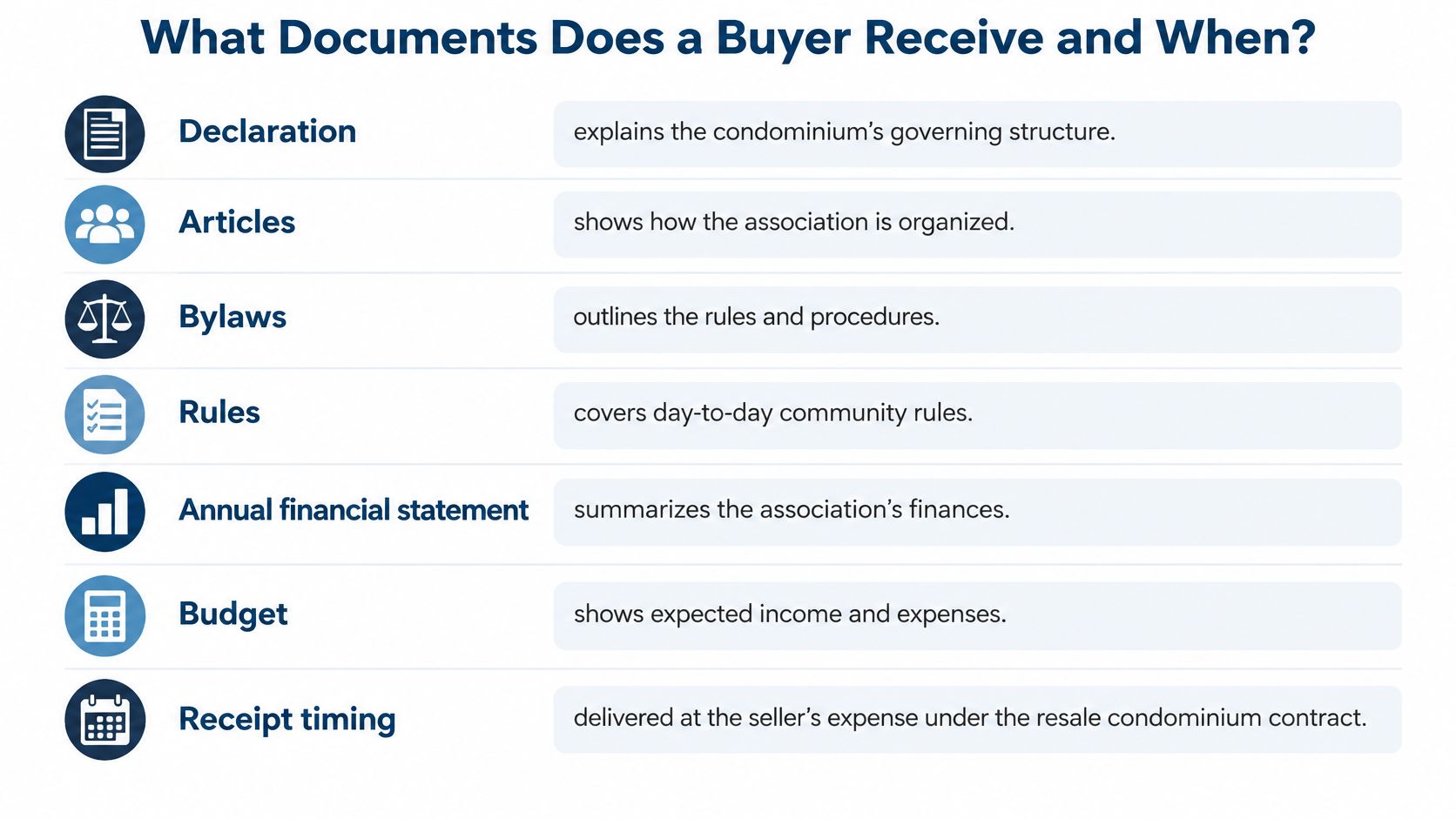
Two statutes set two different delivery clocks. Section 718.503(2) entitles a buyer under contract for a resale condominium unit, at the seller's expense, to the declaration, articles, bylaws and rules, an annual financial statement and the annual budget, and the most recent structural integrity reserve study or a statement that none was completed, among other items the statute lists.
Section 720.401 works on an earlier clock. It requires an HOA disclosure summary before the contract is signed, and that summary states assessments are owed and may change. The condominium statute delivers a document set during the contract period. The HOA statute delivers a shorter notice before signature, so the two papers carry different weight at different moments in the purchase.
Before the contract: the HOA disclosure summary arrives while the buyer can still decide, which puts the assessment warning on the table early.
The condominium package rewards slow reading, and a worked example shows why. A buyer can compare the date on the structural integrity reserve study against the reserve line in the current budget: a recent study paired with a thin reserve line reads differently than a recent study paired with a funded one. Each document answers a different question, so the checklist below pairs the paper with what it tells you.
- Current budget: the page that shows what the charge funds, line by line.
- Declaration and amendments: the document that defines common elements and maintenance duties.
- Board meeting minutes: where pending special assessments surface.
- Special assessments: any approved, pending or recently completed charge, kept separate from the monthly amount.
For buildings subject to inspection rules, Florida condo milestone inspection deadlines explain the timing that can drive later work.
What Should You Confirm Before Comparing Two Charges?
Two monthly figures can sit side by side on a listing sheet and fund entirely different obligations. A condominium fee may carry building insurance, common systems and required reserves. Until every line is assigned to an association or to the owner, the lower number says nothing about which property costs less to hold.
- Confirm the governing chapter in the recorded declaration, and note whether a second association also charges the property.
- Run the document checklist on each association covered above: current budget, declaration and amendments, board minutes, and any approved or pending special assessments.
- Add the owner's separate costs beside each charge, starting with unit or home insurance, exterior upkeep and any flood coverage the owner carries.
- Route each question to the right professional: coverage terms to a licensed insurance agent, budget line items to the association, and legal rights to a Florida real estate attorney.
An HOA due that reads lower on the sheet can still leave the owner paying for the roof, exterior and full dwelling coverage out of pocket, so the two totals only become comparable after every row is filled in.
The full method for lining up two associations sits in the fee comparison guide, and buyers building a full purchase budget can start with the budget breakdown from Dream Destin Realty. Dream Destin Realty helps clients review available building records, including association information, inspections, reserves, rental rules and insurance, as part of purchase due diligence.
What Are the Answers to Common Condo Fee and HOA Due Questions?
Can one property owe both a condo fee and an HOA due?
Yes. A condominium unit can sit inside a neighborhood that also has a homeowners' association, so a buyer may see a condo fee charged under Chapter 718 alongside a second charge from the community or master association. Section 720.302, Florida Statutes, states that Chapter 720 does not apply to an association regulated under Chapter 718. Add both charges together, then add the owner's separate insurance and upkeep, before comparing that property with one that pays a single monthly fee.
What should you do when a budget shows no reserve line?
Check which chapter governs the association first. Under s. 718.112(2)(f), Florida Statutes, a condominium budget must include reserve accounts for capital expenditures and deferred maintenance, so a condo budget with no reserve line deserves a direct question to the association. An HOA budget faces a different rule: s. 720.303(6) says it may include reserves. Ask either association for its current budget and read what it funds rather than assuming the two figures cover the same ground.
If the association insures the condo building, what is left for the unit owner to cover?
Everything the statute leaves outside the association's policy. Section 718.111(11), Florida Statutes, requires the association to carry adequate property insurance, but that policy excludes personal property and items inside the unit, including floor, wall and ceiling coverings, appliances and built-in cabinets. Because s. 718.115 makes the association's premium a common expense, part of the monthly fee already buys the building coverage. The interior items remain the owner's responsibility to insure, and a licensed insurance agent can match a policy to those exclusions.
Who supplies the association paperwork, and when does it have to arrive?
The timing differs by chapter. For a resale condo, s. 718.503(2), Florida Statutes, entitles the buyer under contract to the declaration, bylaws and rules, an annual financial statement and the annual budget, at the seller's expense. For a home in an HOA, s. 720.401 puts the disclosure summary in the buyer's hands before the contract is signed, so a buyer who has not received it should raise that before signing rather than after. A Florida real estate attorney can explain what each delivery means for the buyer's rights.
Dream Destin Realty works with Emerald Coast buyers who want the association records read before they commit, including available inspection reports, reserve information, rental rules and insurance documents. Send the property address and the association name, and the brokerage will walk through what the documents show and flag what still needs a licensed insurance agent or a Florida real estate attorney. Visit Dream Destin Realty to start that review.


