
Condo Renovation Approval vs Building Permits: Why Buyers Check Both
Condo Renovation Approval vs Building Permits: Why Buyers Check Both. Learn which records to request and how to match them on the Emerald Coast.

On this page
On this page
Association approval and a government building permit are separate approvals, and one does not replace the other. A board letter records what the condominium allowed. A permit record records what the building authority reviewed. A buyer who checks only one has answered half the question and closed the file too early.
The counterintuitive part is that the more finished a unit looks, the easier it becomes to skip the paperwork. New tile, a relocated vanity, a swapped water heater: the work reads as evidence of its own quality. None of it records who approved what. Two separate trails exist for a reason, and each one stops exactly where the other begins.
Table of Contents
- What Association Approval and a Permit Each Prove
- Which Office Checks Your Address
- How to Trace a Renovation Through Both Approval Chains
- Which Details Must Match Across Records
- When a Closed Permit or Finished Work Still Leaves Gaps
- Decide What to Request Before You Move Forward
- Frequently Asked Questions About Approvals and Permits
What Association Approval and a Permit Each Prove
Two different reviewers can look at the same bathroom and write two different conclusions, and neither one is wrong. The association answers a private question: did this building's own rules allow the work? The building department answers a public one: does the work meet the code the jurisdiction enforces? The 2026 Florida Statutes text of section 553.79 makes it unlawful to construct, erect, alter, modify, repair, or demolish a building without first obtaining a permit from the appropriate enforcing agency, unless a specific statutory exception applies, and it requires the permitting authority to review plans and specifications for Florida Building Code compliance before issuing that permit.
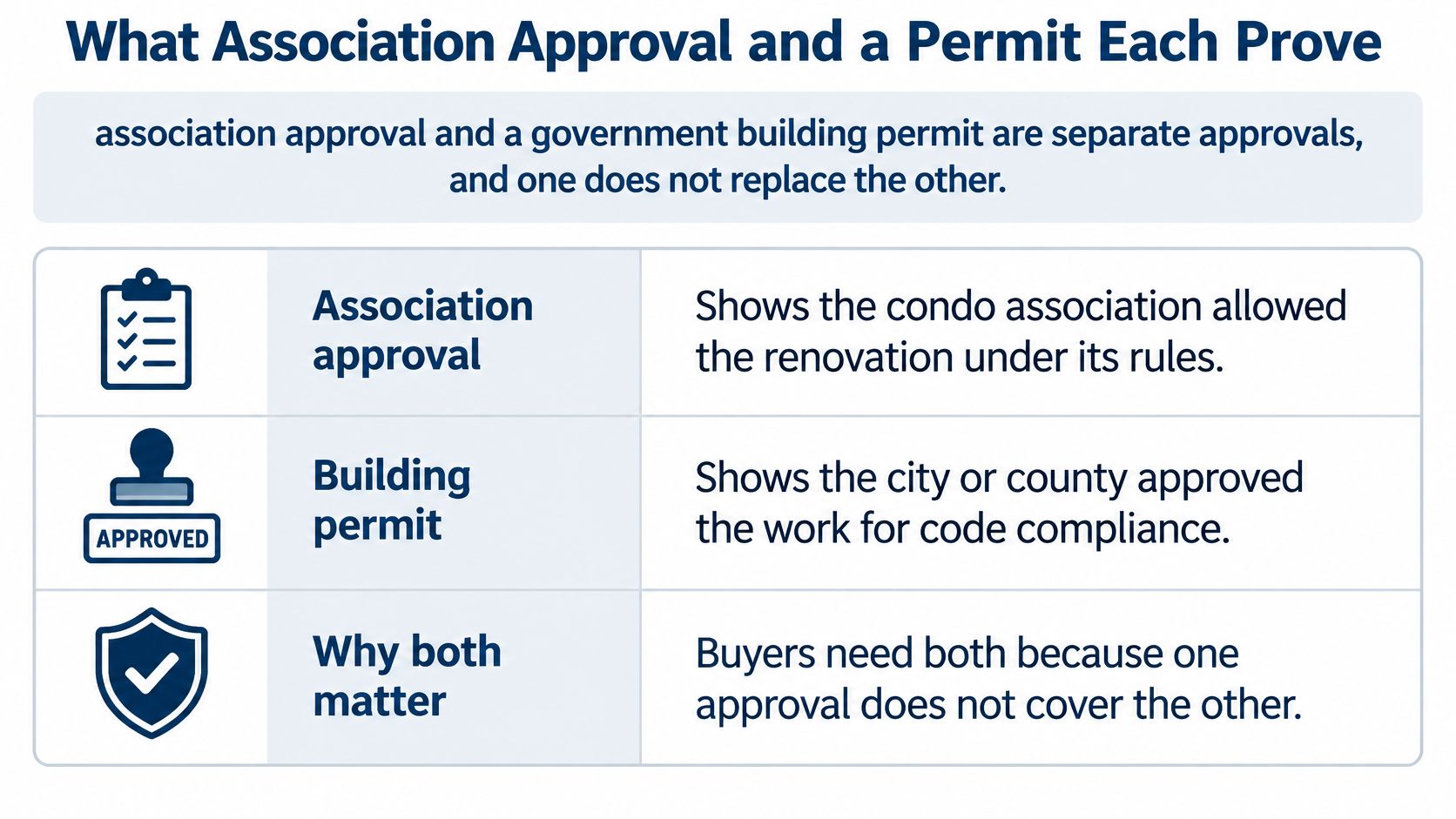
A signed approval letter is the association's answer, not the government's. The reverse holds too. A permit does not prove the association said yes.
| Record | Issued or held by | What it confirms | What it does not confirm |
|---|---|---|---|
| Association approval letter | Board or architectural committee, under the governing documents | The association authorized the work under its documents | Building code compliance or any government permit |
| Board minutes or alteration agreement | Association | Terms, conditions and approval date for the project | Permit issuance, inspection results or final approval |
| Approved plans and specifications | Owner or contractor, submitted for review | The scope and layout presented for approval | That the finished work matches the drawings |
| Building permit record | City or county building department | Permit number, scope and permit status | Association approval or any private restriction |
| Inspection results | Building department inspectors | Specific inspections recorded with a result | Association compliance or future performance |
| Final approval or certificate of completion | Building department | Permit work recorded as completed | Association approval, or that every private restriction was met |
A board approves a bathroom change, the minutes capture the approval, and the work is finished well. The file holds no permit for that work. The seller's statement that the board approved it is accurate and incomplete.
Statutory exceptions exist, and their scope has to be read in the source text before anyone leans on them. The association side works the same way: the declaration and its approval route govern, not a general assumption. Buyers who want that half explained end to end can start with the Emerald Coast condo buyer's association guide.
Which Office Checks Your Address
A mailing address does not pick the reviewer. Destin, Miramar Beach and Santa Rosa Beach are useful comparison starting points, but a postal name on a listing does not settle which office handles a building. Some addresses sit inside city limits, others on unincorporated county land, and the file follows the jurisdiction rather than the postmark.
- Start with the legal description. Take the unit address and unit number from the purchase contract and the association documents, not from the listing headline.
- Confirm which government the building sits in. Use an official source to establish whether the property is inside City of Destin limits.
- Inside the city, read the city page. The City of Destin Building and Permitting page sets out how that office handles permits.
- On unincorporated Walton County land, read the county page. The Walton County Building Division page does the same for that jurisdiction.
- Use only the lookups the official page lists. Skip any third-party site that claims to hold permit records for you.
Each of those pages describes an office's public guidance. Neither one tells you the status of a single unit's renovation, and reading either does not confirm that a permit exists.
Building guides help one step earlier, with which properties to compare: Shoreline Towers, Silver Beach Towers and Emerald Grande, in Destin, Okaloosa County, are three starting points. A guide tells you what to look at, never what a renovation file contains.
How to Trace a Renovation Through Both Approval Chains
The two trails run in sequence. Work through them in this order and each step produces the question the next one answers.
- Ask the seller for the association file. Request the written approval, the application, the approved plans and any post-work sign-off. The association record is separate from the permit record and may exist while no permit does.
- Pull the permit number and its scope. Use the building office's public record where the official page lists a lookup for that jurisdiction.
- Read both scopes line by line. Set the association approval beside the permit description. A short approval can cover more or less work than the permit, and that difference is where gaps hide.
- Check inspections and final status. Confirm whether a final approval or certificate of completion is recorded. A permit without final status stays an open item on your list.
- Flag anything shared. Note windows, balconies, plumbing stacks, electrical risers or walls shared with other units. Those items can involve association rights even when the work sat inside one unit, and the Emerald Coast condo balcony upkeep guide shows where that line usually falls.
- Write the gaps down. Take the list to a qualified attorney or licensed professional before you rely on the file.
A visual version of the same sequence is easier to hand to someone else.
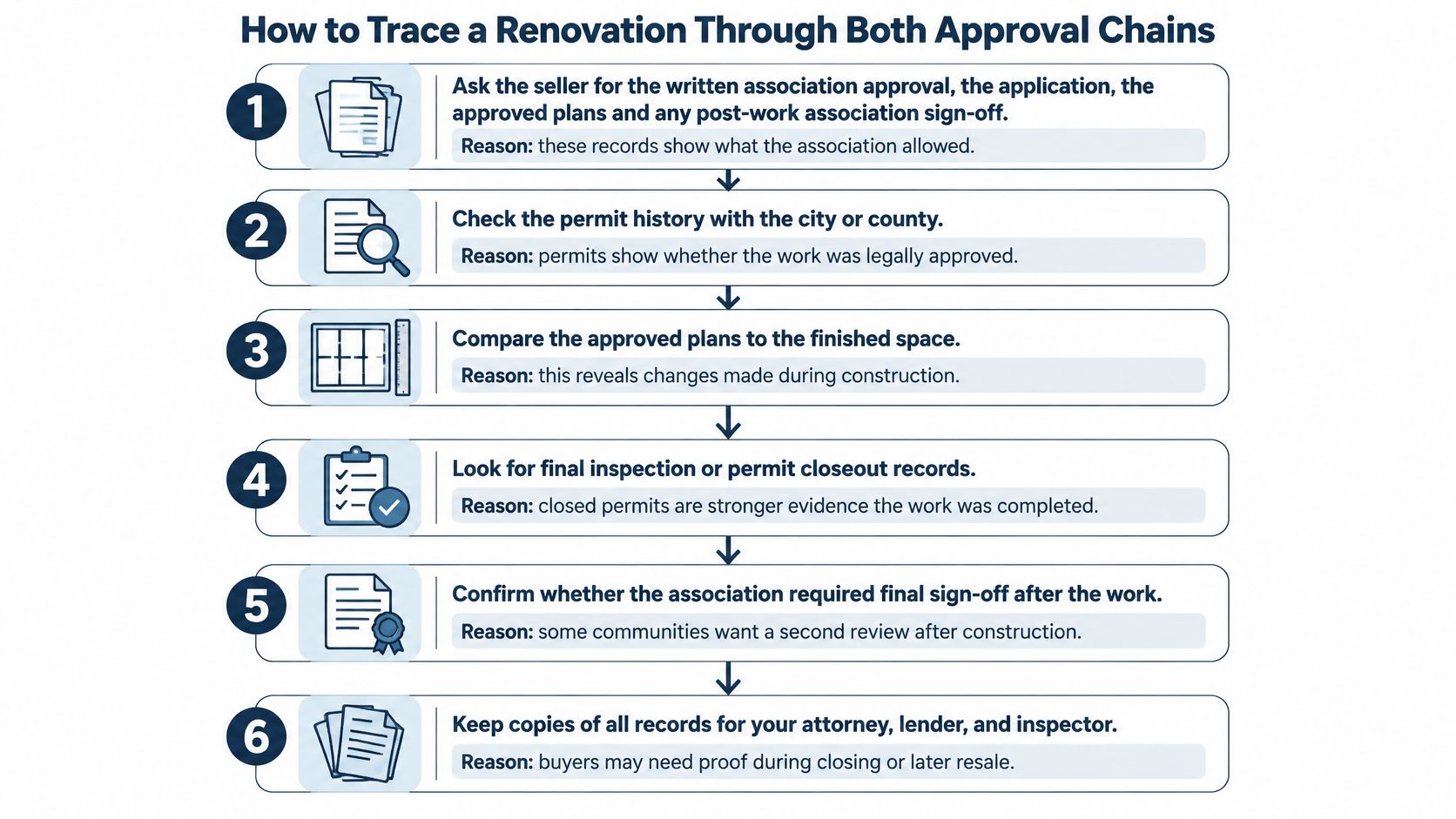
A match means both records agree on the same work. It never means one record stands in for the other.
Which Details Must Match Across Records
Two files can each look complete and still disagree. The association letter approves one scope while the permit authorizes another, and neither record flags the difference on its own. A field-by-field comparison is what exposes it.
Pull each detail below from the association file, then from the permit file, and mark it match, mismatch or missing. Leave a missing cell visible instead of guessing at it.
| Detail | What a match looks like | What a mismatch suggests |
|---|---|---|
| Unit address and unit number | Same unit, same address on both records | A different unit, or a typo that must be resolved before anything else is trusted |
| Work description | Same work on both sides, nothing extra | Part of the approved work lacks a government record, or the permit covers work the association never approved |
| Dates | Inspections follow the work | A sequence on paper that could not have happened as described |
| Plans | Same layout and systems in the approved plans and the permit drawings | The layout changed between association sign-off and the permit set |
| Contractor | Same company named in both records | A different party pulled the permit, or the file never shows who did |
| Trade permits | Each electrical, plumbing or mechanical item in the approval has a matching permit | A listed trade has no permit record behind it |
| Inspections | Each required inspection shows a result | An inspection was required but never recorded |
| Final status | Final approval or certificate of completion on the permit, association sign-off recorded where required | The permit stayed open, or the association sign-off is absent |
| Common elements | Shared items appear in both scopes, with association approval recorded | Windows, balconies, stacks, risers or shared walls sit in one file but not the other |
Record the dates rather than assuming their order. A final inspection dated before the work it covers describes a sequence that could not have happened as written. Plans and trade permits fail in quieter ways, through a layout shifted between the approved drawings and the permit set, or an electrical item in the approval with no electrical permit behind it.
The table compares the core fields. It does not judge the legal validity of either record, and credential checks run through their own licensing files. Buyers weighing a renovated resale unit against new construction can see how the rest of the file differs through these due diligence tips from Dream Destin Realty.
Treat the finished checklist as organized questions rather than answers. It cannot prove code compliance, private rights or the condition of the work, and an unresolved mismatch needs written advice from a qualified professional before anyone relies on the file.
When a Closed Permit or Finished Work Still Leaves Gaps
A file can look complete and still leave questions open. A signed approval sits next to a closed permit, the unit shows new finishes, and every page seems answered. Gaps in renovation records tend to hide in three shapes, and each shape points to a different missing document.
Issued but never finished. A permit number exists, the inspection history shows one or two early visits, and no final approval or certificate of completion follows. A bathroom remodel that passed its plumbing rough-in two years ago and then went quiet fits this pattern. The tile may be flawless. The record only says the process stopped before the last sign-off.
Closed but silent on private rules. The permit trail ends cleanly, and the association file still holds unanswered questions. A closed permit for new flooring will not show whether the declaration required a sound-rated underlayment or whether the board approved the switch from carpet to tile. That answer lives on the association side of the file, if it lives anywhere.
Finished but unaccounted for. The unit tells one story and the records tell another. A kitchen with a relocated range, new island plumbing and fresh cabinetry sits in a unit whose permit history lists only an air-conditioning change-out. The work clearly happened. Neither trail names it.
Shared property raises the stakes on that third shape. Material alterations and substantial additions to common elements or association property must follow the approval procedure in the declaration, according to the 2026 text of section 718.113, and only where the declaration sets no procedure does the default of approval by 75% of total voting interests apply.
Owners who already closed on a unit with gaps can find next steps in this guide for Emerald Coast homeowners facing permit problems.
The takeaway: a closed permit and an association approval answer two separate questions, and a finished kitchen answers neither.
Decide What to Request Before You Move Forward
Read the two trails as separate columns: the permit trail confirms scope, address, inspections and closure; the association trail confirms permission under the declaration, conditions and any common-element sign-off. Then request the document that fills the blank field.
- Both records present and consistent. Ask for the completion proof behind each one: the final inspection or permit closure record for the permit side, and the association letter or board resolution showing the approved scope and conditions. Matching descriptions can still leave an inspection, condition or common-element consent undocumented.
- One record missing. Request the absent record by name before relying on the one you hold: permit number, approved plans and final inspection for the government side, or the architectural approval, board resolution and conditions list for the association side. An approval without a permit, or a permit without association sign-off, answers only half the question.
- Mismatches that survive your questions. Get written advice on which fix belongs in the contract: a seller-produced permit closure or association letter, a credit for unresolved work, or a disclosure listing the exact scope, address and date fields that do not match.
A renovation file is one part of a larger purchase, and buyers usually work through it alongside other checks, such as flood insurance for beach condos and current association budget documents. Dream Destin Realty helps clients review available building records, including association information, inspections, reserves, rental rules and insurance, as part of purchase due diligence. The brokerage does not verify or guarantee what an association or permit record shows, so the records themselves decide the answer. Readers who want to talk through the documents they already hold can use the contact page.
Frequently Asked Questions About Approvals and Permits
Does association approval replace a government building permit?
One approval letter answers one trail, never both. The association's side runs through the recorded condominium documents, while the permit office applies the building code for the jurisdiction where the unit sits. Check both files before closing.
Does a closed permit prove that every association requirement was met?
Treat a closed permit as the end of the government trail only. It shows inspectors signed off on the work the building department reviewed. Board resolutions, architectural review sign-offs and material restrictions live in association records, so reconcile the permit's completion against the separate approvals the governing documents require.
Which records should match when a condo was renovated?
Compare the file field by field. The work description and property address should read the same way across the association approval, the permit, the approved plans and the inspection or completion record. Start with jurisdiction: the postal city on a listing is not always the office that issued the permit, so confirm which building division covers the address before trusting anything else in the file.
Why can an attractive finished renovation still need document review?
A finished kitchen photographs well and still leaves the record open. Fresh finishes say nothing about whether permits were pulled, inspections passed or the association approved the scope. Compare the documented scope with the completed work, and take any gap to the appropriate qualified professional rather than to the listing photos.
Dream Destin Realty publishes buyer and seller resources for Florida's Emerald Coast, including building guides and due diligence explainers that keep a purchase file in order. Its condo and area pages show what to compare across Destin, Miramar Beach and Santa Rosa Beach before a showing turns into a contract. Visit Dream Destin Realty to browse the building guides and start with the records you already have.


