
Florida Condo Reserve Study Requirements for Buyers
Florida condo reserve study requirements explained: SIRS rules, milestone inspections, how to request the study, and what it means for fees.

On this page
On this page
Under s. 718.112(2)(g), Florida Statutes, a residential condominium association must complete a structural integrity reserve study at least every 10 years for each building three habitable stories or higher, covering items such as the roof, structure, fireproofing, plumbing and electrical. The association must also fund reserves for covered items assigned to it.
Having a completed study doesn't establish that the association has enough money for upcoming work. For buyers, the useful comparison is between the study's funding recommendations, the adopted budget and the decisions recorded in board minutes.
Table of Contents
- Which Florida Condo Buildings Need a Reserve Study
- How a SIRS Differs From a General Reserve Schedule
- What a SIRS Must Cover and How Funding Works
- How Milestone Inspections Relate to the Reserve Study
- How to Get the Reserve Study Before You Close
- How Underfunded Reserves Can Lead to Higher Fees or Special Assessments
- Request the SIRS, Budget and Minutes Before You Commit
Which Florida Condo Buildings Need a Reserve Study
The building, rather than an individual unit or the association's name, determines coverage. The 2025 Florida Condominium Act requires the study at least every 10 years after the condominium's creation for each residential condominium building three habitable stories or higher, as determined under the Florida Building Code.
An association with several buildings therefore needs to identify which buildings qualify and which buildings its studies address. Buyers shouldn't estimate habitable stories from listing photographs.
Florida condo reserve study requirements are statewide. Buildings in Destin, Okaloosa County, and Miramar Beach, Walton County, follow the same statutory test discussed here.
Starting point: Confirm the building designation and story count in the association's official records, then request the applicable study.
The Florida Department of Business and Professional Regulation's Division of Florida Condominiums, Timeshares, and Mobile Homes is the state regulator for general condominium questions. Buyers choosing between condos and townhouses in Destin should confirm the recorded ownership structure rather than assume that appearance establishes which rules apply.
How a SIRS Differs From a General Reserve Schedule
A budget shows planned collections and spending, while financial statements show cash on hand. A structural integrity reserve study, or SIRS, connects major building components with their condition, expected replacement timing and funding needs.
A general reserve schedule lists the items the association tracks and its planned savings or spending. It isn't automatically a substitute for the statutory study, which includes a visual inspection and estimates of remaining useful life and replacement cost under s. 718.112.
Building documents compared by purpose
| Document | Who prepares it | What it covers | What it tells the buyer |
|---|---|---|---|
| Structural integrity reserve study | Licensed engineer or architect, or certified reserve specialist or professional reserve analyst | Required structural and safety components | Useful life, replacement costs and funding plan |
| Milestone inspection | Licensed engineer or architect | Structural condition | Findings and repair recommendations |
| General reserve schedule | Association and budget preparer | Assigned reserve items | Balances and planned spending |
| Annual budget | Board of directors | Annual operating and reserve accounts | Assessments and reserve contributions |
A reserve balance isn't a funding plan. Cash may look substantial without being sufficient for the work scheduled next. Conversely, a recently adopted budget can still leave questions about how the association will meet the study's recommendations.
What a SIRS Must Cover and How Funding Works
The statutory scope includes the following components, as described in Florida's reserve-study provisions:
- Roof: Replacement and deferred-maintenance needs.
- Structure: Load-bearing walls and other primary structural members.
- Fire protection: Fireproofing and fire-protection systems.
- Plumbing.
- Electrical systems.
- Waterproofing and exterior painting.
- Windows and exterior doors.
The complete applicable scope should be checked against the governing statute and building records. The visual inspection must be performed or verified by a Florida-licensed engineer or architect, or a reserve professional certified by the Community Associations Institute or Association of Professional Reserve Analysts.
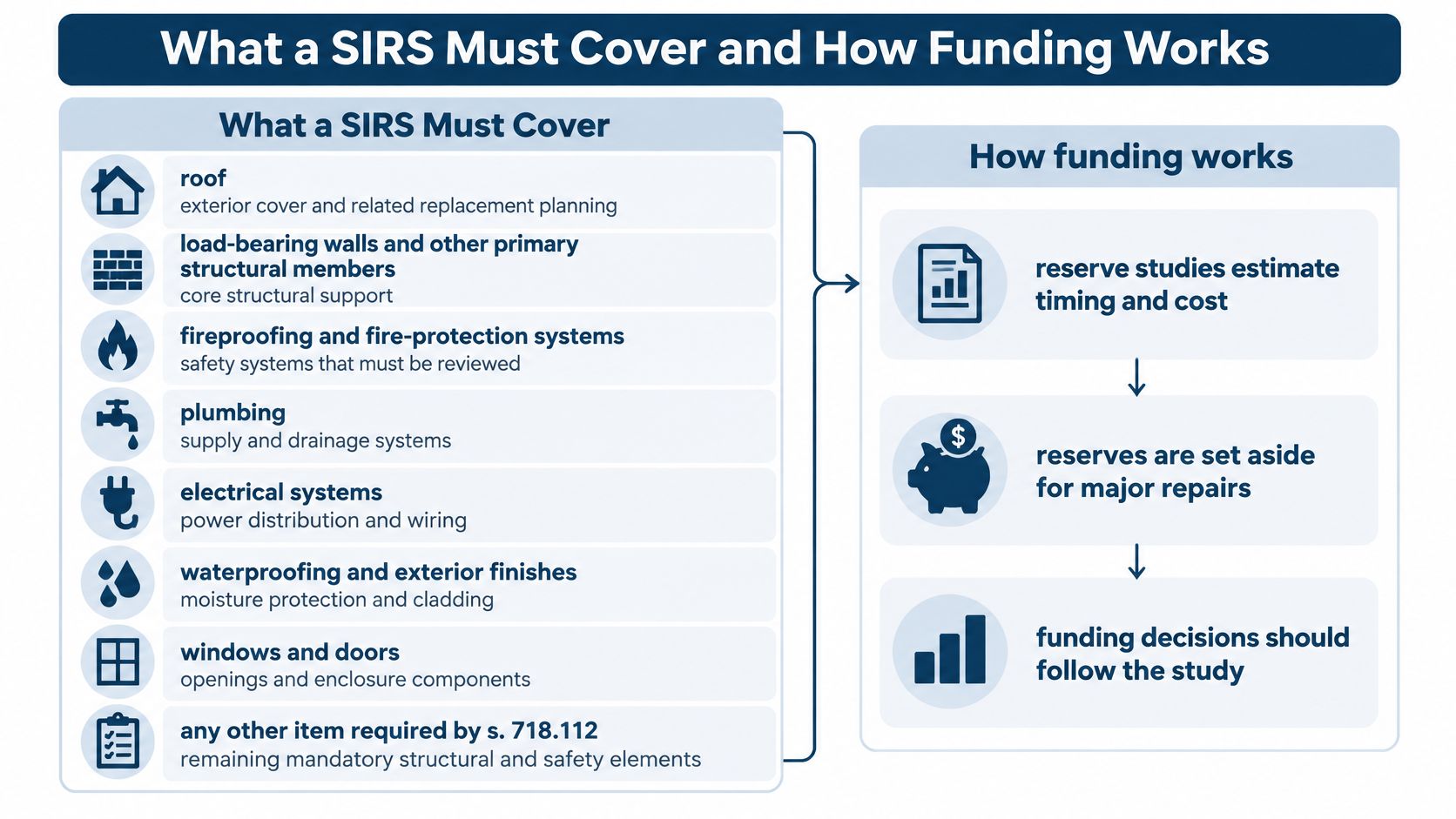
The report connects remaining useful life, estimated replacement cost and a funding schedule. Under the statutory reserve-funding rules, the budget must reserve for covered items assigned to the association, using the most recent SIRS findings and recommendations; the baseline funding schedule is designed to keep reserve cash above zero in every budget year.
A visual inspection can't guarantee that every hidden defect or future expense has been identified. Scope and assumptions matter more than the report date alone. The guide to condo association responsibilities explained provides context for checking which components the declaration assigns to the association.
How Milestone Inspections Relate to the Reserve Study
A milestone inspection isn't a reserve study. Mandatory structural inspections arise under s. 553.899, Florida Statutes, separately from the SIRS requirement.
The inspection evaluates structural condition. The reserve study addresses future repair and replacement funding. Inspection findings can therefore identify work that needs to be reflected in financial planning, but findings alone don't establish a repair price or an owner's charge.
Buyers should ask the association:
- Was a milestone inspection required for this building, and what is its status?
- When was it completed, and did it identify repairs?
- Where does the repair work appear in the budget or reserve plan?
A licensed engineer should interpret technical findings. Dream Destin Realty doesn't interpret a specific building's engineering report or determine its structural condition.
An inspection finding is a reason to ask about scope, estimates and funding, not a basis for predicting a special assessment.
How to Get the Reserve Study Before You Close
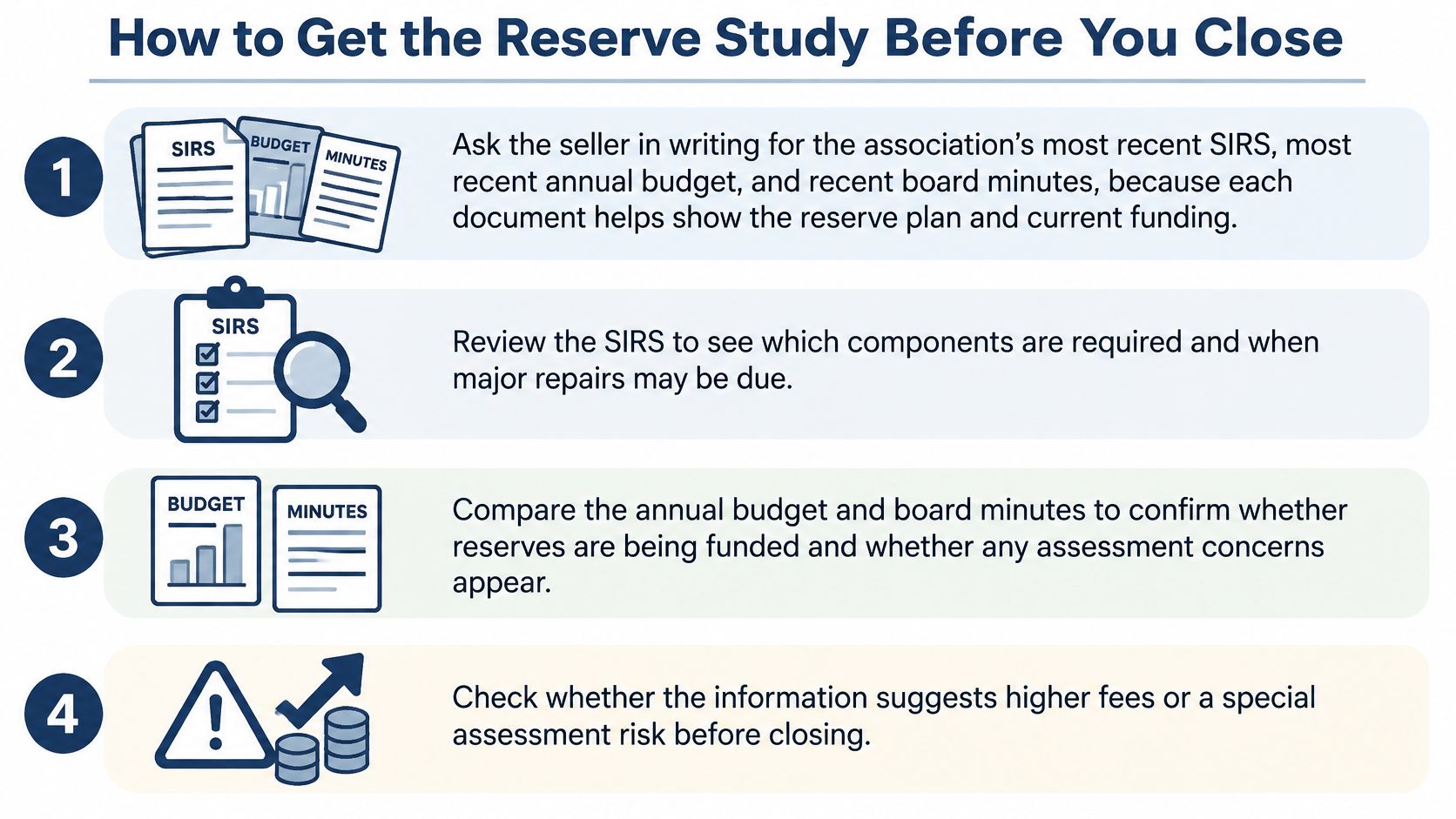
- Ask the seller in writing for the latest SIRS, annual budget and recent board minutes. Each answers a different financial question.
- Request the association's official records through its manager or authorized representative. Confirm the applicable request process rather than assume unrestricted buyer access.
- Check the study's building designation, inspection date, component inventory and funding schedule.
- Compare recommended contributions with the adopted budget and minutes showing approved repairs or deferred projects.
- For a developer sale, confirm delivery of the most recent SIRS or the statement required by s. 718.503, Florida Statutes.
- Check the regulator's completion information and its date. The statutory DBPR reporting requirement makes this a useful cross-check, not a substitute for the report.
- If a required study is missing, request a written timeline. A Florida real estate attorney should address compliance questions.
Where the reserve study comes from by sale type
| Situation | Where the study usually comes from | What to request |
|---|---|---|
| Resale of an existing unit | Seller and association | Latest SIRS, budget and minutes |
| Developer or first sale | Developer's disclosure materials | Latest SIRS or required statement |
| Study missing or outdated | Association's written response | Compliance timeline and related board minutes |
The pre-construction vs resale condo diligence guide explains the different purchase contexts.
How Underfunded Reserves Can Lead to Higher Fees or Special Assessments
Reserves are savings for major repairs. When available funds and planned contributions fall short of scheduled expenses, the board has to close that gap through its financial planning.
The response appears in the records: a higher contribution line in the budget, a proposed special assessment in the minutes, or a project pushed to a later date. Postponement alone isn't proof that required work can lawfully or safely wait.
The DBPR condominium FAQs provide context for reading the study alongside budgets, inspection findings and assessment information. A study sets out a funding plan, and the study alone doesn't determine a particular buyer's share. Ask whether the budget shows a contribution increase or a special assessment, and when it takes effect.

Reserve record signals and the questions to ask
| Signal in the records | What it may mean | Question to ask |
|---|---|---|
| Balance below funding schedule | Timing gap | How will the board close it? |
| Deferred projects | Changed schedule or unresolved funding | Which projects, and why? |
| Proposed special assessment | Additional owner payments under consideration | What amount, purpose and payment schedule? |
| Inspection repairs absent from budget | Funding remains unclear | Where are these repairs funded? |
| Study predates current budget | Assumptions need comparison | Have costs or conditions changed? |
When a study predates the current budget, compare its cost estimates and component timelines with the projects the budget now funds. The question is whether the assumptions still fit the building and the planned work.
The Emerald Coast condo fee guide helps compare reserve contributions and insurance costs alongside fees.
Request the SIRS, Budget and Minutes Before You Commit
Three documents do most of the work in this review. The structural integrity reserve study shows what the building needs and when. The current budget shows what the association collects and sets aside. Recent meeting minutes show which projects the board approved, deferred or funded through owner payments. A reserve study works like a maintenance forecast, and the budget and minutes reveal whether the association follows it.
A simple way to read them is one question per document.
- The SIRS: Which components need work, and what funding plan does the study recommend?
- The budget: Do current reserve contributions match that plan, or do they fall short?
- The minutes: Which repairs did the board approve, defer or leave for a special assessment vote?
Send the request through the seller or association early enough to read all three before the applicable purchase deadlines. A short tracking list helps: request sent, document received, and the open question each one leaves. The condo association reserve study explainer can help organize unresolved funding issues into follow-up questions.
A missing document, unexplained budget difference or unresolved repair item becomes a specific question for the association before the deadline passes.
The second-home buying guide for the Emerald Coast provides additional purchase-planning context.
Dream Destin Realty helps buyers organize available building records and identify questions about reserves, budgets and inspection findings. Visit Dream Destin Realty and use the brokerage contact page for help preparing a property-specific request for the SIRS, budget and minutes.


